Marie Jules César Savigny
Savigny was born in Provins, France, to Jean-Jacques Lelorgne de Savigny and Françoise Josèphe de Barbaud. He was educated at the Collège des Oratoriens in classical languages, with aspirations to become a priest, and also learned a bit of botany and the use of a microscope.
He then studied with a local apothecary after passing an exam to attend the École de Santé (school of health) in Paris in 1793. He also attended lectures at the Muséum d'Histoire Naturelle, where Lamarck noticed him. Georges Cuvier suggested that he join an expedition. In 1798, he traveled to Egypt under the sponsorship of Emperor Napoleon as part of the French scientific expedition to that country, and returned in 1802.
He then contributed to the publication of the "Napoléon" expedition (1809) in "Description de l'Égypte", which was published in full in 1822.
By 1817, Savigny's eyesight had deteriorated, and he suffered from a nervous affliction and had to stop working for several years.
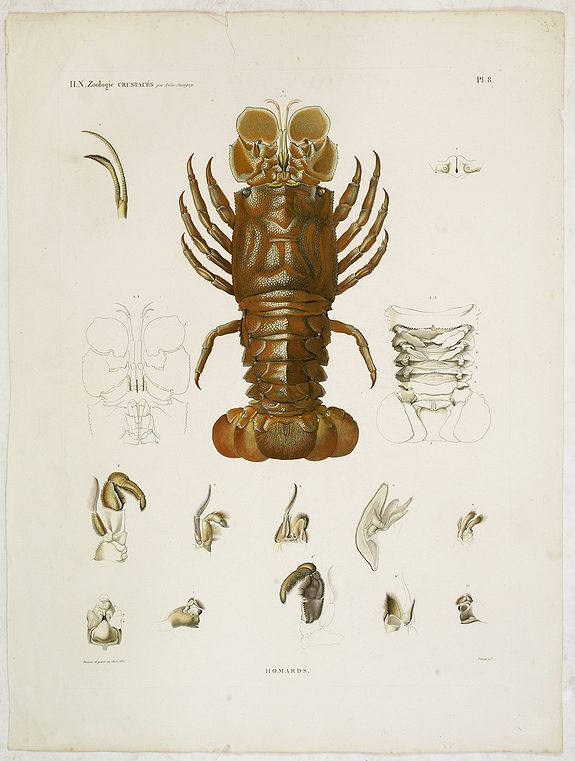
Between 1816 and 1820, he published the important Mémoires sur les animaux sans vertèbres ("Dissertations on the invertebrate animals"). He had examined flowers and their parts as a botanist and applied the same approach to insect details. He compared the mouthparts of lepidoptera, crustaceans, and other arthropods and proposed the theory (Théorie de la bouche) of their homologies.
After he returned to work in 1822, his eyesight continued to worsen, and by 1824 he became more-or-less blind, with terrible "optical hallucinations". Victor Audouin offered to complete Savigny's work, but Savigny refused to part with the original artwork. Savigny was elected a member of the Academy of Science on 30 July 1821. From 1824 until his death, he lived a reclusive life in Versailles.
We offer a small selection of prints from the Description de l'Égypte.
The French invasion of Egypt sparked a national passion for all of Egypt's ancient Pharaonic history. Napoleon not only came to invade Egypt but also brought with him more than 167 scientists and artists, spanning every discipline: engineers, architects, mathematicians, astronomers, naturalists, painters, chemists, and more.
In August 1798, less than a month after his arrival on the banks of the Nile, Bonaparte founded the Institut d’Égypte, whose main objective was “the progress and dissemination of knowledge in Egypt.” Its members were tasked with conducting field research to obtain the most comprehensive possible study of the country’s physical, industrial, and historical realities.
The first comprehensive description of ancient and modern Egypt was produced by the Institut d'Egypte in Cairo. Its influence was enormous, establishing Egyptology as an intellectual discipline and nurturing a passion for Egyptian art throughout the Western world.
Thus began an extraordinary publishing venture that would last thirty years. The ambitions surrounding the Description de l’égypte were monumental—not only in scale, allowing reproductions of medals, papyrus, and the Rosetta Stone at actual size, but also in scope, requiring the labor of 300 of the best Parisian engravers.
One of the greatest achievements of French publishing would not have been possible without difficulty. Supervised by a commission of eight members, the publication was beset by divergent opinions, jealousies, and the technical difficulties inherent in such a vast undertaking. Yet it also sparked many inventions and improvements, notably the machine devised by Nicolas-Jacques Conté, then in charge of the publication, which enabled the rapid printing of backgrounds, skies, and architectural masses—reducing the engraving work that would otherwise have taken months to days.
Edited by some of the leading intellectual figures in France, the Description also includes contributions from celebrated artists such as Jacques Barraband, Pierre-Joseph Redouté, Geoffrey Saint-Hilaire, Jules-César Savigny and others.
The first edition was printed in Paris by Imprimerie impériale, 1809-1813, Imprimerie royale, 1817-[1829]
Despite its scientific success, the Description de l’Égypte was not a commercial one. Its considerable purchase price was the main reason. In addition, many copies were presented as gifts to important dignitaries and institutions who could have afforded the work. It was therefore decided to publish a second, more manageable and affordable edition. The Parisian publisher C.L.F. Panckoucke was authorized to print this new, small-format edition.
Published concurrently, the second edition was also limited to 1,000 copies. The plates were printed from the original copper plates, which were already showing signs of wear at the time of the first edition and were subsequently retouched. To differentiate it from the imperial edition, all illustrations were printed in black, except for a single colored plate that Panckoucke offered to subscribers. The commission, through the government’s representative, exercised oversight of the publication of this second edition by stamping each plate with a dry seal.
