First German text edition of the Spieghel der Zeevaerdt…
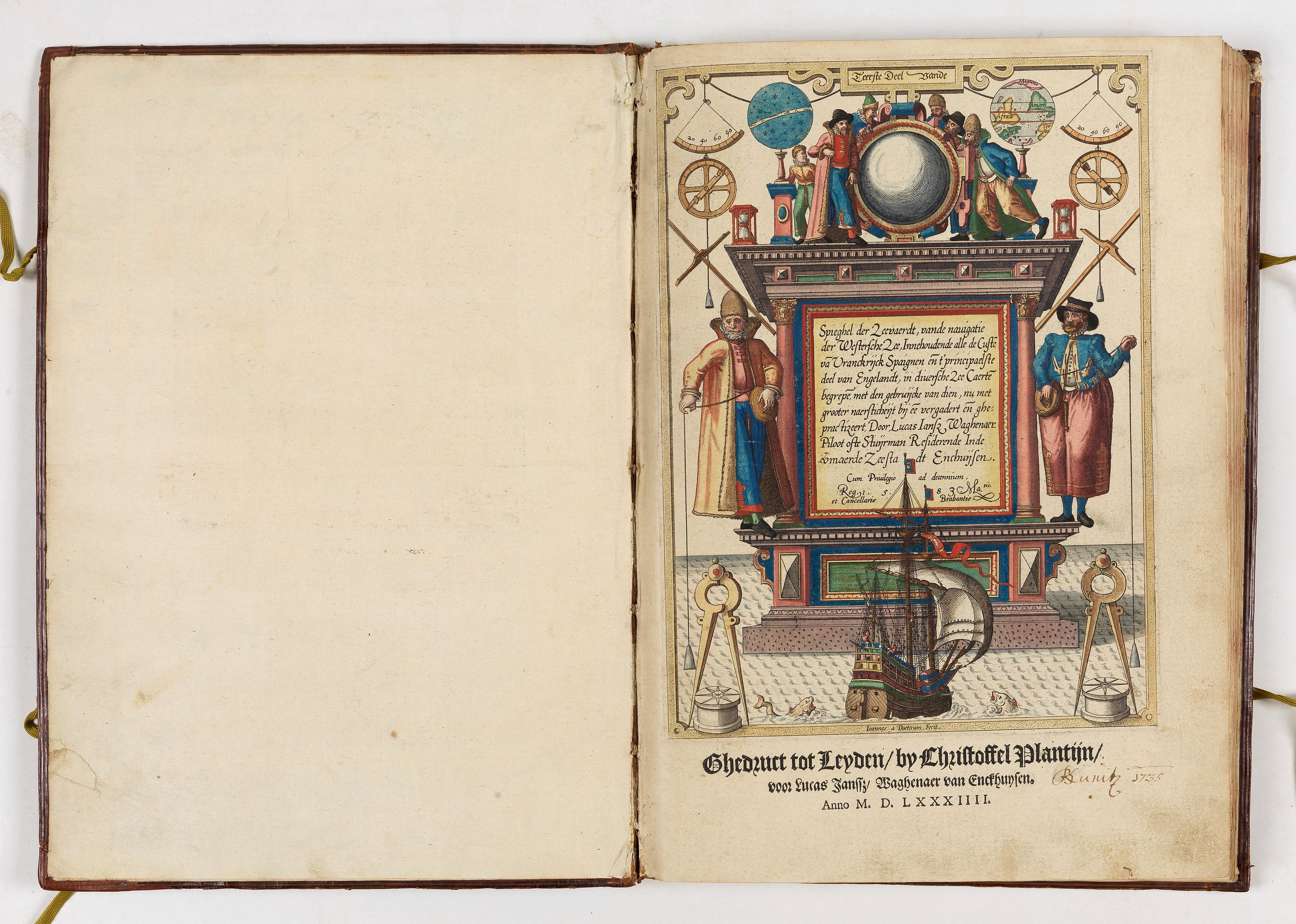
First German edition including 47 charts in very fine contemporary colors and bound in a contemp. brown calf binding. The boards are richly blind stamped, with a design of heavy arabesque center and corner-pieces. Part one of our example differs from the item described by Koeman Atlantes Neerlandici, Vol IV Wag 6.
As it starts with the frontispiece from the first Dutch edition from 1593, followed by the dedication also in Dutch. The first 36 text pages, according to Koeman, are not present. Charts numbered 1-19 + XIX(?). Part two conforms to Koeman’s description, except that it contains the charts 20-46. Signature 36 is corrected in pen and ink [But this might have been missed by Koeman].
P.O.R.
Part one: Frontispiece from the first Dutch edition from 1593, followed by the dedication also in
Dutch. Charts numbered 1-19 + (?)XIX (Map of Canalis velebris vel navigationis à Bristouio../
Beschrijvinghe van de vermaerde Canael, ofte voert van Bristow…),
Second part: frontispiece with German text, 2pp. dedication to Johan Friderik and Ernst
Lodewijk, Dukes of Pomerania, 26 charts numbered on verso 20-46, followed by 4 pages.
According to Koeman the charts in the German edition are mainly in a state D; The charts have a
date 1585 and title cartouches are in Dutch and Latin. The plates have engraved page number on
the recto.
The letterpress on the verso has different letter types and sizes. The numbers on the verso are
printed separately from the text.
The German edition was the first issue of the atlas printed by Claes in Amsterdam in 1589, edited by
Richard Slotboom who presumably also did the translation in German and who wrote the supplementary
text on the, until then, white pages on verso of the charts.
Each of the charts has now in the top a German title, printed from type. The German edition was not reissued
until 1615.
Waghenaer's own personal experiences as a pilot along European coasts were used to compile the Spiegel der
Zeevaerdt.
The text is based on the traditional 16th-century seamen's guides, but the charts have totally new
elements. This makes the book the first printed sea atlas in the world. The first edition was published in Dutch at Leyden in 1584/85 by the house of Plantin.
The charts cover the coastlines from Holland to Spain and the North Sea and Baltic and were
engraved by the famous artists Baptist and Johannes van Deutecom. The charts show
soundings, sandbanks, landmarks and coastal profiles.
Provenance : In brown ink in a 19th century hand on the inside of the front plate a written text
“Exlibris des a) Geizhofler Zacharius 1605 b) Brösamer Augustin 1706”. The two ex-libris are
removed.
Zacharias Geizkofler (1560-1617) was born in Brixen in 1560 and died in Prague in 1617. A
Lutheran active in literature. He was a lawyer, diplomat and imperial councillor.. He came from
an old Tyrol family settled in Jáchymov and in Augsburg. He studied in Strasbourg and in Basel;
from 1597 until his death, he was the Master of the Imperial Mint as well as a councillor to the
emperors Rudolf II and Matthias. During the reign of Emperor Rudolf II, G. cooperated with large
banking houses and participated in the organization of the so-called anticipation loan. His
agenda included i.a. securing the funding for the Turkish wars.
Like other members of the family,
he also worked as a diplomat in the service of the Fuggers. In the town of Haunsheim, he built a
magnificent Renaissance residence. He was famous for his charitable work for the poor and the
abolition of serfdom.
In 1603, G. acquired the library of Anton Fugger (10 June 1493 – 14 September 1560), German
merchant, banker, and member of the Fugger family. He was a nephew of Jakob Fugger.
Reference: Koeman Atlantes Neerlandici; Vol IV Wag 6.
