VOC (Dutch India Company)
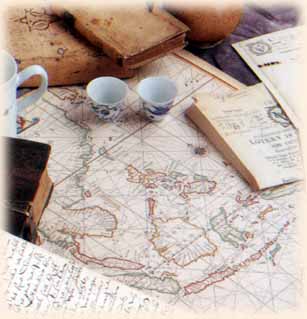
From the second part of the 16th century, Dutch ships sailed to the Caribbean, particularly to fetch salt, which was of great importance as a preservative for fish, meat, and other foodstuffs. The commercial risks of these undertakings were considerable. In order to reduce these risks, ship owners decided to establish trading companies and to sail in a flotilla. Several companies, each of which specialized in a certain area, existed independent from one another; and from an economic point of view, these companies were very vulnerable.
 On 20 March 1602, the prime companies of Holland merged to form a large company called "Verenigde Oostindische Compagnie
(V.O.C.) on the suggestion of the "landsadvocat" of the province of Holland Johan van Oldenbarnevelt (1547-1619), and the later
General Governor Prinz Johann Moritz von Nassau (1606-1679).
On 20 March 1602, the prime companies of Holland merged to form a large company called "Verenigde Oostindische Compagnie
(V.O.C.) on the suggestion of the "landsadvocat" of the province of Holland Johan van Oldenbarnevelt (1547-1619), and the later
General Governor Prinz Johann Moritz von Nassau (1606-1679).
The new company received a state charter which granted it sovereign rights, this would be of great significance for its future development.
This company soon became the first and largest worldwide trading company, totally dominant in its time. The VOC displayed the basic attributes of a modern joint-stock company and initiated future economic and financial history.
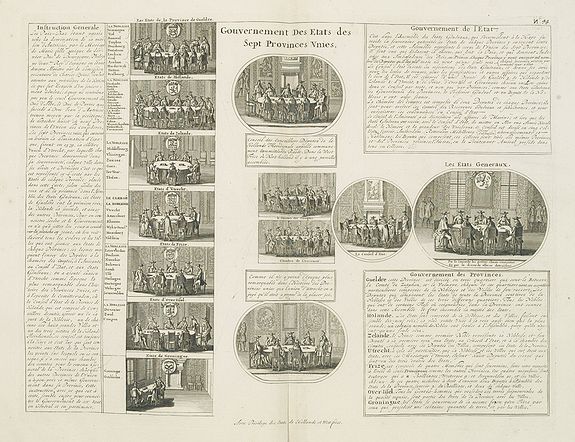
In the beginning, the company was run by six chambers in significant trading centers: Amsterdam as the main focus, Zeeland, Delft, Rotterdam, Hoorn and Enkhuizen.
Each chamber appointed its own directors to Board of Directors - a board that was 75 strong. From these board directors, the actual executive board was elected, which consisted of 17 members.
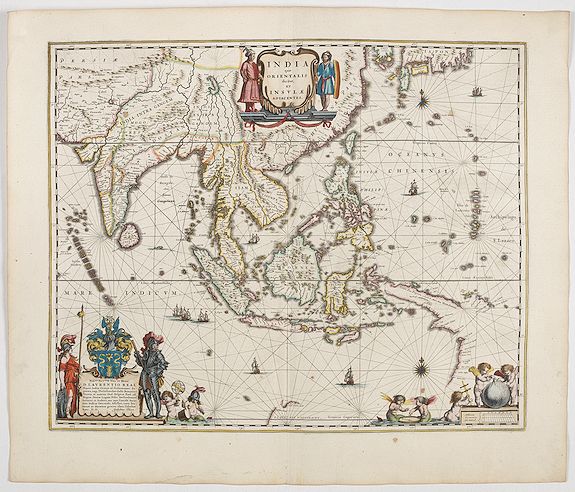
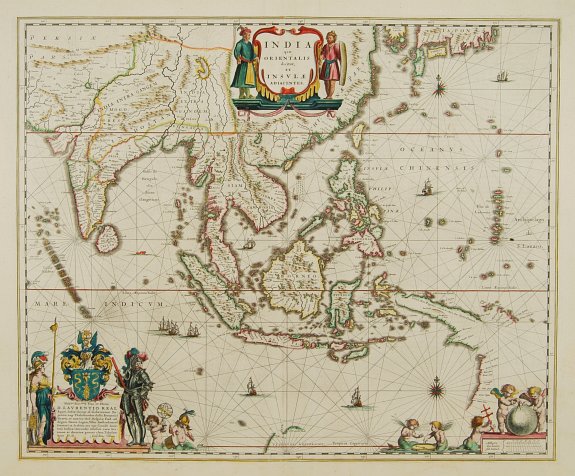
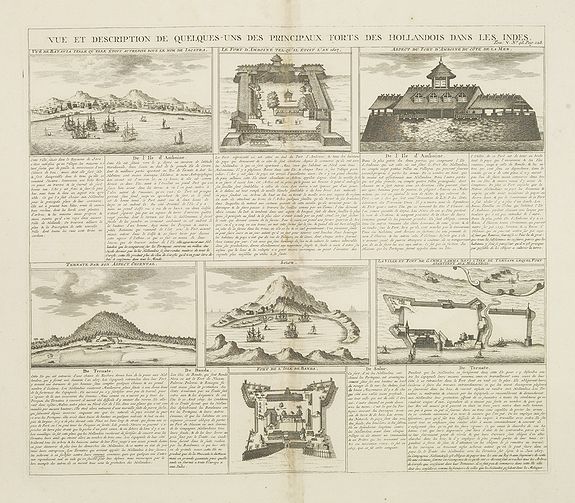
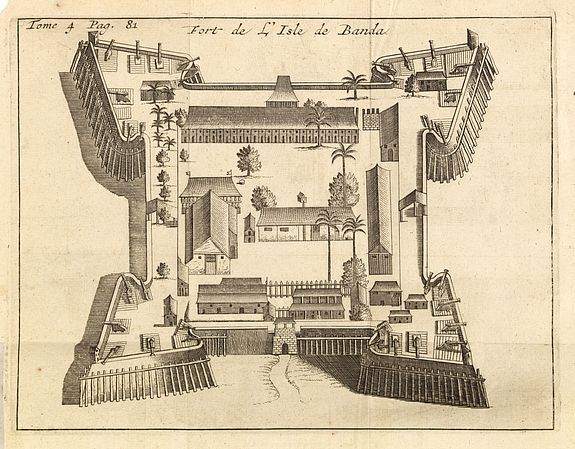
The East Indian quarters of the VOC were set up in Batavia on the island of Java, the Portuguese were driven out of Ceylon and Malacca, and the first white colony was established in South Africa. "Finally, the VOC ruled over eight foreign governments in Amboyna, Banda, Ternate, Macassar, Malacca, Ceylon, Java and on the Cape of Good Hope. Factories stood in Bengal, on the Coromandel coast, in Surat, Thailand and on the Persian Gulf.
In the end, the Dutch East Indies Company was the richest company in the world; it helped to finance the blossoming of Dutch civilization: Rembrandt, Vermeer, Frans Hals, Vondel, Grotius, Spinoza, the largest publishing operation in the world in the 17th century with numerous authors and poets, some forgotten today, all the painter's, architects and above all the patrons". (Henry Hobhouse)The VOC dealt in the typical commodities: spices, coffee, tea, tobacco, etc. but also more cultural items: silks, Chinese and Japanese porcelain, furniture and "objects d'art" were transported to Europe where they found a ready market.
On February 1603, it was decided that all properties of the company would be fitted with the VOC mark: the facades of buildings, fortresses and factories as well as ships, flags, chests, glassware, chinaware, canons, swords, guns, pipes, bales, publications, book bindings and paper.
Until its demise, the VOC was lord of over 150 trading vessels, 40 warships, 20,000 seamen, 10,000 soldiers and had nearly 50,000 civilians in its service; with all of this, it still managed to pay out a dividend of 40%. It was the envy of its rivals.
Its trading routes connected Japan, China, India, the Persian Gulf, Africa and Europe, with all its countries, directly to Amsterdam.
In the Persian Gulf, it traded spices for salt, in Zanzibar salt for cloves, in India cloves for gold, in China gold for tea and silk, in Japan silk for copper, and in the islands of southeast Asia copper for spices. The whole inner-Asian trade was nearly as profitable as the main trade between the Orient and Europe.
The company flourished in spite of the losses caused by pirates - the hostages of the Chinese seas, the weather, European rivals, corruption, inefficiency, theft and disease.
The VOC was unscrupulous: it created monopolies, destroyed local competitors and forced up prices for the most important spices by 180%.
Up to the middle of the 18th century, the VOC succeeded in reinforcing its economic and political pre-eminence. It prospered and became the largest monopoly company of its time and was also at this point the first European power in India.
After 198 years of existence, the most significant company in the history of world trade was dissolved on 31 December 1799. As a result of mismanagement, debts of 110 million Guilders had been run up and these were taken on by the Dutch state.
Batavia
Batavia was designed and settled by European Dutch in 1619 and at one point of time was renamed to Jakarta. The city expanded from a small Dutch colony into one of the world’s biggest cities.
The ship "Batavia"
—the first of Europeans on Australian soil. The story of the Batavia highlights the perils of early maritime exploration and the complex human dynamics that unfolded in dire circumstances.
Launched in 1628, the 150-foot Batavia was the pride of the VOC fleet. Laden with silver, she set sail on her maiden voyage from the Dutch port of Texel on 28 October that year as the flagship of a fleet of eight VOC vessels. In keeping with VOC practice, the Batavia had two commanders: a senior merchant, or commandeur, who had overall command of the fleet; and a skipper responsible for the ship itself. On the Batavia, these men were Francisco Pelsaert and Ariaen Jacobsz respectively. There were about 330 people aboard the Batavia, among them 180 sailors, about 100 mercenaries, and a number of relatively wealthy passengers.
Also on board was Pelsaert’s deputy Jeronimus Cornelisz, a former apothecary who had joined the VOC and signed up for the voyage to avoid being persecuted for his adherence to the heretical values of the painter Torrentius.
Cornelisz befriended Jacobsz and together the two men began plotting a mutiny and recruiting accomplices, presumably tempted by the Batavia’s valuable cargo. Their plans became more feasible when the Batavia separated from the rest of the fleet during a storm off the Cape of Good Hope.
On June 4th 1629 the Batavia smashed into Morning Reef just off the Houtman Abrolhos, an island chain 60 kilometres west of what is now Geraldton in Western Australia.
As with all VOC ships at the time, the Batavia had sailed before the prevailing winds known as the Roaring Forties east across the Indian Ocean. Lacking any accurate means of determining longitude, they relied on dead reckoning to decide when to turn north for Batavia.
Following the Fourth English War and the resultant loss of trade, the VOC's bankruptcy came in steps. After 1795 and the accession of the French satellite regime of the 'patriots', the VOC's Board, the Gentlemen Seventeen (G17), were replaced by a 'Committee for East Indies Trade'.
At the end of 1799 the VOC was nationalized. The State took over all property and the catastrophic debt. The operations of the VOC Chambers continued for a while, but in 1803 those in Enkhuizen, Hoorn and Delft were closed. The Chambers in Middleburg and Rotterdam were downgraded to branch offices. Employees were dismissed and marine infrastructure given to the Dutch navy.
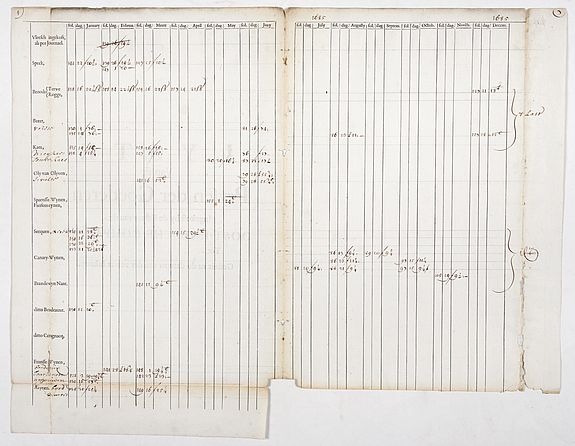
![32187/300:VOC Het uitvoerend bewind der Bataafsche Republiek, doet te
weeten: […] hangende de deliberatien (over) den aanvoer
van thee, uit het rijk van China](/images/Lgimg/32187.jpg)
