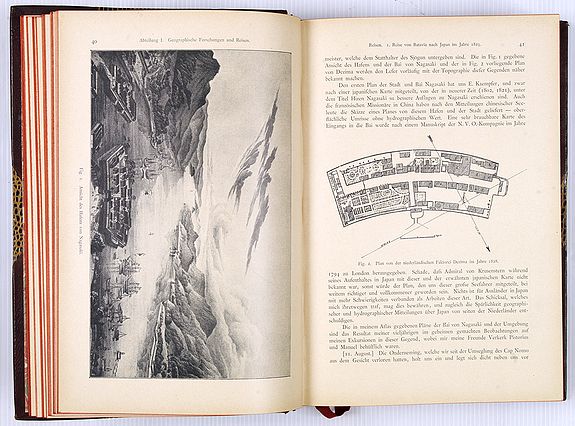
Japan
Nevertheless, some Japanese intellectuals, particularly of the 'Dutch Learning' (Rangaku) School, were aware of developments in the outside world and the Tokugawa became quietly but increasingly concerned about foreign threats.
Whalers, adventurers, and would-be traders from Russia, Europe, and the United States appeared on Japan's shores with increasing frequency in the late 18th and early 19th centuries (including a group of American ships sailing under a Dutch flag during the Napoleonic Wars). Publication History and Census No publication information is provided aside from the seal of the printer Bunkindō (文錦堂) at bottom-left. Given the known works of that firm and based on the content, it can be roughly dated to the early 19th century. This view went through several printings and was sometimes paired with a similar depiction of a Chinese ship (also sold by us), although the two are usually seen separately in institutional collections. Outside of Japan, an example of this printing of the view is held by the Dutch Nationaal Museum van Wereldculturen, while examples of a slightly different alternate printing, also by Bunkindō, are held by the University of California San Francisco and the Nationaal Museum van Wereldculturen. Within Japan, examples of this view are held by the Kobe City Museum, Kuboso Memorial Museum of Arts, Waseda University, and Tsurumi University. The view appears to be based on an original (of the same title) by Hayashi Shihei (林子平, 1738 - 1793), one of 18th century Japan's great scholars of the outside world, and there are multiple variations on the view by different printers of the late 18th and early 19th centuries, usually with the perspective and the text above and around the ship changing slightly. However, these are all quite rare today.
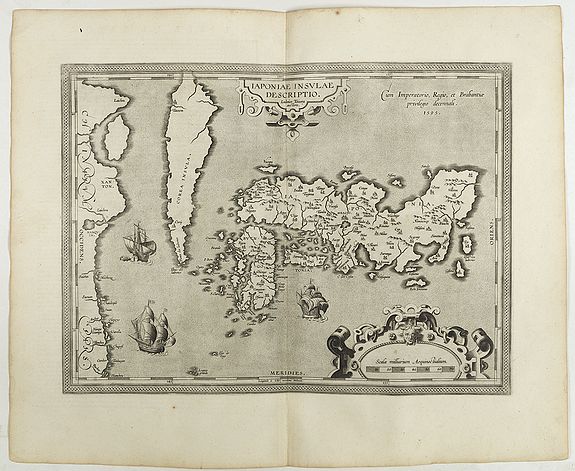
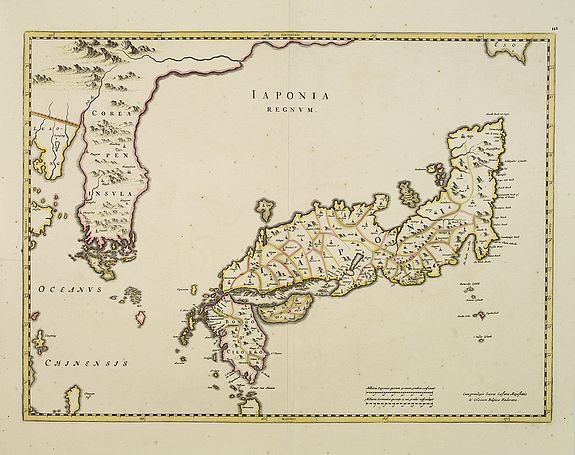
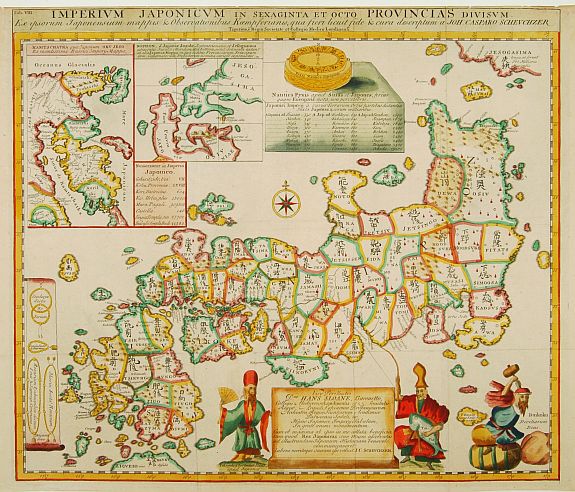
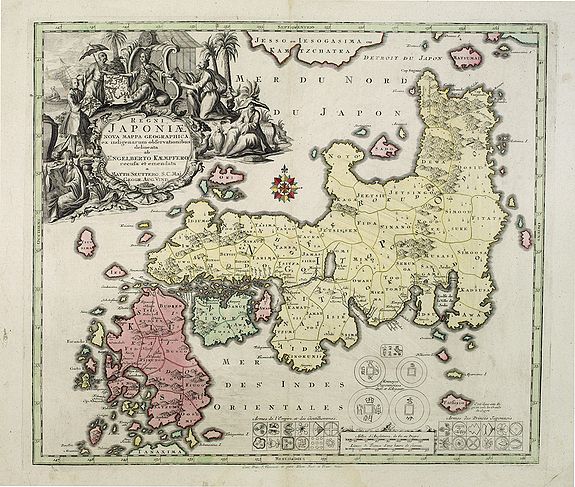
The first accurate map of Japan
The first printed map of Japan to appear in an atlas a milestone map of Japan. The map retained its influence until more than fifty years later when a new milestone map appeared, the Martini map of 1655.
With a letter dated at February 2, 1592 Texeira sent to Ortelius "dos piesas de las descriptiones de la China y del Japan." (Hessels letter 210) Ortelius had asked for these maps in a previous letter, which has not been found. At the same time he promised a map of Brazil, but only the map of Japan and Korea was used for the Theatrum since 1595. The map is the first reasonably accurate and recognizable European depiction of Japan. Little was known in the west of this mythical and remote island in 1595.
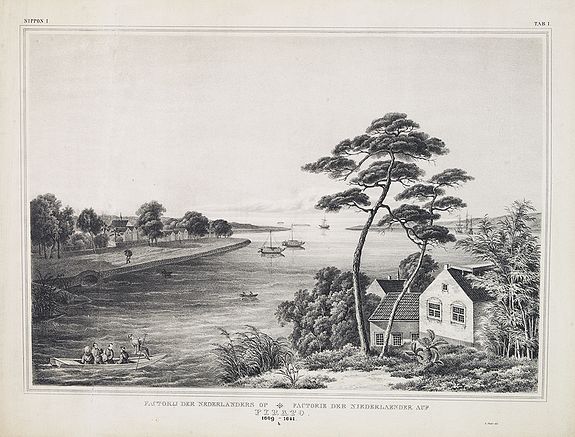
Dutch-Japanese relations have a long and interesting history, shaped by commerce, trade, and war. Below are some interesting artifacts marking the 400 years that the Netherlands and Japan share.
Japan, for most of its history, was a relatively isolated country. Whoever dared to invade had to put up with a civilization that would not give in easily.
First, the Japanese made contact with Europeans through the Portuguese, but their relationship with the Dutch proved to be the enduring one shortly afterward.
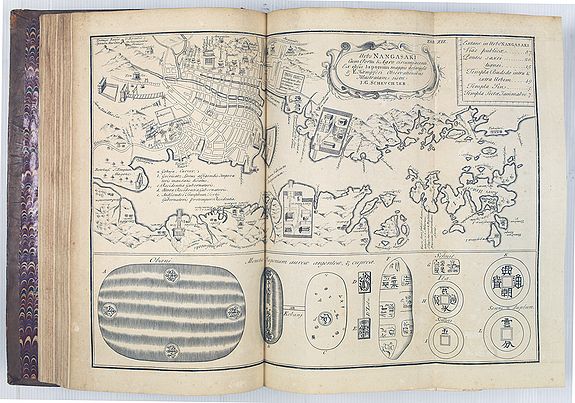
From the beginning of relations between Japan and the Netherlands, the VOC would bring maps to Japan to be gifted to the Shogun and his court. We saw how in 1635, the Governor of Nagasaki gained information on a special map illustrating military affairs. A general demand for up-to-date maps of the world and globes was always there.
In the early stages of Dutch-Japanese relations, VOC officials in Asia took note of the Japanese interest in maps. They had regular requests for these from the Netherlands. Some requests for Dutch wall maps are documented in the archives. In 1637, the governor-general in Batavia asked for six world maps. He wanted to use them as diplomatic gifts in the fortress town of Golconda (India) and Japan.
Interesting reading : Dutch impressions of the world in Japan, by MIYOSHI Tadayoshi
Gifts
In Japanese diplomacy, gifts had a greater meaning than merely creating receptiveness in the opposing party. Gifts were not bribes; they were an indicator of willingness to negotiate. Drawing on their Indian Ocean trading networks, the Dutch sporadically brought extravagantly large and exotic animal gifts throughout the Edo period, including two tiger cubs (1614), an ostrich (1658), elephants (1813, actually brought by the British)46 and camels (1646, 1821). Some of these large animal gifts were accepted like the ostrich, which was received with great pleasure by Shogun Ietsuna (1641–1680), and some, like a pair of camels brought in 1821, were refused and ended up living out their lives in Japan as a source of income for the Dutch factory head's courtesan, who reputedly made a fortune by charging an admission fee to see them.
jacquard
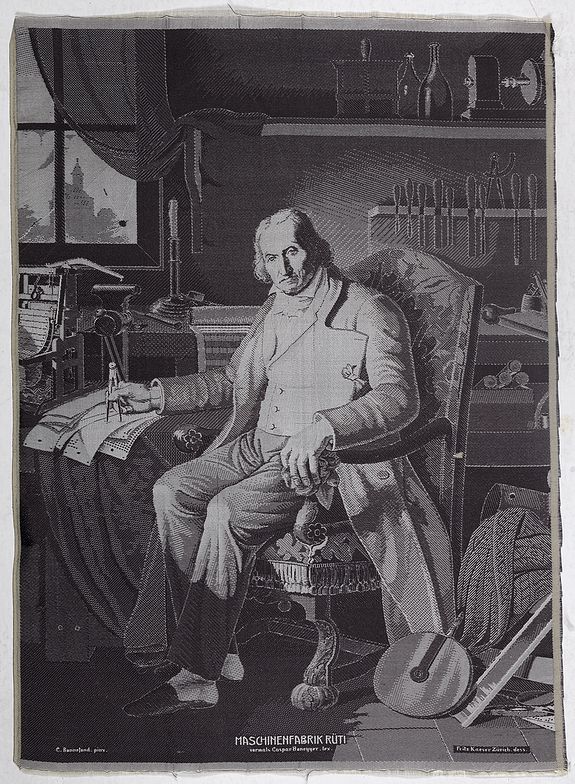
In 1872, Kyoto Prefecture dispatched 3 weavers, including SAKURA Tsuneshichi (1835-1899), to Lyon, and had them bring back new machinery, including jacquards and battants. In 1877, 8 exchange students, including KONDO Tokutaro (1856-1920), were dispatched to France to study textiles, dyeing and other subjects, headed by Léon Dury (1822-1891), a Frenchman who had worked as an instructor at the French College of Kyoto, etc.
Winemaking
After the Meiji Restoration, from the perspective of providing an alternative to brewer's rice, which was in short supply at the time, and of providing employment for the Samurai who had returned to farming, winemaking began as a national enterprise. FUKUBA Hayato (1856-1921), was born as the child of a retainer of the Tsuwano Domain and studied at the Products Research Institute of Agriculture Encouragement Bureau of the Ministry of Home Affairs, etc.
Cosmetics
ITO Sakae (the first, 1847-1911) was the 4th son of Ranpoi (a person who studied Western medicine by means of the Dutch language), ITO Genboku (1800-1871), who studied under Heinrich Philipp von Siebold (1796-1866) and worked to ensure the propagation of immunization. He studied abroad in France through the Yokosuka Shipyards, and became a weapons dealer. In 1904, when HASEBE Nobuhiko (1850-1924), who had also studied abroad in France and specialized in chemistry, succeeded in manufacturing lead-free powder, ITO cooperated in the product's commercialization and established Ito Kochoen.
In Japan, traditionally, face powder, which used lead as a raw material, was used, so there were a large number of people among women and kabuki actors who suffered from lead poisoning. In 1887 in particular, in a Kabuki played in the presence of the Emperor, held at the residence of Minister of Foreign Affairs INOUE Kaoru, NAKAMURA Fukusuke (Fukusuke IV of the Narikoma-ya school, later NAKAMURA Shikan V and NAKAMURA Utaemon V, 1866-1940), was unable to stop his body from shaking due to lead poisoning, and the poisonous nature of the lead became more widely known. Ito Kochoen's Misono Oshiroi was supported by kabuki actors and became a big hit. This book is written by 5th generation NAKAMURA Shikan to promote the sales of Misono Oshiroi.
In 1877, MAEDA Masana (1850-1921) returned from France after studying there as an exchange student since the first year of the Meiji Era, proposed the establishment of a government-operated nursery company, and the Mita Breeding Station was established. The breeding station collected both domestic and foreign grape breeds and researched the industrialization of winemaking. In Yamanashi Prefecture at the time, prefectural governor FUJIMURA Shiro (1845-1909) was already attempting the production of wine using the local specialty Koshu grapes, and winemaking was promoted as one part of the Increase Production and Promote Industry policy.
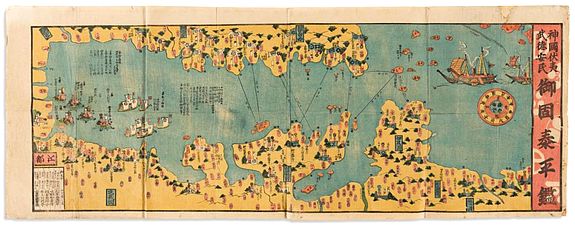
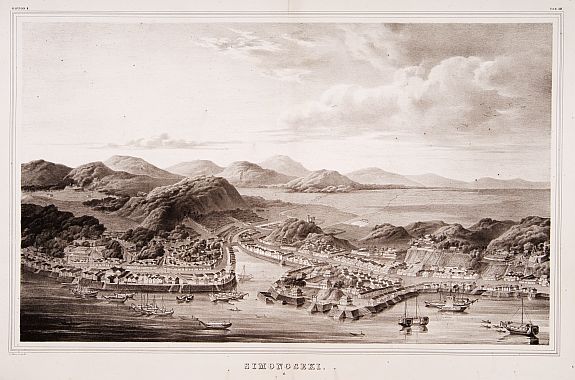
The Perry Expedition was a diplomatic and military undertaking to Japan during its Bakumatsu period. The Expedition involved two separate trips of steamships of the United States Navy, which took place during 1852-1854. The goals of the expedition included exploration, surveying, the establishment of diplomatic relations, and the "opening" of Japan to trade with the United States.
The Perry Expedition had a colossal influence on 19th century Japan, leading to interaction with, and influence by, the outside world, the collapse of the Tokugawa shogunate and the Meiji Restoration. In the Western world, the opening of Japan to trade led to a period of Japonisme in decorative and fine arts and culture.