China export
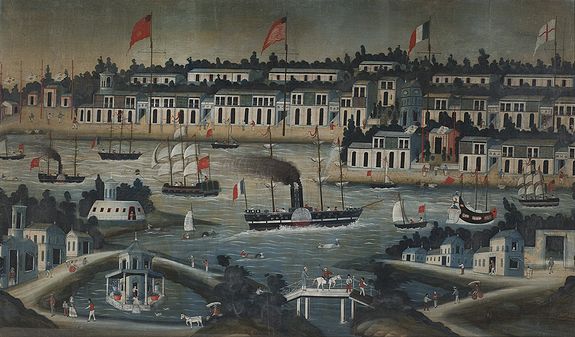
Canton
For much of the 18th–early 19th century, Qing policy concentrated most Western trade at Guangzhou (Canton) under what’s often called the Canton System; it was a tightly controlled framework that shaped where foreigners could trade and reside.
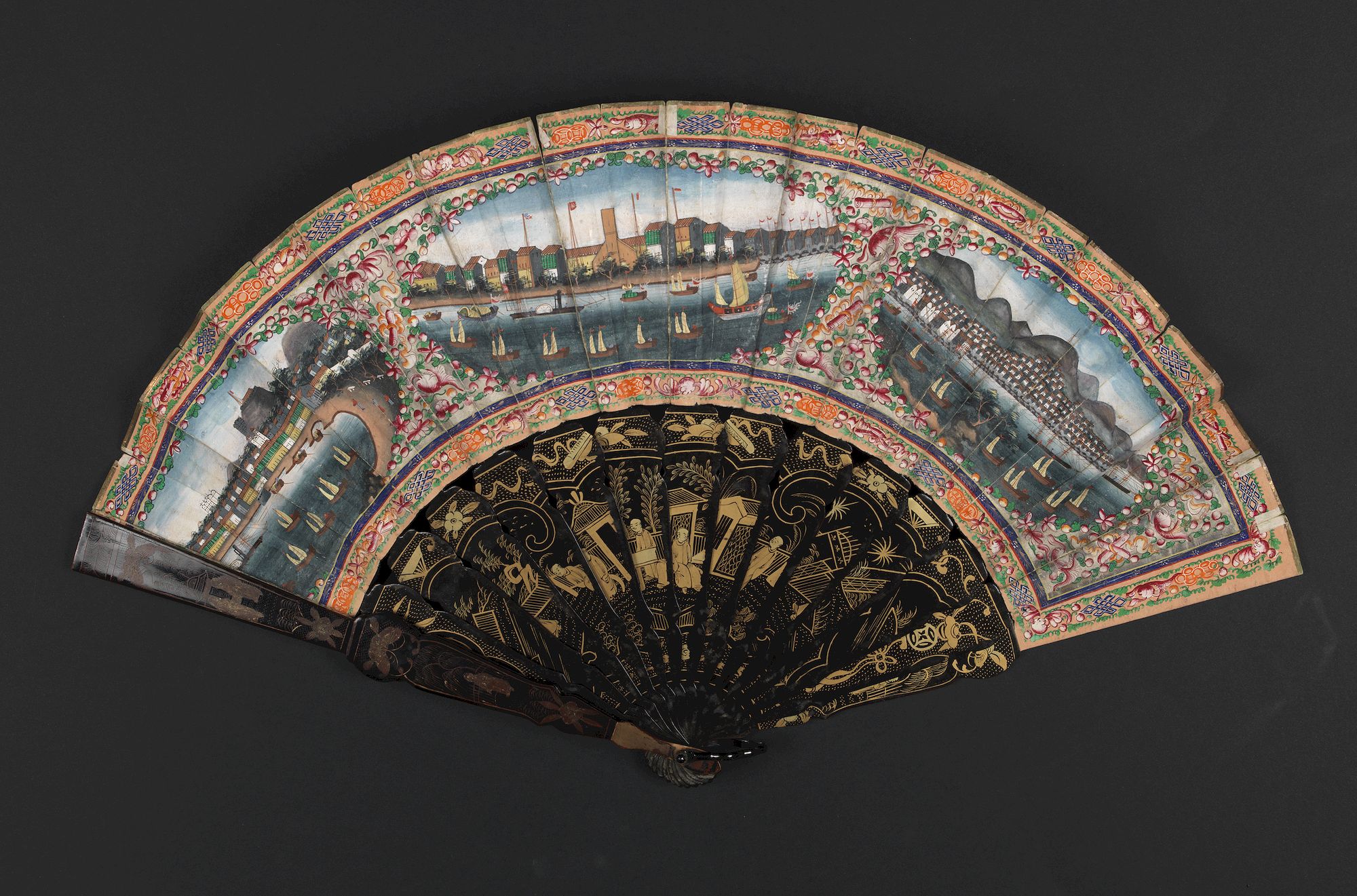
That system ended after the Opium War era and the opening of treaty ports, but Canton remained symbolically and commercially important, and the “hongs/factories on the river” stayed one of the best‑selling export images.
Notably, the old foreign‑factory district was destroyed again by fire in 1856 during the turmoil around the Second Opium War period and was never rebuilt in quite the same way—so paintings dated around the 1850s can feel like “late snapshots” of a fading riverside world
Trading was carried on at Canton through privileged merchants
called Hong merchants, whose council, called Co-hong, was
incorporated in 1720. Their number carried, but never exceeded
thirteen. The foreign merchants traded in thirteen hongs, or
factories, extending about 300 feet from the banks of the Pearl
River, and about 1,000 broad. The Hong merchants, hard-pressed by
the Hoppo, or custom mandarin, ran into debt with the foreign
merchants. A visit of Commodore Anson (1742), a special mission of
Captain Panton, even a transfer to another part of the empire, did
not remedy the numerous grievances of the Europeans, who were not
allowed to reside permanently at Canton, but were compelled to
retire to Macao when business was done.
The English sent an embassy, headed by Lord Macartney, in the Lion
and the Hindostan. Macartney reached Peking 21st Aug., 1793, but did
not obtain permission for the English to trade at Chusan, Ning-po,
and T'ien-tsin, or to have a warehouse at Peking for their goods.
Macartney's voyage cost £80,000 (about $380,000), but was without
result. Still less successful was the embassy of Lord Amherst
(1816). Lord Napier, who was sent on a special mission in 1833-4,
died worn out by his negotiations. Grievances continued to increase
year after year, until the destruction (June, 1839) of 20,283
chests of opium by Commander Lin brought matters to a climax.
On 9th June, 1840, a blockade of the Canton River was proclaimed by
Admiral Sir John Gordon Bremer. Ting-hai (Chusan) was captured, 7th
July, 1841. Sir Henry Pottinger was now appointed plenipotentiary,
and Sir William Parker commander-in-chief. Amoy was captured 27
August, Ning-po 13 Oct., 1841, Shanghai, 16th June, 1842, and the
British squadron entered the Ta-kiang (Yang-tze). Finally, a treaty
of thirteen articles was signed at Nan-king by Pottinger and
Ki-yang, 29th August, 1842, on board the Cornwallis. Canton, Amoy,
Fu-chou, Ning-po, and Shanghai were to be opened to trade, and
consuls appointed to reside at each of these cities.
The island of Hong-Kong was ceded to Great Britain, and indemnities
were paid: $6,000,000 for the opium seized, $12,000,000 for the
expenses of war, and $3,000,000 for the debts of the Hong
merchants, whose guild was abolished. The United States and France
followed the example of Great Britain. A treaty was signed with the
United States at Wang-hia, near Macao, 3 July, 1844, by Caleb
Cushing, and one with France by Theodose de Lagrene at Wham-poa, 24th
Oct., 1844. An agreement with Belgium was signed at Canton, 25th
July, 1845, and a treaty with Norway and Sweden, 20th March, 1847.
The Chusan Archipelago was surrendered to the Chinese in 1847 by
Sir John F. Davis, Governor of Hong-Kong. Hong-Kong had been
declared a free port, 6th Feb., 1842 to the great damage of
Macao.
The advantages, however, were obtained through the treaty of Nan-king
were soon found insufficient. The murder of the French priest
Chapdelaine in Kwang-si (26th Feb., 1856) and the seizure at Canton
of the lorcha Arrow (8th Oct., 1856) by the Chinese furnished the
pretext for a joint action of England and France against China. The
bombardment of Canton (27-29th Oct, 1856), the great rebellion in
India (May, 1857), the appointment of Lord Elgin and Baron Gros as
envoys to China by the two belligerents, the capture of Canton (29th
Dec., 1857) and of the Taku forts (20th May, 1858), are the chief
events that preceded the signing of the English (26th June) and
French (27th June, 1858) treaties of T'ien-tsin. These treaties
permitted the appointment of French and English ambassadors to
Peking, and allowed the Chinese a like privilege of appointing
ambassadors at the Court of St. James and the Court of Paris,
provided for the opening of the ports of New-chwang, Tang-chou
(Che-fu), Tai-wan (Formosa), Chao-chou (Swatow), and Kiung-chou
(Hai-nan), granted an indemnity of 2,000,000 taels for damages to
the British and a like sum to both powers for war expenses, besides
an indemnity to French subjects for the loss sustained through
plunder, when Canton was taken, and guaranteed the punishment of
the murderer of Father Chapdelaine.
On the 25th of June, 1859, the plenipotentiaries, Bruce and
Bourboulon, who were on their way to Peking to have these treaties
ratified, were fired upon by the Taku forts. A second war ensued.
Elgin and Gros were appointed special envoys to China; Sir Hope
Grant and Admiral Hope, General de Mountauban and Admiral Charner
were placed in command of the British and French land and naval
forces. The forts of Taku were recaptured (21st Aug., 1860). The
allies marched passed T'ien-tsin, and after withstanding a
treacherous attack by the Chinese at Tung-chou (18 Sept., 1860),
they forced a passage across the Pa-li-k'iao bridge (21st Sept.), and
captured the Summer Palace (Yuan-ming-yuan), 6th Oct., which was
plundered. Wan-shou-shan, another part of the imperial summer
resort, was burnt by order of Lord Elgin (18th Oct.) on account of
the barbarous treatment inflicted upon the European prisoners taken
in the dastardly attack at Tung-chou. The emperor fled to Shehol,
and his brother, Prince Kung, who had remained at Peking, signed
the Conventions of 24th and 25th Oct., 1860, with the allies. The indemnity was raised to 8,000,000 taels, and Kow-loon, opposite Hong-Kong, was ceded to England as a dependency of this island. A
like indemnity was to be paid to France, and T'ien-tsin was to be
opened to trade. Meanwhile, a treaty had been made at T'ien-tsin
with the United States (18th June, 1858), signed by William B. Reed,
and one with Russia (13th June, 1858) signed by Admiral Putiatin, and another treaty was made with Russia at Peking (9-14th Nov., 1860),
and signed by General Ignatiev. A still earlier treaty had been
made with Russia at Aigun (18th May, 1858) and signed by Muraviev.
The final result of these various treaties was a rectification of
the frontier between Russia and China, the Amur and Usuri rivers
forming the new boundary lines.
The wretched Hien Fung, who had replaced Tao-kwang in 1851, died 22nd
Aug., 1861, and was succeeded by his son T'ung-chi (b. 17th Nov.,
1834), under the regency of the two dowager empresses, Tze-ngan and
Tze-hi, and Prince Kung. With the help of foreigners, the American,
Ward, the English general, Gordon, and the "Ever Victorious Army",
the French admiral Protet, Lebrethon, and others, the T'ai-p'ing
rebels, who had captured Nan-king (19th March, 1853) and made a raid
on T'ien-tsin, were expelled from Su-chou (4th Dec., 1863) and
Nan-king (19th July, 1864), and their power was completely destroyed.
Treaties were signed with Prussia and the German States
(T'ien-tsin, 2nd Sept., 1861), Portugal (T'ien-tsin, 13th Aug., 1862),
though not ratified, Denmark (T'ien-tsin, 13th July, 1863), Spain
(T'ien-tsin, 10th Oct, 1864), Holland (T'ien-tsin, 6th Oct., 1863),
Belgium (Peking, 2nd Oct., 1865), Italy (26th Oct., 1866), and Austria
(Peking, 2nd Oct., 1869). A new convention, negotiated by the British
minister, Sir Rutherford Alcock, (Peking, 23th Oct., 1869), was not
ratified by the British Government. In 1868, a special embassy
headed by Anson Burlingame, formerly American Minister to Peking,
was sent to Western countries. They went first to the United
States. and additional articles to the Treaty of 1858 were signed
at Washington (28th July, 1868); thence they proceeded through
Europe. Burlingame died at St. Petersburg. A few months afterward,
news was received of the awful massacre of French and Russian
subjects by the Chinese at T'ien-tsin, 21 June, 1870. A mission
under Chung-hou was sent to Versailles to apologize for this.
T'ung-chi married, Oct., 1872, and being of age, received in
audience the foreign envoys; Japan, France, Great Britain, Russia,
the United States and Holland were represented by their ministers,
and Germany by an interpreter (29th June, 1873). Relations were
strained between Japan and China, owing to an attack made by the
aborigines of southern Formosa on the wrecked crew of a Luch'uan
junk, and for a time war seemed inevitable. Through British
intervention, however, satisfaction was obtained by Japan, and an
agreement between the two Asiatic nations was signed at Peking, 31st
Oct., 1874. T'ung-chi died 12 Jan, 1875.
The situation in China at this time presented many difficulties.
There were grave questions to be settled with England, Russia, and
France. On 21 Feb., 1875, the English interpreter, A. R. Margary,
was murdered at Manwyne (Yun-nan), and an attack was made on the
British exploring party from Burma headed by Colonel Horace A.
Browne, which Margary had preceded. Protracted and knotty
negotiations conducted by the British minister, Thomas F. Wade, led
to the conclusion of the convention signed at Che-fu, 13th Sept.,
1876. According to this: regulations were to be framed for the
frontier trade of Yun-nan; British officials were to be stationed
at Ta-li, or some other suitable place in Yun-nan, for a period of
five years; the viceroy of India was given permission to send a
mission to this province; the indemnity was fixed at 200,000 taels;
China was to establish missions and consulates abroad; the ports of
I'ch'ang, Wu-hu, Wen-chou, and Pak-hoi were to be opened to trade;
British officers might be sent to Ch'ung-k'ing, which was to be
opened to trade when steamers succeeded in ascending the river. A
special mission, including Hon. G.T. Grosvenor, A. Davenport, and
E.C. Baber, was sent to Yun-nan to witness the trial and the
punishment of the murderers of Margary. On 28th August 1875, Kwo
Sung-tao was appointed envoy extraordinary to the Court of St.
James.
The Russians, who had signed a treaty with China, 25th July, 1851, at
Kuldja, took possession of this region (4th July, 1871), during the
rebellion of Yakub. When the Mohammedan rising was crushed by Tso
Tsung-tang (1877-78), China claimed the territory that Russia had temporarily occupied. A special Chinese mission with Ch'ung-hou as
chief was sent to Russia and concluded a treaty at Livadia (Oct.,
1879). The contested territory, together with the Muzart Pass, was ceded to Russia, and extensive inland commercial facilities were also
granted to Muscovite merchants. Ch'ung-hou was denounced by the
censor, Chang Chi-tung, and sentenced to death; his treaty came to
nought. It was a casus belli, but the intervention of England and
France prevented the war. Tseng Kai-tze, the Chinese minister in
Paris, was sent to St. Petersburg, where he signed a treaty
restoring to China the greater part of the Ili and the Muzart Pass
(12-24th Feb., 1881).
The third difficulty arose from France's occupation of Tong-king. China intervened as Annam's suzerain power. A treaty
was signed at T'ien-tsin by Commodore Fournier (11th May, 1884), but
was soon followed by the Bac-l affair (23th June, 1884), and
hostilities were resumed. Admiral Courbet bombarded the Fu-chou
arsenal (23th Aug., 1884); Ki-lung in northern Formosa was captured
(1st Oct., 1884); the Pescadores were taken (29th March, 1885); finally
the Billot-Campbell peace protocol, signed in Paris (4th April,
1885), was followed by a treaty signed at T'ien-tsin (9th June, 1885)
by Patentre, minister, a commercial convention (T'ien-tsin, 25th
April, 1886) by Cogoirdan, minister, and an additional convention
(26th June, 1887), under Constans, minister. France retained
possession of Tong-king.
Emperor Kwang Siu came of age on 7th Feb., 1887, and took control of the government on 4th March, 1889. On 26th Feb., 1889, he married
Ye-ho-na-la-shi, daughter of Kwei-siang. The imperial audience took
place 5th March, 1891. For a long time, matters had gone from bad to
worse between China and Japan, Korea being the coveted prey of both
nations. The murder of the Korean Kim-ok Kyum, a friend of the
Japanese, by his countryman, Hung Tjung-wu, at Shang-hai (28th March,
1894), and the attack made on the steamship, Kow-shin by the
Japanese at the mouth of the Ya-lu River (25th July, 1894) were the
starting points of a war. The principal events during the course of
this war were: the battle of Sei-kwan (29th July 1894); a declaration
of war (1st Aug.); a convention between Korea and Japan (26th Aug.);
the battles of Ping-yang (16th Sept.), and the Ya-lu (17th Sept.); the
capture of Port Arthur (21st Nov.) and Wei-hai-wei (30th Jan., 1895) by
the Japanese; the occupation of New-chwang by the Japanese (6th
March); the landing of the Japanese at Formosa. The negotiations
between Li Hung-chang, who had been wounded by a fanatic Japanese,
and Ito and Mutsu, resulted in the signing of the treaty of
Shimonoseki (17th April, 1895). The principal articles of this treaty
were the cession of Liao-tung, Formosa, and the Pescadores to the
Japanese, an indemnity of 200,000,000 Kuping taels to be paid by
China, the opening to Japanese trade of Sha-shi or Kin-chow
(Hu-pe), Chung-k'ing, Su-chou, and Hang-chou, etc. On the
interference of France, Russia, and Germany, Liao-tung was
retroceded to China by the convention of 8th Nov., 1905. Korea fell
entirely into Japanese hands. Ostensibly to obtain
satisfaction for the murder of two missionaries, the Germans seized
Kiao-chou Bay (Shan-tung) (14th Nov., 1897), which was granted to
them on a long lease (6th March, 1898). Following the example of
Germany, Russia obtained a similar lease of Ta-lien-wa and the
adjacent waters (27th March 1898); England, Wei-hai-wei (2nd April,
1898); France, Kwang-chou-wan (27th May, 1898). On 9th June the
territory of Kow-loon ceded to Great Britain was extended to
include Deep Bay and Mir's Bay; moreover, various declarations
stipulated the non-alienation byChina of the Yang-tze valley (11th
Feb., 1898) and Fu-kien (April, 1898). Prince Kung died, 29th May
1898.
From 10th June, 1898, until 20th Sept., 1898, when a coup d'etat of
Empress Tze-hi deprived Emperor Kwang Siu of all his power, he made
a strong attempt to reform the administration of his empire with
the assistance of K'ang Yu-wei and others. There followed a
terrible reaction, which culminated in the Boxer rebellion. This
began in Shang-tung and extended to Chi-li, secretly fostered by
the empress dowager and her camarilla, Prince Twan, and General
Tung Fu-siang. Everywhere missionaries were murdered. The German
minister, Von Ketteler, was murdered (20th June); the legations at
Peking was besieged by troops and the infuriated mob. A relief
column, under the command of the English admiral, Sir Edward
Seymore, failed to reach the capital. Finally, a strong
international army entered Peking (14th August, 1900), relieving the
legations and the Catholic cathedral (Pe-tang), while the emperor,
the empress dowager, and the court fled top Si-ngan-fu (Shen-si).
Peking was looted and left in ruins.
The negotiations were long and involved, and on their completion, a protocol was signed at Peking, 7th Sept., 1901, by the representatives of the ten foreign powers. The principal clauses
included: a mission of expiation to Berlin and an expiatory
monument to Baron von Ketteler on the spot where he was murdered;
the rehabilitation of officials executed for being favorable to
foreigners; the suspension of official examinations for five years
in all cities where foreigners had been massacred or mistreated;
missions of reparation to Japan for the assassination of Sugiyama
of the Japanese legation; expiatory monuments in cemeteries where
foreign tombs had been desecrated; prohibition of the importation
of arms; a total indemnity of 450,000,000 Haikwan taels (about
$360,000,000); special quarters for the legations at Peking; the
destruction of the forts at Taku; the reorganization of the foreign
offices. An imperial edict of 24th July, 1901, transformed the
Tsung-li Yamen into a Ministry of Foreign affairs (Wai-wu Pu),
which takes precedence over the other ministries of State. Treaties
were signed at Shang-hai byChina with Great Britain (5th Sept.,
1902), with Japan (commercial, 8th Oct., 1903), and with the United
States for the extension of commercial relations (8th Oct.,
1903).
The great victories gained by Japan over Russia and the signing of
the treaty of Portsmouth (23th Aug., 5th Sept., 1905), the various
agreements signed by the European nations with the victorious
power, the tremendous effects produced on all Asian peoples by
the triumph of one of them, the latent discontent in China, the
delusive and superficial attempts at reform in the Middle Kingdom,
leave to the future prospects which are anything but encouraging to
the Western counties.
Canton and the Dutch VOC
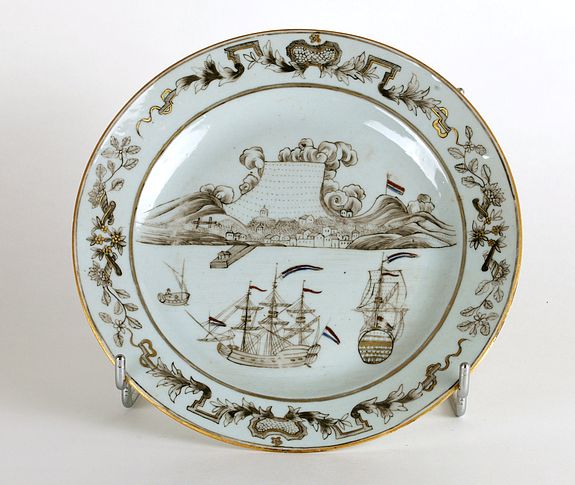
The V.O.C.founded a trading post in Canton (Guangzhou) on 1742 and it was kept until 1826.
Export paintings
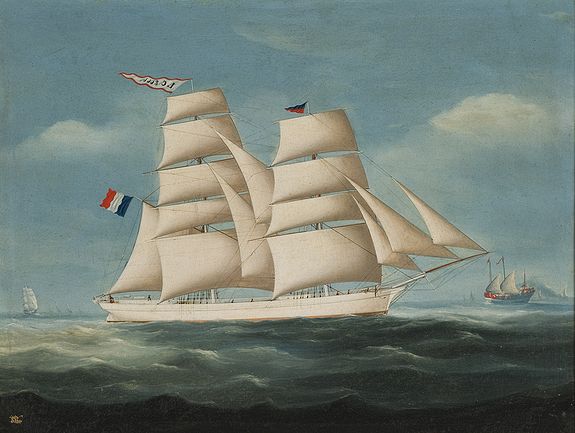
Chinese export paintings, often from Canton (Guangzhou), were created by artists like Spoilum, Lamqua, and Tingqua. These works depict the nearby ports and ships, reflecting both commerce and cultural interactions. A row of buildings with arcades could represent the Thirteen Factories before their destruction in the mid-1800s.
Export porcelain
Fans

>/P>
