India Company
The word India was used, until the 19th century, to refer to various lands, because the world had not yet been mapped accurately.
Great Britain
East India Company
Company of Scotland
Netherlands
Dutch East India Company (VOC)
Belgium
Ostend Comagnie
Portugal
Portuguese East India Company Sweden
Swedish East India Company
France
First French East Indies Company, in existence from 1604 to 1614
French West India Company, active in the Western Hemisphere from 1664 to 1674
Louis XIV's East India Company merged into Law's Company in 1719
French Indies Company, created in 1723 from the reorganization of the non-monetary operations of Law's Company, liquidated in 1770
Compagnie de Calonne, established in 1785 and liquidated in 1794
East India Company
On 31 December 1600, Queen Elizabeth I of England (1533–1603) granted a group of English merchants a charter to establish a joint-stock company which became known as the East India Company. Subsequently, during the reign of King James I (1567–1625), Sir William Hawkins and Sir Thomas Roe were sent to negotiate with the Mughal Emperor Jahangir (1569–1627) to permit the establishment of trading factories in India on behalf of the company. The first of these were built at Surat on the west coast[8] and at Masulipatinam on the country's eastern seaboard.[9] Masulipatinam is thus the oldest English trading post on India's east coast, dating back to 1611. In 1625, another factory was established at Armagon, a few miles to the south, whereupon both the factories came under the supervision of an agency based at Machilipatnam.
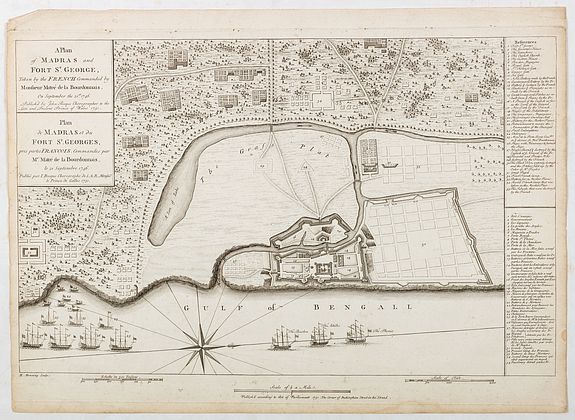
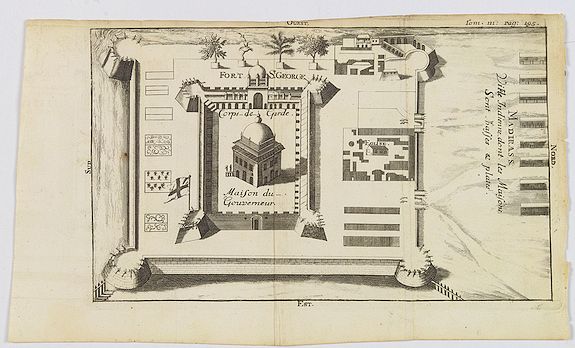
By 1641, Fort St George became the company's headquarters on the Coromandel Coast.
In January 1819 Stamford Raffles of the English East India Company, searching for a trading site, forestalled by the Dutch at Riau, and finding the Carimon (Karimun) Islands unsuitable, landed at Singapore. He found only a few Chinese planters, some Indigenous people, and a few Malays and was told by the hereditary chief, the temenggong (direct ancestor of the sultans of present-day Johor, Malaysia), that the company could purchase land. [See our Singapore section]
The Real Compañia de Filipinas
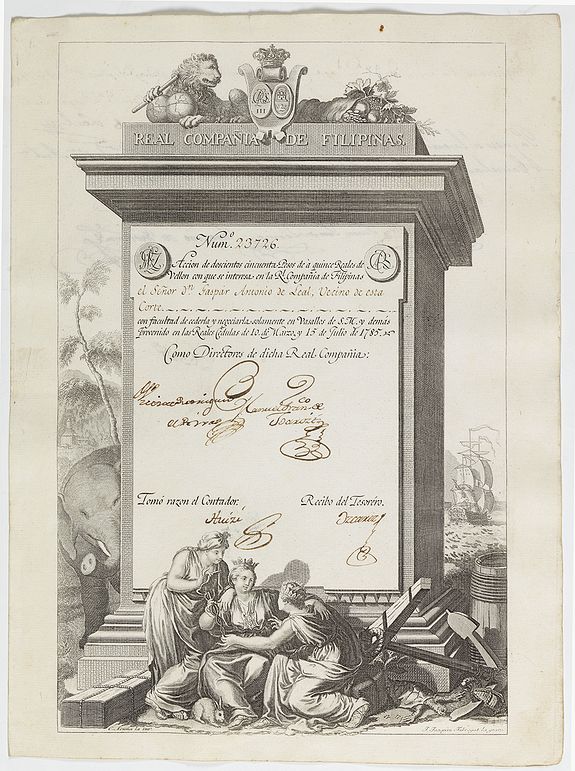
The Real Compañia de Filipinas (Royal Company of the Philippines) was created by royal decree on the 10th of March 1785 to promote the commercial activities of Spain with Asia and America.
Several thousand shares of 250 Pesos were initially issued attracting many investors including apparently the Spanish King Charles III.
On March 10, 1785, Real Compañía de Filipinas (The Royal Company) was established through a royal decree. The company together with Sociedad Económica de Amigos del Pais (Economic Societies of Friends of the Country) established in 1781, were two of the most important events during the coming of Governor General José de Basco y Vargas which marked a new era in the economic history of the country.
The capital of the Real Compañía de Filipinas was fixed at 8 million pesos divided into 32,000 shares of 250 pesos each, the King bought 4000 shares, and the citizens of Manila were allowed 3000.
The main goal of the company was to establish commercial relations among the different colonies, and also between the colonies and Spain, to supply Manila with the products of Europe, and, in return, to carry to Spain not only the products of the Philippines, but also the merchandise coming from the Oriental countries.
The second important object was the encouragement of Philippine agriculture. Its charter required the company to invest 4% of its net profits in some extractive industries, chiefly agriculture. In order to help the company, all the laws and decrees which prohibited the importation of Oriental cloths into Spain, were repealed, and the products of the Philippines were exempted from all kinds of duties both in Manila and in Spain. Furthermore, the merchants of Manila were allowed to go to the Asiatic ports for trade, and the Chinese who came to Manila were allowed to trade freely without subjecting themselves to any restrictions. However, the old Manila-Acapulco trade was not to be disturbed, for the company could not send ships to Acapulco.
The company encouraged the production of silk, indigo, sugar, cotton, and especially of pepper and other spices. For this purpose it bought lands, established posts in Ilocos, Bataan, Cavite, and Camarines, and offered prizes to persons who succeeded in the production. It also gave stimulus to manufacturing by establishing textile factories. In spite of the special protection and privileges granted to the company, it declined from year to year.
In 1805 it was rechartered, and given 15 years of new life and the same privileges as before. Its capital was fixed at 12.5 million pesos divided into shares of 250 pesos each, foreigners were allowed to own shares, and the ships were allowed to sail directly from the Asiatic ports without stopping at Manila, and finally the 3-year privilege, allowed to foreigners at the request of the company in 1789, of importing into Manila Asiatic goods, and exporting the products of the country, was made perpetual.
In 1830 the privileges of Real Compañía de Filipinas were revoked, and Manila was left open to foreign commerce and navigation.