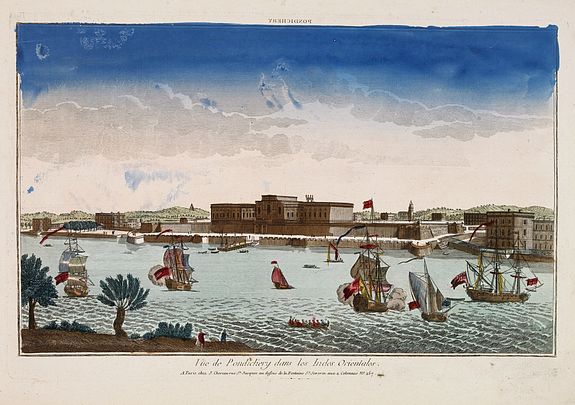
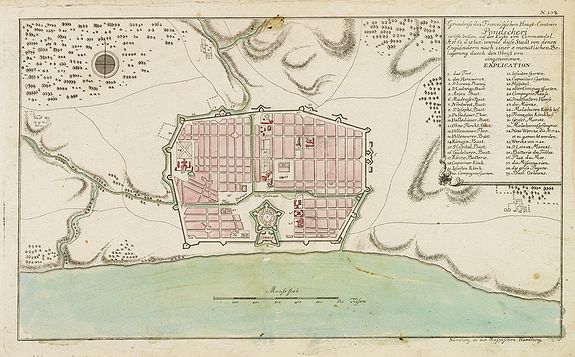
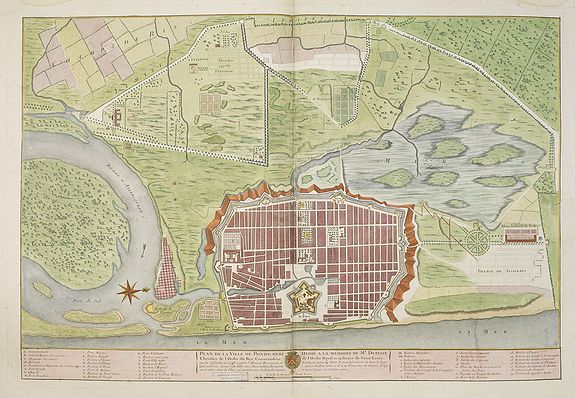
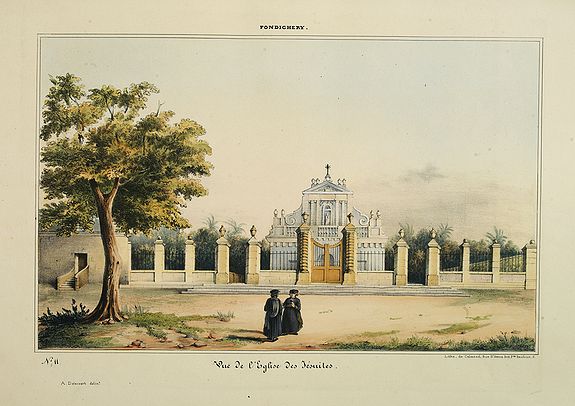
Pondicherry
The settlement was once an abode of learned scholars versed in the Vedas, hence it was also known as Vedapuri. The original name was changed by the French to Pondichéry, which it was called until its name was officially changed to Puducherry in 2006.
Unlike the Arab merchants, who had been sailing the coasts of India since times immemorable, the impact of European contact had far reaching consequences in terms of establishments and in the end the occupation of the entire Subcontinent.
In 1497 the Portuguese discovered the route to India and began to expand their influence by occupying coastal areas and building harbour towns, which soon extended more than 12.000 miles of coast-line.
The Portuguese established a factory at the beginning of the sixteenth century, but were compelled to leave a century later by the ruler of Gingee, who found them unfriendly. After that the Danes shortly set up an establishment, and likewise the Dutch. The latter set up trading posts in Porto Novo and Cuddalore. The French, who had trading centres in the North, Mahe and Madras were invited to open a trading centre in Puducherry by the new ruler of Gingee to compete with the Dutch.
In 1673, February 4th, Bellanger, a French officer, took up residence in the Danish Lodge in Puducherry and the French Period of Puducherry began.In 1674 Francois Martin, the first Governor, started to build Puducherry and transformed it from a small fishing village into a flourishing port-town.
In 1693 the Dutch took over and fortified the town considerably. But four years later Holland and France signed a peace treaty and the French regained Puducherry in 1699. In the 18th century the town was laid out on a grid pattern and grew considerably.
Able Governors like Lenoir (1726-1735) and Dumas (1735-1741) and an ambitious Governor Dupleix (1742-1754) expanded the Puducherry area and made it a large and rich town. But ambition clashed with the English interests in India and the local kingdoms and a period of skirmishes and political intrigues began. Under the command of Bussy, Dupleix's army successfully controlled the area between Hyderabad and Cape Comorin. But then Robert Clive arrived in India, a dare-devil officer who dashed the hopes of Dupleix to create a French Colonial India. After a defeat and failed peace talks, Dupleix was recalled to France.
In spite of a treaty between the English and French not to interfere in local politics, the intrigues continued. Subsequently France sent Lally Tollendal to regain the French losses and chase the English out of India. After an initial success they razed Fort St. David in Cuddaloreto the ground, but stategic mistakes by Lally led to the loss of the Hyderabad region and the siege of Puducherry in 1760. In 1761 Puducherry was razed to the ground in revenge and lay in ruins for 4 years. The French had lost their hold in South India.
In 1765 the town is returned to France after a peace treaty with England in Europe. Governor Law de Lauriston set to rebuild the town on the old foundations and after five months 200 European and 2000 Tamil houses had been erected. During the next 50 years Puducherry changed hands between France and England with the regularity of their wars and peace treaties.
Only after 1816 the French regained permanent control of Puducherry, but the town had lost much of its former glory. Successive Governors improved infrastructure, industry, law and education over the next 138 years. In 1947 the English left India for good, but it lasted till 1954 when the French handed Puducherry over to an independent India.
Adolphe Delessert traveled for a period of 5 years, during which he successively visited the islands Mauritius, Réunion and Prince of Wales (today Pinang), Pondicherry, Malacca, Singapore, part of Java and Madras. During his expedition he gathered an important collection of natural history including reptiles, birds and specimens of mammals. Many species were still unknown.