1639 MERIAN, M. - [Title page] Theatri Europaei, oder historischer chronicken Beschreibung . . .
[Title page] Theatri Europaei, oder historischer chronicken Beschreibung . . .
| Maker: | MERIAN, M. | |
| Date: | Frankfurt, ca. 1639 | |
| Colored: | Uncolored. | |
| Size: | 295 x 183 mm / 11.6 x 7.2 inches | |
| Condition: | Dark impression. Paper slightly age-toned. Right margin cut close and frayed. | |
 Add/Remove this item to MyCollection+




Description
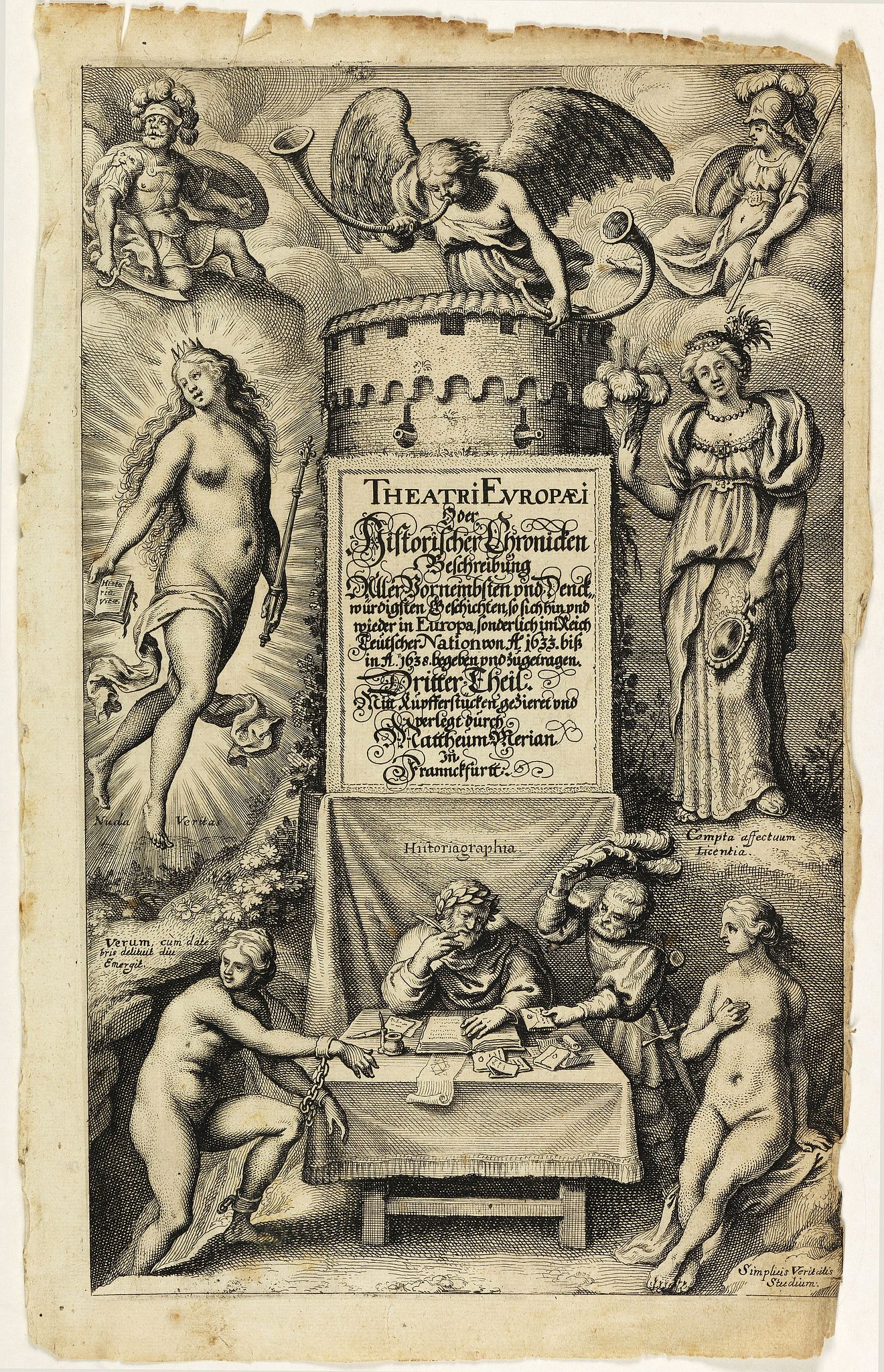
On the left side of the tower, gun barrels sticking out of its loopholes, a naked, crowned female figure, surrounded by a halo of light, floats on the middle plane. Through the floating and the light she appears in a religious context. The personification of the "Nuda Veritas" (Naked true), as the explanatory words at her feet, has in his right hand an open book with the inscription "Historia vitae", possibly supplemented by "magistra". In her left hand she holds a sceptre, like the crown signum of dominion.
This Veritas figure represents the claim of the historian to rule in agreement with God's will as a magistra vitae and thus to be useful in life-practical terms.
On the right side of the turret stands a clothed female figure on earth, conspicuously ornamented by jewellery and fashionable garb. In the right she holds a frond, in the left a mirror. With the two accessories may be alluded to the vanity of the "Licentia".
At her feet is the interpretation: "Compta affectuum Licentia". It is thus Licentia, goddess of license, arbitrariness and frivolity, and the manageable lawlessness of affects. The motto can be related to the "Nuda Veritas": The unveiled truth and its reproduction should be achieved by the taming of the passions.
The allegory of truth finds its reference scene on the lower picture. Beneath a panel with title and publisher's name, a historiographer working at a desk is shown in the foreground, indicated by the inscription "Historiographia" appearing on a cloth above him.
The historian, decorated with a laurel wreath, has an open book lying on the table top. In his right hand he holds a quill pen, his left hand rests on a book page. On the desk stands an inkwell, sheets, sealed sheets, letters, envelopes and a paper roll scattered around. Coming from the right, a male figure brings a new sealed document, probably a report or a message, which highlights the timeliness of the news to be processed.
The historiographer has apparently just described a page of the book and now looks thoughtfully reflective of the delivered document of the messenger, who is just about to step in, to lift his hat off his head.
To the left and right of the historian, two more Veritas personifications can be seen at the edges of the picture. From the lower left approaching - from a dark cave to the light rising - a naked female figure approaches the historiographer. Once bound, she still wears the rest of a clamp on her left lower leg. Her forearms are tied by a chain. At the height of the figure of a woman, who turned her gaze away from the historiographer, the phrase "verum cùm datebris delituit diu emergit" can be read - the long-hidden truth has finally come to light.
In the lower right sits a naked female figure looking at the historiographer. At her feet are the words "Simplicis Veritatis Studium". It thus personifies the effort for the simple truth.
Matthäus Merian Sr. (1593-1650)
Matthäus Merian Sr. (Switzerland, 1593-1650) and Jr. (Switzerland, 1621-1687). Matthäus Merian, the leading German illustrator of the 17th century, was born in Basel in 1593. He learned copperplate engraving in Zurich and later worked and studied in Strasbourg, Nancy, Paris, and the Low Countries. In 1618, he went to Frankfurt, where he married the eldest daughter of J.T. de Bry, publisher and engraver. After de Bry died in 1623, he took over his business. De Bry’s business remained in Merian’s family until 1726, when a fire destroyed it.In 1635, he began the series Theatrum Europaeum. Between 1642 and 1688, he published Martin Zeiller’s Topographia Germaniae, with more than 2,000 plates etched and engraved by himself and his sons Matthäus and Caspar. He also took over and completed the later parts and editions of the Grand Voyages and Petits Voyages, which de Bry had started in 1590. Matthäus Merian died after in 1650 in Bad Schwalbach near Wiesbaden.
FAQ - Guarantee - Shipping
Buying in the BuyNow Gallery
This item is available for immediate purchase when an "Add to Cart" or "Inquire Now" button is shown.
Payments are accepted in Euros or US Dollars. We accept most major credit cards, PayPal and bank transfer.
Authenticity Guarantee
 We provide professional descriptions, condition report and HiBCoR rating (based on 45 years experience in the map business).
We fully guarantee the authenticity of items we sell. We provide a certificate of authenticity for each purchased item.
Condition and Coloring
We indicate the condition of each item and use our unique HiBCoR grading system in which four key items determine a map's value:
Historical Importance, Beauty, Condition/Coloring and Rarity.
We offer many maps in their original black and white condition. We do not systematically color-up maps to make them more sellable to the general public or buyer.
Copper engraved or wood block maps are always hand colored. Maps were initially colored for aesthetic reasons and to improve readability.
Nowadays it is becoming a challenge to find maps in their original colors, and these are therefore more valuable.
We use the following color keys in our catalog:
- Original colors: the colors were applied around the time the map was issued.
- Original o/l colors: only the borders were colored at the time of publication.
- Colored: the colors were applied recently or at the end of the 20th century ("attractive colors" may also be used).
Read more about coloring of maps [+]
FAQ
Please have a look for more information about buying in the BuyNow gallery.
Many answers are likely to be found in the general help section.
MyCollection+

With MyCollection+ you can collect all your favorite items in one place. It is free, and anyone can create his or her virtual collection.
Unless you are logged in, the item is only saved for this session. You have to be registered and logged in if you want to save this item permanently.
Read more [+]
To save permanently, please
sign in or
create an account first.
Register here, it is free and you do not need a credit card.
Add this item to
MyCollection+
or see MyCollection+.
Invoice
Invoices and certificates of authenticity are available in the
client center > Invoices.
Paulus Swaen maintains an archive of most of our high-resolution rare maps, prints, posters and medieval manuscript scans.
We make them freely available for download and study.
Read more about free image download
Click the image for a free small image download.
YOUR RIGHT TO CANCEL THE PURCHASE OF A LOT
In accordance with the EU Consumer Rights Directive and habitually reside in the European Union you have the right to cancel the contract for the purchase of a lot, without giving any reason.
The cancellation period will expire 14 calendar days from the day after the date on which you or a third party (other than the carrier and indicated by you) acquires, physical possession of the lot. To exercise the right to cancel you must inform Paulus Swaen Inc, of your decision to cancel this contract by a clear statement (e.g. a letter sent by post, or e-mail.
To meet the cancellation deadline, it is sufficient for you to send your communication concerning your exercise of the right to cancel before the cancellation period has expired.
