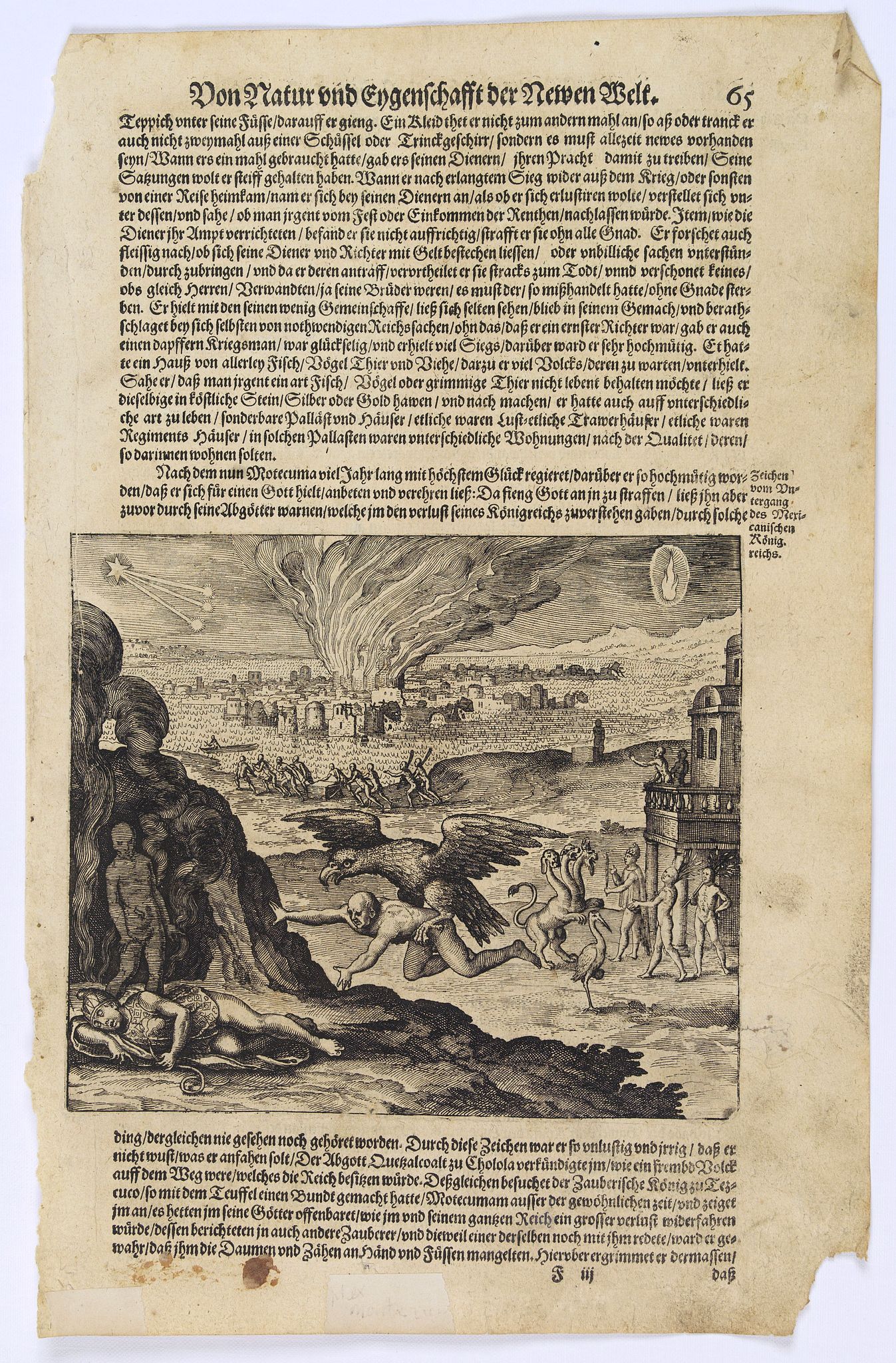
1633 GOTTFRIED, J.L. - Showing Montezuma's dream as told by a laborer, predicts calamities to come.
[Montezuma's dream as told by a labourer, predicts calamties to come.]
| Maker: | GOTTFRIED, J.L. | |
| Date: | Frankfurt, M.Merian, 1633 | |
| Colored: | Uncolored. | |
| Size: | 150 x 174 mm / 5.9 x 6.9 inches | |
| Condition: | Copper plate engraving on text sheet, paper is browned, with good margins. Two corners missing. Some crude repairs to lower margin. Size of sheet: 345 x 212 mm.<br />German text and on verso. | |
You can choose from more than 30,000 items from our BuyNow Catalog or Archive.
It's free, and you can delete items anytime.
 Add/Remove this item to MyCollection+



Description
An apocalyptic scene of Montezuma's dream. Montezuma II (Moctezuma Xocoyotzin), who became tlatoani, the supreme ruler of Mexico, in 1502, after a career as a warrior and priest. By 1519, he ruled an empire of tributary city-states, some of them restless under the burden.
When news arrived of strange ships on the Gulf coast, he sent envoys with gifts, probably hoping to impress the strangers and persuade them to leave. The gold had the opposite effect. Cortés marched inland, allied with the Tlaxcalans (long-time enemies of the Mexica), and massacred a crowd at Cholula. On 8 November 1519, Montezuma met him on the Iztapalapa causeway, welcomed him, and lodged the Spanish in his father’s palace.
Within weeks, Cortés had taken him hostage. In May 1520, while Cortés was away, Pedro de Alvarado attacked unarmed worshippers during the Toxcatl festival, and the city rose up. Montezuma died in June. Spanish sources say his own people stoned him when he tried to calm them, while Indigenous accounts say the Spanish killed him. The Spanish fled on the “Noche Triste” (30 June 1520). A smallpox epidemic then ravaged the city, and Tenochtitlan fell in August 1521 under his successor Cuauhtémoc.
One caution about the scene I drew: the omens and the idea that Montezuma took Cortés for the returning god Quetzalcoatl come mostly from accounts written after the conquest, such as Sahagún’s Florentine Codex. Many modern historians treat them as later reinterpretation rather than what he believed at the time.
Tenochtitlan and the Templo Mayor were founded in 1325, on an island in Lake Texcoco. By 1519, it likely held over 200,000 people, larger than any city in Spain. Three causeways linked it to the shore, an aqueduct brought fresh water from Chapultepec, and farmland on artificial islands (chinampas) fed it. The market at neighboring Tlatelolco astonished the Spanish with its size and order.
At the center stood the Templo Mayor, a stepped pyramid with twin shrines on top. One was for Huitzilopochtli, god of war and the sun, the other for Tlaloc, god of rain and water, so the temple joined the city’s military power to the farming that fed it. It was rebuilt in several phases, with a major dedication in 1487 under Ahuitzotl. The Spanish destroyed it and built Mexico City over the ruins. Electrical workers rediscovered it in 1978 when they unearthed the great Coyolxauhqui stone, and excavation has continued ever since.
In 1631, Johann Ludwig Gottfried inherited Theodor De Bry’s publishing firm, which included the illustrated accounts of the expeditions of Magellan, Columbus, Vespucci, Cortes, Balboa, Raleigh, Drake, Smith, and many others.
Gottfried issued together with Matthaeus Merian a one-volume condensation "Newe Welt Vnd Americanische Historien/ Jnhaltende Warhafftige vnd volkommene Beschreibungen Aller West-Jndianischen Landschafften..." that used many of the original copper plates and supplemented them with new ones of more recent voyages. The book was published by Matthaeus Merian. The work was reprinted in 1655 / 1657.
Johann Ludwig Gottfried
Johann Ludwig Gottfried studied theology in Heidelberg. As of 1603, he was active as a deacon and, afterward, as a reformed priest in villages in the Electoral Palatinate's left side of the Rhine. Between 1625 and 1633 he was active in Offenbach. Owed to his talent for languages and his education in general, he became a highly esteemed assistant of Frankfurt publishers like Johann Theodor de Bry, de Bry's nephew Lucas Jennis and de Bry's son-in-law Matthäus Merian the Elder as of 1619. He made translations, epigrams, paraphrases and compilations for many distinguished publications.FAQ - Guarantee - Shipping
This item is available for immediate purchase when a "Add to Cart" or "Inquire Now" button is shown.
Payments are accepted in Euros or US Dollars. We accept most major credit cards, PayPal and bank transfer.
Authenticity Guarantee
 We provide professional descriptions, condition report and HiBCoR rating (based on 45 years experience in the map business)
We fully guarantee the authenticity of items we sell. We provide a certificate of authenticity for each purchased item.
Condition / Coloring
We indicate the condition of each item and use our unique HiBCoR grading system in which four key items determine a map's value: Historical Importance, Beauty, Condition/Coloring and Rarity.
We offer many maps in their original black and white condition. We do not systematically color-up maps to make them more sellable to the general public or buyer.
Copper engraved or wood block maps are always hand colored. Maps were initially colored for aesthetic reasons and to improve readability. Nowadays, it is becoming a challenge to find maps in their original colors and are therefor more valuable.
We use the following color keys in our catalog:
Original colors; mean that the colors have been applied around the time the map was issued.
Colored; If the colors are applied recently or at the end of the 20th century, then "colored", or "attractive colors" will be used.
Original o/l colors; means the map has only the borders colored at the time of publication.
Read more about coloring of maps [+]
FAQ
Please have a look for more information about buying in the BuyNow gallery.
Many answers are likely to find in the general help section.
MyCollection+

With MyCollection+ you can collect all your favorite items in one place. It is free, and anyone can create his or her virtual map collection.
Unless you are logged in, the item is only saved for this session. You have to be registered and logged-in if you want to save this item permanently to MyCollection+. Read More [+]
If you want to save the items permanently, please sign in
or create account first.

Registering Here, it is and you do not need a credit card.
Add this item to MyCollection+ or click the following link to see MyCollection+.
Invoice
The invoice and certificates of authenticity are available in the client center >Invoices
|
Digital Image Download Paulus Swaen maintains an archive of most of our high-resolution rare maps, prints, posters and medieval manuscript scans. We make them freely available for download and study. Read more about free image download |
Click the image for a free small image download. |
YOUR RIGHT TO CANCEL THE PURCHASE OF A LOT
In accordance with the EU Consumer Rights Directive and habitually reside in the European Union you have the right to cancel the contract for the purchase of a lot, without giving any reason.
The cancellation period will expire 14 calendar days from the day after the date on which you or a third party (other than the carrier and indicated by you) acquires, physical possession of the lot. To exercise the right to cancel you must inform Paulus Swaen Inc, of your decision to cancel this contract by a clear statement (e.g. a letter sent by post, or e-mail.
To meet the cancellation deadline, it is sufficient for you to send your communication concerning your exercise of the right to cancel before the cancellation period has expired.
