Sign In or Sign Up
Sign In or Sign Up
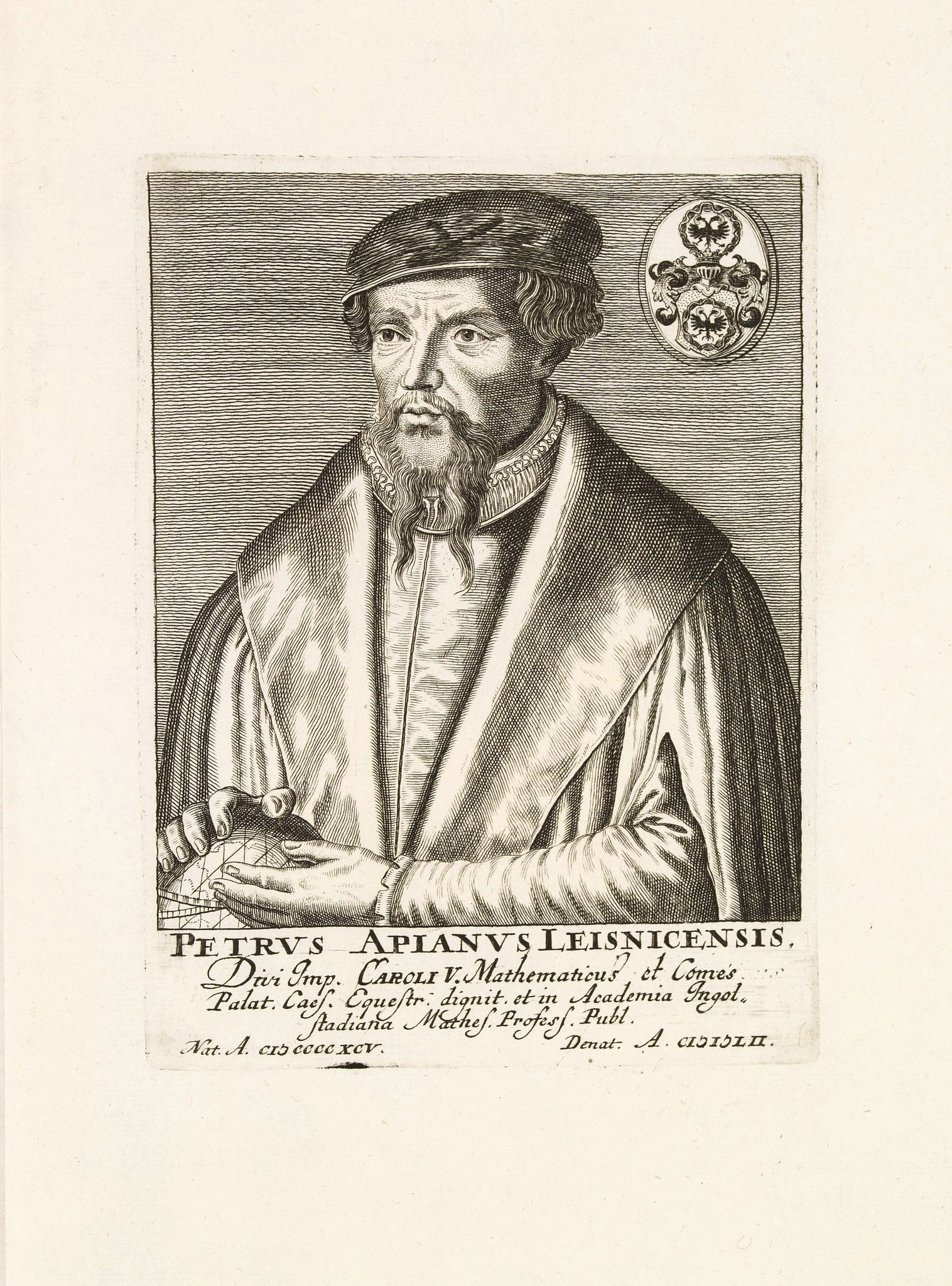
1700 KILIAN, W. - Petrus Apianus Leisnicensis.
Petrus Apianus Leisnicensis.
| Maker: | KILIAN, W. | |
| Date: | Augsburg, ca.. 1700 | |
| Colored: | Uncolored. | |
| Size: | 160 x 117 mm / 6.3 x 4.6 inches | |
| Condition: | In good condition. Dark impression. | |
 Add/Remove this item to MyCollection+




Description
He was born as Peter Bienewitz (or Bennewitz) in Leisnig in Saxony, his father was a shoemaker. The family was relatively well off, belonging to the middle-class citizenry of Leisnig. Apianus was educated at the Latin school in Rochlitz. From 1516 to 1519 he studied at the University of Leipzig, during this time, he Latinized his name to Apianus (lat. apis means "bee", "Biene" is the German word for bee).
In 1519, Apianus moved to Vienna and continued his studies at the University of Vienna, which was considered one of the leading universities in geography and mathematics at the time and where Georg Tannstetter taught. When the plague broke out in Vienna in 1521, he completed his studies with a B.A. and moved to Regensburg and then to Landshut.
In Landshut, he produced his Cosmographicus liber (1524), a highly respected work on astronomy and navigation that was to see at least 30 reprints in 14 languages and that remained popular until the end of the 16th century. He married the daughter of a councilman of Landshut, Katharina Mosner, in 1526. They would have 14 children together, five girls and nine sons, one of which was Philipp Apian.
In 1527, Peter Apian was called to the University of Ingolstadt as a mathematician and printer. His print shop started small. Among the first books he printed were the writings of Johann Eck, Martin Luther's antagonist. Later, his print shop soon became well-known for its high-quality editions of geographic and cartographic works.
Through his work, Apian became a favourite of emperor Charles V. Charles had praised his work (the Cosmographicus liber) on the Reichstag of 1530 and granted him a printing monopoly in 1532 and 1534. In 1535, the emperor made Apian an armiger, i.e. granted him the right to display a coat of arms. In 1540, Apian printed the Astronomicum Caesareum, dedicated to Charles V. Charles promised him a truly royal sum (3,000 golden guilders)1, appointed him his court mathematician, and made him a Reichsritter and in 1544 even a Hofpfalzgraf. All this furthered Apian's reputation as an eminent scientist.
Apian is also remembered for publishing the only known depiction of the Bedouin constellations in 1533. On this map Ursa Minor is an old woman and three maidens, Draco is four camels and Cepheus was illustrated as a shepherd with sheep and dog.
Despite many calls from other universities, including Leipzig, Padua, Tübingen, and Vienna, Apian remained in Ingolstadt until his death. Although he neglected his teaching duties, the university evidently was proud to host such an esteemed scientist. Apian's work included in mathematics—in 1527 he published a variation of Pascal's triangle, and in 1534 a table of sines— as well as astronomy. In 1531, he observed a comet and discovered that a comet's tail always point away from the sun. (Girolamo Fracastoro also detected this in 1531, but Apian's publication was the first to also include graphics.)
He designed sundials, published manuals for astronomical instruments and crafted volvelles ("Apian wheels"), measuring instruments useful for calculating time and distance for astronomical and astrological applications.
Apian was followed by his son Philipp (1531-1589), who, in addition to his own research, preserved the legacy of his father.
The lunar crater Apianus and minor planet 19139 Apian are named in his honour.
List of Explorers and Mapmakers [+]
Reference: Wellcome, 84.
FAQ - Guarantee - Shipping
Buying in the BuyNow Gallery
This item is available for immediate purchase when an "Add to Cart" or "Inquire Now" button is shown.
Payments are accepted in Euros or US Dollars. We accept most major credit cards, PayPal and bank transfer.
Authenticity Guarantee
 We provide professional descriptions, condition report and HiBCoR rating (based on 45 years experience in the map business).
We fully guarantee the authenticity of items we sell. We provide a certificate of authenticity for each purchased item.
Condition and Coloring
We indicate the condition of each item and use our unique HiBCoR grading system in which four key items determine a map's value:
Historical Importance, Beauty, Condition/Coloring and Rarity.
We offer many maps in their original black and white condition. We do not systematically color-up maps to make them more sellable to the general public or buyer.
Copper engraved or wood block maps are always hand colored. Maps were initially colored for aesthetic reasons and to improve readability.
Nowadays it is becoming a challenge to find maps in their original colors, and these are therefore more valuable.
We use the following color keys in our catalog:
- Original colors: the colors were applied around the time the map was issued.
- Original o/l colors: only the borders were colored at the time of publication.
- Colored: the colors were applied recently or at the end of the 20th century ("attractive colors" may also be used).
Read more about coloring of maps [+]
FAQ
Please have a look for more information about buying in the BuyNow gallery.
Many answers are likely to be found in the general help section.
MyCollection+

With MyCollection+ you can collect all your favorite items in one place. It is free, and anyone can create his or her virtual collection.
Unless you are logged in, the item is only saved for this session. You have to be registered and logged in if you want to save this item permanently.
Read more [+]
To save permanently, please
sign in or
create an account first.
Register here, it is free and you do not need a credit card.
Add this item to
MyCollection+
or see MyCollection+.
Invoice
Invoices and certificates of authenticity are available in the
client center > Invoices.
Paulus Swaen maintains an archive of most of our high-resolution rare maps, prints, posters and medieval manuscript scans.
We make them freely available for download and study.
Read more about free image download
Click the image for a free small image download.
YOUR RIGHT TO CANCEL THE PURCHASE OF A LOT
In accordance with the EU Consumer Rights Directive and habitually reside in the European Union you have the right to cancel the contract for the purchase of a lot, without giving any reason.
The cancellation period will expire 14 calendar days from the day after the date on which you or a third party (other than the carrier and indicated by you) acquires, physical possession of the lot. To exercise the right to cancel you must inform Paulus Swaen Inc, of your decision to cancel this contract by a clear statement (e.g. a letter sent by post, or e-mail.
To meet the cancellation deadline, it is sufficient for you to send your communication concerning your exercise of the right to cancel before the cancellation period has expired.
