Subscribe to be notified if similar examples become available.
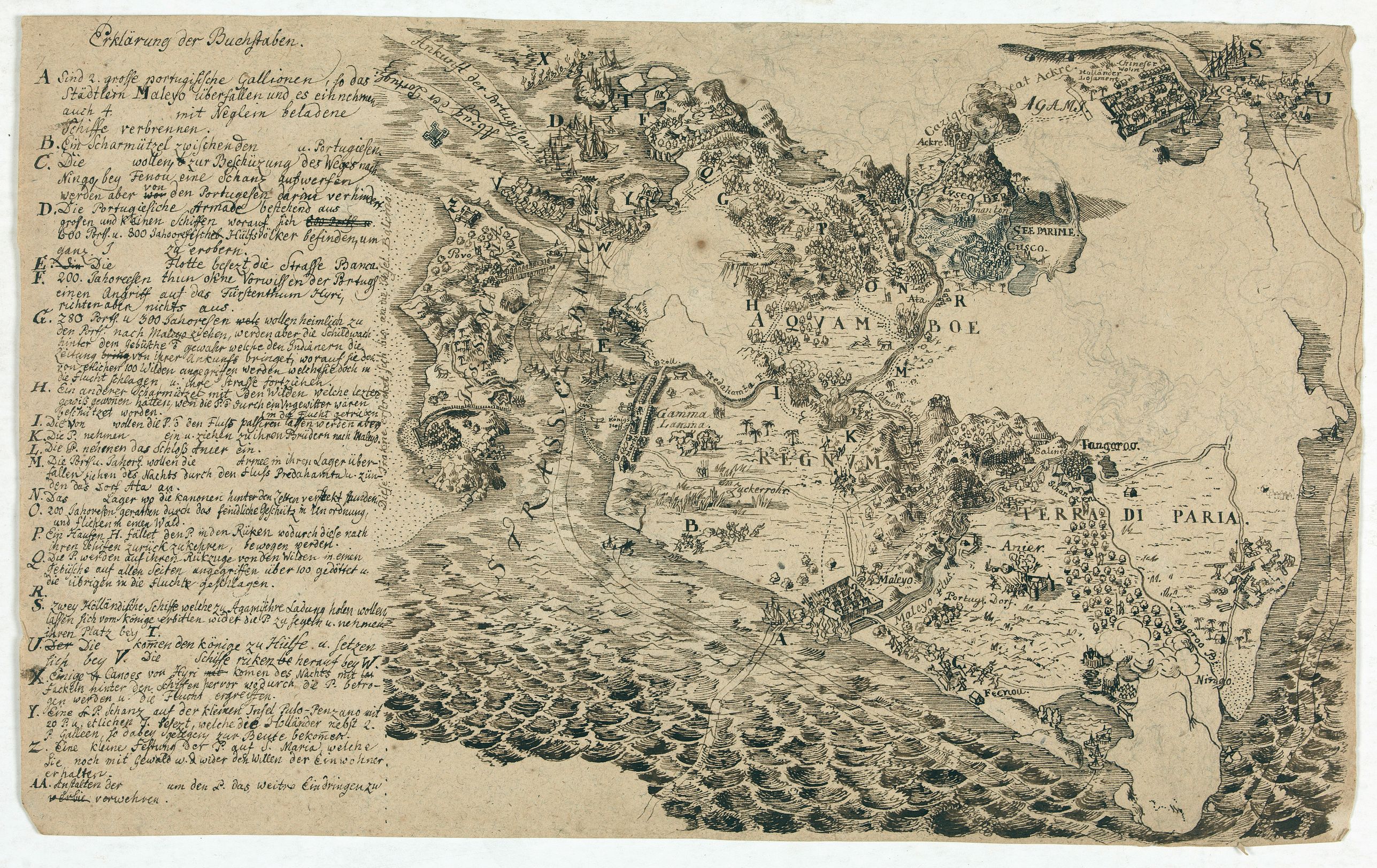
1750 ANONYMOUS - Manuscript map in brown ink showing the island Ternate centered on Gamalama (and fort Malayu.
Manuscript map in brown ink showing the island Ternate centered on Gamalama (and fort Malayu.
| Maker: | ANONYMOUS | |
| Date: | ca. 1750 | |
| Colored: | In original outline colors. | |
| Size: | 210 x 345 mm / 8.3 x 13.6 inches | |
| Condition: | Very detailed pen and ink drawing in dark brown and black ink on 18th century laid paper, contemporary laid down on another sheet. With a lettered key. Text in German. | |




Description
Detailed German manuscript map with part of the island Ternate showing in great detail the main harbor town of the island Gamalama and the nearby fortress Maleyo. The island neighboring island Maria (Mare Island) is to the left. In top of the drawing are a Chinese and Dutch village. Arriving Portuguese vessels offshore the town of Gammolammo.
Gammolammo , or “ Big Town ” was Ternate's principal city and the sultan's residence.
Fort Malayo became the VOC Fort Oranje
To the right, we see fort Malayo which was built around 1522 by the Portuguese as a balancing force against the Spanish defense.
Eventually Malayo was occupied by the Spanish until 1606 when the Ternate Sultanate drove out the Spanish with the help of the VOC. As a reward the VOC were given permission by the Sultan to build a new fort at the same location as fort Malayo, which the Dutch called 'Fort Oranje' (Benteng Orange, in the city of Ternate).
Fort Oranje was one of the first permanent bases of the V.O.C. in Asia and became the seat of the V.O.C.’s Council of the Indies and the Governor General in 1610.
It was the de-facto center for the V.O.C. in Asia until Jan Pieterszoon Coen moved the administration to Batavia in 1619.
The VOC was later allowed to use and reinforce various other forts on Ternate island and signed several treaties with the Sultanate of Ternate until the the bankruptcy of the VOC in 1799.
Forts in Ternate
There are various forts that were used by the VOC that still remain on Ternate. The largest and historically most important is Fort Oranje, located in the crowded center of Ternate city. The fort has arrow-head bastions in each of its four corners named Zeebolwerk (the largest bastion on the southeast side near the sea), Klein Zeebolwerk, Gilolo and Rael. It is made of stone layers with an encircling ditch and the entrance gate is decorated with a crown on its top.
In 2008 and 2014 Fort Oranje underwent a revitalization program in which the moat and the buildings inside the fort were renovated. Fort Oranje is now used as a community space and there are plans for a spice museum to be set up.
Other remaining forts such as Fort Kalamata and Fort Tolukko, originally built by the Portuguese and later used and expanded by the VOC, give a fascinating glimpse into the contested spice trade.
In the 17th and 18th century, several German (artist) was active in the Dutch VOC, including Caspar Schmalkalden.
FAQ - Guarantee - Shipping
This item is available for immediate purchase when a "Add to Cart" or "Inquire Now" button is shown.
Payments are accepted in Euros or US Dollars. We accept most major credit cards, PayPal and bank transfer.
Authenticity Guarantee
 We provide professional descriptions, condition report and HiBCoR rating (based on 45 years experience in the map business)
We fully guarantee the authenticity of items we sell. We provide a certificate of authenticity for each purchased item.
Condition / Coloring
We indicate the condition of each item and use our unique HiBCoR grading system in which four key items determine a map's value: Historical Importance, Beauty, Condition/Coloring and Rarity.
We offer many maps in their original black and white condition. We do not systematically color-up maps to make them more sellable to the general public or buyer.
Copper engraved or wood block maps are always hand colored. Maps were initially colored for aesthetic reasons and to improve readability. Nowadays, it is becoming a challenge to find maps in their original colors and are therefor more valuable.
We use the following color keys in our catalog:
Original colors; mean that the colors have been applied around the time the map was issued.
Colored; If the colors are applied recently or at the end of the 20th century, then "colored", or "attractive colors" will be used.
Original o/l colors; means the map has only the borders colored at the time of publication.
Read more about coloring of maps [+]
FAQ
Please have a look for more information about buying in the BuyNow gallery.
Many answers are likely to find in the general help section.
MyCollection+

With MyCollection+ you can collect all your favorite items in one place. It is free, and anyone can create his or her virtual map collection.
Unless you are logged in, the item is only saved for this session. You have to be registered and logged-in if you want to save this item permanently to MyCollection+. Read More [+]
If you want to save the items permanently, please sign in
or create account first.

Registering Here, it is and you do not need a credit card.
Add this item to MyCollection+ or click the following link to see MyCollection+.
Invoice
The invoice and certificates of authenticity are available in the client center >Invoices
|
Digital Image Download Paulus Swaen maintains an archive of most of our high-resolution rare maps, prints, posters and medieval manuscript scans. We make them freely available for download and study. Read more about free image download |
Click the image for a free small image download. |
YOUR RIGHT TO CANCEL THE PURCHASE OF A LOT
In accordance with the EU Consumer Rights Directive and habitually reside in the European Union you have the right to cancel the contract for the purchase of a lot, without giving any reason.
The cancellation period will expire 14 calendar days from the day after the date on which you or a third party (other than the carrier and indicated by you) acquires, physical possession of the lot. To exercise the right to cancel you must inform Paulus Swaen Inc, of your decision to cancel this contract by a clear statement (e.g. a letter sent by post, or e-mail.
To meet the cancellation deadline, it is sufficient for you to send your communication concerning your exercise of the right to cancel before the cancellation period has expired.
