Subscribe to be notified if similar examples become available.
1493 SCHEDEL, H. - Register Des Buchs der Chronicken und geschichten mit figure...
Register Des Buchs der Chronicken und geschichten mit figure...
| Maker: | SCHEDEL, H. | |
| Date: | Nuremberg, Anton Koberger, 23 Decembre, 1493 | |
| Colored: | Uncolored. | |
| Size: | 450 x 300 mm / 17.7 x 11.8 inches | |
| Condition: | Folio, 16th century Flemish vellum, large blind-stamped arabesque ornament on center covers. Spine has been replaced. Title, pp. (XXXVIII) (index) + CCXCIX, woodcuts throughout, including maps of the world and Northern Europe. Several woodblocks are cut b | |
 Add/Remove this item to MyCollection+




Description
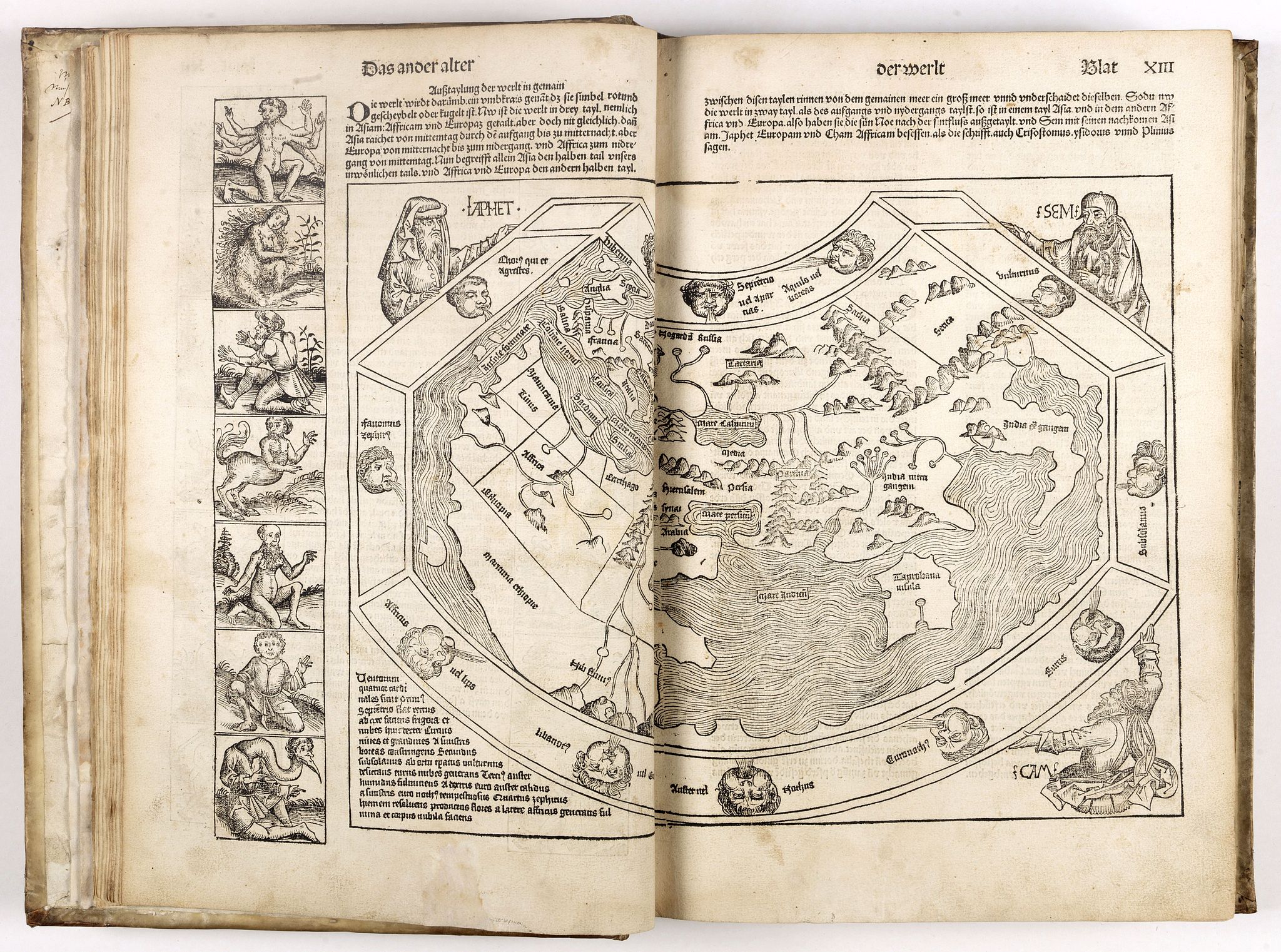
It is a mixture of fact and fantasy, recording events like the invention of printing, but also repeating stories from Herodotus. Even the world map is decorated with strange beings from the far reaches, including a cyclops and a four-eyed man.
645 woodcuts were used to illustrate the Chronicle, but many were used more than once, so there are a total of 1,809 illustrations, making it the most extensively illustrated book of the fifteenth century.
The cutters were Michael Wolgemut, his stepson, Wilhelm Pleydenwurff and their workshop. As Albrecht Dürer was the godson of Koberger and was apprenticed to Wolgemut from 1486 to 1489, it is likely that he was involved in the work.
The immense importance of the Nuremberg Chronicle, in respect to history, geography and topography, cannot be overemphasised. It is often quoted as being the most important book ever printed.
Contemp. marginal manuscript notes in Latin and Flemish. On inside cover plate : Kronijk of opmerkelijke geschiedenissen van het begin der wereld, tot den tijd dat dit boek gedrukt is; zijnde den 23 Dec: 1493. zoo als op de laatste bladzijde vermeldt wordt.
The general condition is very good, with large margins. Bound in a nice 16th cuntury Flemish vellum, with large blind-stamped arabesque ornament on center covers. The spine is renewed, lacking ties. Light marginal water staining throughout. Lacking the final blank, as usual. About 30 pages have a very small marginal tear who are repaired. Pages CI, CII and CIII have a repaired tear of about 3cm. Pages CCLXVIII has a larger tear of 18cm.
Title page and second page have a 4cm. re-installed lower margin. Title with a small worm trace in left margin, among some missing areas along left margin reinforced and the page laid down on very thin Japan paper for protective reason.
Last pages and Europe map with a few small worm holes. Europe map has small margins but complete. An example with good margins.
Two of the abundant illustrations are maps which typify well enough the range of old traditions and new information which characterizes the text itself. The world map is of Ptolemaic configurations, although without Ptolemy's scientific apparatus of latitudes, longitudes, scales, rich nomenclature, etc. The border contains twelve dour wind heads while the map is supported in three of its corners by the solemn figures of Ham, Shem and Japhet taken from the Old Testament.
What gives the map its present-day interest and attraction are the panels representing the outlandish creatures and beings that were thought to inhabit the further most parts of the earth. There are seven such scenes to the left of the map and a further fourteen on its reverse. Pliny, Pomponius Mela, Solinus and Herodotus' Fables have been the sources for many of these mythological creatures; others were doubtless born of medieval travelers' tales. Among the scenes are a six-armed man, possibly based on glimpses of a file of Hindu dancers so aligned that the front figure appears to have multiple arms; a six-fingered man, a centaur, a four-eyed man from a coastal tribe in Ethiopia; a dog-headed man from the Simien Mountains, a cyclops, one of the men whose heads grow beneath their shoulders, one of the crook-legged men who live in the desert and slide along instead of walking; a strange hermaphrodite, a man with one giant foot only (stated by Solinus to be used as a parasol but more likely an unfortunate sufferer from elephantisis), a man with a huge underlip (doubtless seen in Africa), a man with waist-length hanging ears, and other frightening and fanciful creatures of a world beyond.
Twelve winds are named as well as major place names. The source of this map is apparently the frontispiece of Pomponius Mela's Cosmographia printed by Ratdolt at Venice in 1488. [Northern Europe with Poland]. Map of Northern Europe and centered on Poland. First issue, with Latin text colophon and date on verso. The map is deemed to be the first printed map of Germany, even if it shows a larger area. W. B. Grinsberg characterized this map as the first modern map of northern and central Europe. The map ranges from the British Isles to Constantinople.
The designer has been identified as Hieronymus Münzer (1437-1508), who trained as a physician.
The Münzer map is one of the earliest to depict the Scandinavia peninsula.
Nordenskold credits the map of the north in the Zamoyski codes as the prototype for this map. The source for the central European portion is a manuscript map of 1460 of Germany by Cardinal Nicolas Cusanus (also Nicholas of Cusa), printed posthumously at Eichstätt in 1491.
Reference: Br.Museum, IC. 7458 (II 437).
John Senex (1678-
John Senex was a prominent mapmaker, engraver, globemaker and publisher who practiced his trade in early eighteenth-century London. He began his career in 1695 as an apprentice to Robert Clavell of the Stationers’ Company, where he stayed until 1702. His early work primarily consisted of engraving plates for almanacs and scientific books, including Sir William Browne’s Account of Microscopes and Telescopes.In 1706, he turned his talents to cartography and began engraving and selling maps, globes, and astronomical charts. In 1710, he obtained professional premises on Fleet Street in London, and Senex frequently engraved his maps with a description of his shop’s location. As such, many of the maps in this collection have a variation of the inscription, “Engraved by Iohn Senex and sold by him at the Globe against St. Dunstan's Church, Fleet Street, London”.
Between 1710 and his death in 1740, Senex rose to prominence with the publication of his updated version of Ogilby’s Britannia. Senex’s version was in miniature (‘improved, very much corrected, and made portable’) and included updated road maps of England and Wales. As appointed geographer to Queen Anne, Senex frequently published maps and astronomical charts with preeminent eighteenth-century scientists, including astronomer Sir Edmund Halley. Together they published several maps outlining the predicted path of Halley’s namesake comet, as well as star charts and astronomical globes. Their collaboration also included a contentious version of a star catalog that included astronomical data Halley obtained unethically from Astronomer Royal John Flamsteed. This led Flamsteed to purchase and subsequently destroy 300 of the 400 printed charts. Halley nominated Senex for fellowship to the Royal Society of London, which was granted in July of 1728. Senex was also highly respected for producing terrestrial and celestial globes, available in sizes ranging from three to twenty-eight inches.
Following Senex’s death, his wife Mary continued operating the publishing business on Fleet Street until her retirement in 1755. Mary published a broadsheet advertising the continued sale of Senex’s work after his death, which provides descriptions of available globes, and a list of the most popular maps along with prices.
FAQ - Guarantee - Shipping
Buying in the BuyNow Gallery
This item is available for immediate purchase when an "Add to Cart" or "Inquire Now" button is shown.
Items are sold in the EU margin scheme.
Payments are accepted in Euros or US Dollars.
Authenticity Guarantee
 We provide professional descriptions and a condition report (based on 45 years experience in the map business).
Paulus Swaen warrants the authenticity of our items and a certificate of authenticity is provided for each acquired lot.
Condition and Coloring
We indicate the condition of each item and use our unique HiBCoR grading system in which four key items determine a map's value:
Historical Importance, Beauty, Condition/Coloring and Rarity.
We offer many maps in their original black and white condition. We do not systematically color-up maps to make them more sellable to the general public or buyer.
Copper engraved or wood block maps are always hand colored. Maps were initially colored for aesthetic reasons and to improve readability.
Nowadays it is becoming a challenge to find maps in their original colors, and these are therefore more valuable.
We use the following color keys in our catalog:
- Original colors: the colors were applied around the time the map was issued.
- Original o/l colors: only the borders were colored at the time of publication.
- Colored: the colors were applied recently or at the end of the 20th century ("attractive colors" may also be used).
Read more about coloring of maps [+]
Shipping fee
A flat shipping fee of $30 is added to each shipment by DHL within Europe and North America. This covers international priority shipping, packing and insurance (up to the invoice amount).
Shipments to Asia are $40 and rest of the world $50.
We charge only one shipping fee when you have been successful on multiple items or when you want to combine gallery and auction purchases.
Read more about invoicing and shipping
FAQ
Please have a look for more information about buying in the BuyNow gallery.
Many answers are likely to be found in the general help section.
MyCollection+

With MyCollection+ you can collect all your favorite items in one place. It is free, and anyone can create his or her virtual collection.
Unless you are logged in, the item is only saved for this session. You have to be registered and logged in if you want to save this item permanently.
Read more [+]
Register here, it is free and you do not need a credit card.
Add this item to
MyCollection+
or see MyCollection+.
Paulus Swaen maintains an archive of most of our high-resolution rare maps, prints, posters and medieval manuscript scans.
We make them freely available for download and study.
Read more about free image download
Click the image for a free small image download.
YOUR RIGHT TO CANCEL THE PURCHASE OF A LOT
In accordance with the EU Consumer Rights Directive and habitually reside in the European Union you have the right to cancel the contract for the purchase of a lot, without giving any reason.
The cancellation period will expire 14 calendar days from the day after the date on which you or a third party (other than the carrier and indicated by you) acquires, physical possession of the lot. To exercise the right to cancel you must inform Paulus Swaen Inc, of your decision to cancel this contract by a clear statement (e.g. a letter sent by post, or e-mail.
To meet the cancellation deadline, it is sufficient for you to send your communication concerning your exercise of the right to cancel before the cancellation period has expired.