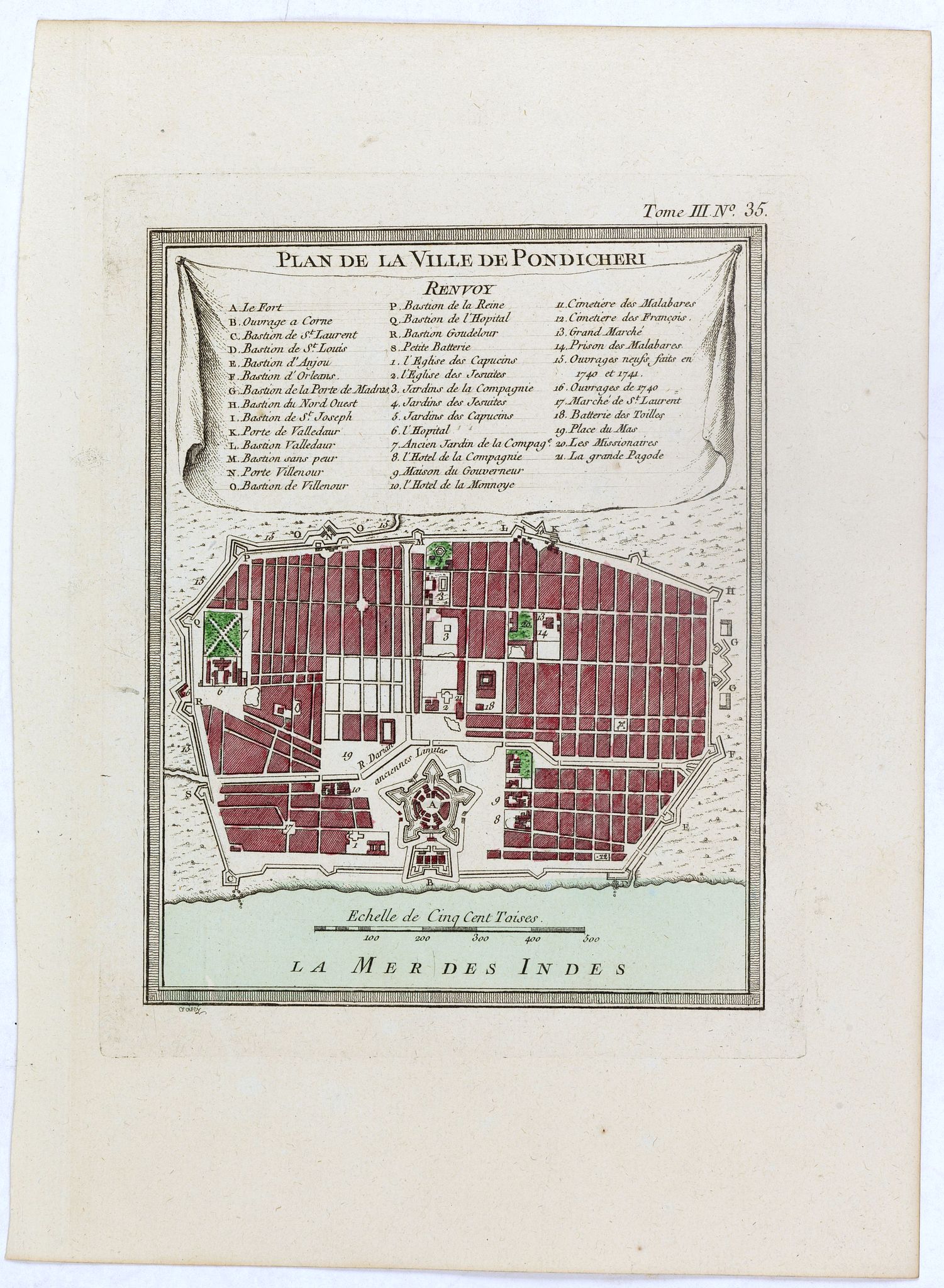
1800 ANDRIVEAU, J. / GOUJON, J. / BRUE - Plan de la ville de Pondicheri.
Plan de la ville de Pondicheri. |
||||||||||||||||||||
|
||||||||||||||||||||
|
|
||||||||||||||||||||
$120 / ≈ €105This item is available for immediate sale! Questions before Buying ?
We are happy to answer your questions. |
My Collection +
Add this or any of your favorite items in one place. If you want to save the items permanently, you have to sign in or create an account first.   Add/Remove
 |
|||||||||||||||||||



Description
The first detailed French plan of Pondicherry. In the lower part, a lettered and numbered key and the coat of arms of Mr. Joseph-François Dupleix.
The Compagnie des Indes, the French equivalent of the British East India Company, was established in Paris with the blessing of King Louis XIV in 1644. Thirty years later, in 1674, its representatives acquired the territory around Putucéri from a local Tamil ruler and set about establishing a French trading post which they renamed Pondicherry.
For four years, between 1693 and 1697, the post was occupied by the Dutch, who endowed it with strong fortifications before handing it back to the French in a peace settlement. Real difficulties began in 1740, however, when Britain and France, at war in Europe, carried their rivalry to the quiet shores of India's Coromandel Coast.
Joseph-François Dupleix, succeeded in repelling the British and extending French influence in South India. France gradually lost the initiative, however, and Lally, Dupleix's successor, was eventually obliged to surrender Pondicherry to the British in January 1761. The settlement was handed back to the French in 1816, and was held by them continuously until 1954, when it was returned to India. In 1962 the former French Indian territories were officially reconstituted as the Union Territory of Pondicherry, with its capital at the historic city of the same name.
For almost three centuries, though, Pondi was under French rule, and this was certainly long enough to impart a distinctive Gallic quality that adds immensely to the city's charm. In 1761, following Lally's surrender, the victorious British razed Pondi to the ground. But beginning in 1816, throughout a long period of uninterrupted peace, the French rebuilt their Indian capital within the confines of an oval boulevard that circles the entire city.
Inside this oval the main roads run along straight, north-south axes, bisected by lesser streets running east-west. The city is thus divided into a series of rectangles and squares, which makes it very easy for visitors to find their way about. The eastern third of the oval is separated from the western two-thirds by a straight, north-south canal.
In colonial times the area to the east, facing onto the Bay of Bengal, was known as Ville Blanche, or "White Town", this was where most French residents lived. By way of contrast, districts to the west of the canal were known as Ville Noire, or "Black Town" - an area inhabited primarily by the indigenous Tamil people.
Such invidious distinctions have long since been swept away, but the former Ville Blanche remains the heart of old Pondi. Here the finest colonial buildings, the cleanest, quietest streets, and the most distinguished compounds are set against an almost Mediterranean seafront.
Even today, forty years after the Tricolor was lowered for the last time, Pondi remains redolent of France, with many streets still retaining their French names. Some recall famous generals - Rue Suffren and Rue Mahé de La Bourdonnais, for example. Others celebrate literary figures, such as Rue Alexandre Dumas, or politicians, like Rue St Martin.
FAQ - Guarantee - Shipping
This item is available for immediate purchase when a "Add to Cart" or "Inquire Now" button is shown.
Items are sold in the EU margin scheme
Payments are accepted in Euros or US Dollars.
Authenticity Guarantee
 We provide professional descriptions, condition report (based on 45 years experience in the map business)
Paulus Swaen warrants the authenticity of our items and a certificate of authenticity is provided for each acquired lot.
Condition and Coloring
We indicate the condition of each item and use our unnique HiBCoR grading system in which four key items determine a map's value: Historical Importance, Beauty, Condition/Coloring and Rarity.
Color Key
We offer many maps in their original black and white condition. We do not systematically color-up maps to make them more sellable to the general public or buyer.
Copper engraved or wood block maps are always hand colored. Maps were initially colored for aesthetic reasons and to improve readability. Nowadays, it is becoming a challenge to find maps in their original colors and are therefor more valuable.
We use the following color keys in our catalog:
Original colors; mean that the colors have been applied around the time the map was issued.
Original o/l colors; means the map has only the borders colored at the time of publication.
Colored; If the colors are applied recently or at the end of the 20th century.
Read more about coloring of maps [+]
Shipping fee
A flat shipping fee of $ 30 is added to each shipment by DHL within Europe and North America. This covers : International Priority shipping, Packing and Insurance (up to the invoice amount).
Shipments to Asia are $ 40 and rest of the world $50
We charge only one shipping fee when you have been successful on multiple items or when you want to combine gallery and auction purchases.
Read more about invoicing and shipping
FAQ
Please have a look for more information about buying in the BuyNow gallery
Many answers are likely to find in the general help section.
My Collection+

With My Collection+ you can collect all your favorite items in one place. It is free, and anyone can create his or her virtual collection.
Unless you are logged in, the item is only saved for this session. You have to be registed and logged-in if you want to save this item permanently to My Collection+. Read More[+]
Register here, it is free and you do not need a credit card.
Add this item to My Collection+ or click the following link to see My Collection+.
|
Digital Image Download Paulus Swaen maintains an archive of most of our high-resolution rare maps, prints, posters and medieval manuscript scans. We make them freely available for download and study. Read more about free image download |
Click the image for a free small image download. |
YOUR RIGHT TO CANCEL THE PURCHASE OF A LOT
In accordance with the EU Consumer Rights Directive and habitually reside in the European Union you have the right to cancel the contract for the purchase of a lot, without giving any reason.
The cancellation period will expire 14 calendar days from the day after the date on which you or a third party (other than the carrier and indicated by you) acquires, physical possession of the lot. To exercise the right to cancel you must inform Paulus Swaen Inc, of your decision to cancel this contract by a clear statement (e.g. a letter sent by post, or e-mail.
To meet the cancellation deadline, it is sufficient for you to send your communication concerning your exercise of the right to cancel before the cancellation period has expired.
