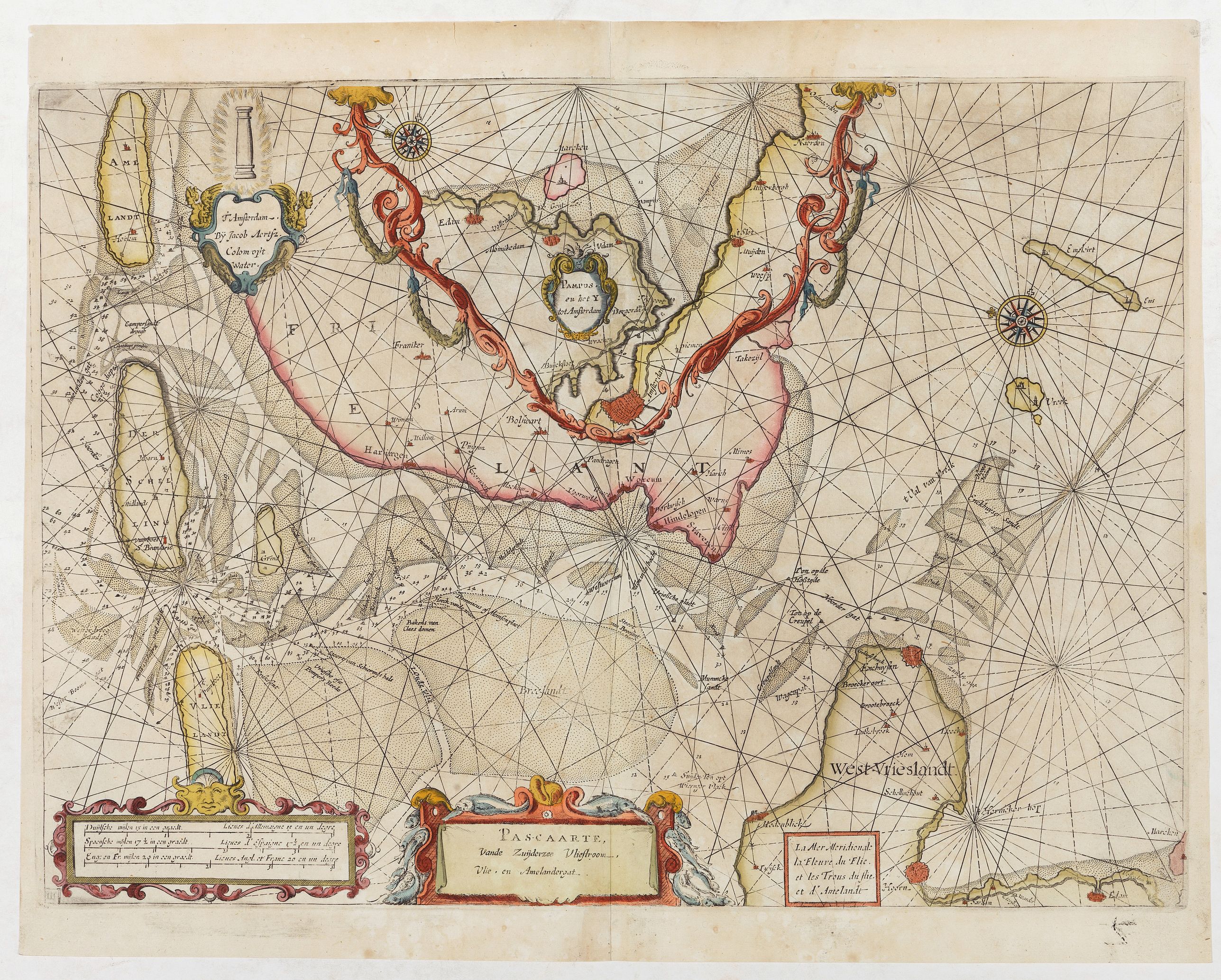
1660 COLOM, A. - Pascaarte, van de Zuijderzee, Vliestroom, Vlie, en Amelandergat…
Pascaarte, van de Zuijderzee, Vliestroom, Vlie, en Amelandergat…
| Maker: | COLOM, A. | |
| Date: | Amsterdam, c. 1660 | |
| Colored: | Colored. | |
| Size: | 370 x 515 mm / 14.6 x 20.3 inches | |
| Condition: | A good and dark impression on plypaper. A few small closed tears in outer blank margins | |
 Add/Remove this item to MyCollection+




Description
Two compass roses indicate north to the left and a large decorative inset with the region of the Pampus and Amsterdam.
After the Dutch V.O.CC ships parted from from the IJ of Amsterdam they arribved in the shallow waters of Pampus, there was a broad channel towards the island of Urk. The former island of Schokland (now poldered in) was an important refuge, providing needed shelter during storms. From there on there were two trajectories towards the North Sea. The eastern route was between Vlieland and Terschelling, the western route was between Den Helder and Texel. It could take days for the ships to reach open North Sea water — the channels were hard to navigate during unfavorable winds.
Pampus (an old word meaning thick mush) was the name given to a soft mud treshold east of Amsterdam and north of Muiden, where the IJ exited into the Zuiderzee. This tidal channel continually silted up with meters deep soft sludge, hindering ships to and from Amsterdam’s harbor. Even at high tide it barely had a depth of 3 m (10 ft). In the 17th century there were no efficient dredging tools available to remedy that situation. Pampus is now the name of an artificial island north of Muiden with a fort on it, constructed between 1887 and 1895 to protect the Pampus channel, part of a defense line called Stelling van Amsterdam.
During the colonial world trade large ships were often unable to pass — due to low tide or unfavorable winds — and needed to wait in queue for weeks and even months. This gave rise to the Dutch expression “voor Pampus liggen” (lie in front of Pampus), meaning to be unable to move, to be knocked out cold. More and more the really big ships were loaded and unloaded at Texel, their wares, guns and crews transported with smaller vessels. This came at a high cost in time, tools, manpower and money. The lighter ships could then — just — pass Pampus at high tide for maintenance at Amsterdam’s wharfs.
Decorative title cartouche completes this lovely and rarely seen sea chart. The vignet of the Colom publishing house to the left.
Reference: Spiegel der Zuiderzee Z8.5, the 5th state of 6; cf. Koeman IV, J. Col 1 [3]
FAQ - Guarantee - Shipping
Buying in the BuyNow Gallery
This item is available for immediate purchase when an "Add to Cart" or "Inquire Now" button is shown.
Items are sold in the EU margin scheme.
Payments are accepted in Euros or US Dollars.
Authenticity Guarantee
 We provide professional descriptions and a condition report (based on 45 years experience in the map business).
Paulus Swaen warrants the authenticity of our items and a certificate of authenticity is provided for each acquired lot.
Condition and Coloring
We indicate the condition of each item and use our unique HiBCoR grading system in which four key items determine a map's value:
Historical Importance, Beauty, Condition/Coloring and Rarity.
We offer many maps in their original black and white condition. We do not systematically color-up maps to make them more sellable to the general public or buyer.
Copper engraved or wood block maps are always hand colored. Maps were initially colored for aesthetic reasons and to improve readability.
Nowadays it is becoming a challenge to find maps in their original colors, and these are therefore more valuable.
We use the following color keys in our catalog:
- Original colors: the colors were applied around the time the map was issued.
- Original o/l colors: only the borders were colored at the time of publication.
- Colored: the colors were applied recently or at the end of the 20th century ("attractive colors" may also be used).
Read more about coloring of maps [+]
Shipping fee
A flat shipping fee of $30 is added to each shipment by DHL within Europe and North America. This covers international priority shipping, packing and insurance (up to the invoice amount).
Shipments to Asia are $40 and rest of the world $50.
We charge only one shipping fee when you have been successful on multiple items or when you want to combine gallery and auction purchases.
Read more about invoicing and shipping
FAQ
Please have a look for more information about buying in the BuyNow gallery.
Many answers are likely to be found in the general help section.
MyCollection+

With MyCollection+ you can collect all your favorite items in one place. It is free, and anyone can create his or her virtual collection.
Unless you are logged in, the item is only saved for this session. You have to be registered and logged in if you want to save this item permanently.
Read more [+]
Register here, it is free and you do not need a credit card.
Add this item to
MyCollection+
or see MyCollection+.
Paulus Swaen maintains an archive of most of our high-resolution rare maps, prints, posters and medieval manuscript scans.
We make them freely available for download and study.
Read more about free image download
Click the image for a free small image download.
YOUR RIGHT TO CANCEL THE PURCHASE OF A LOT
In accordance with the EU Consumer Rights Directive and habitually reside in the European Union you have the right to cancel the contract for the purchase of a lot, without giving any reason.
The cancellation period will expire 14 calendar days from the day after the date on which you or a third party (other than the carrier and indicated by you) acquires, physical possession of the lot. To exercise the right to cancel you must inform Paulus Swaen Inc, of your decision to cancel this contract by a clear statement (e.g. a letter sent by post, or e-mail.
To meet the cancellation deadline, it is sufficient for you to send your communication concerning your exercise of the right to cancel before the cancellation period has expired.
