Subscribe to be notified if similar examples become available.
1690 VAN KEULEN, J. - OOST INDIEN Wassende-Graade Paskaart, vertoonende nevens het Oosterlykste van Afrika, meede de Zeekusten van Asia, van C. de Bona Esperance tot Eso, boven Japan. . .
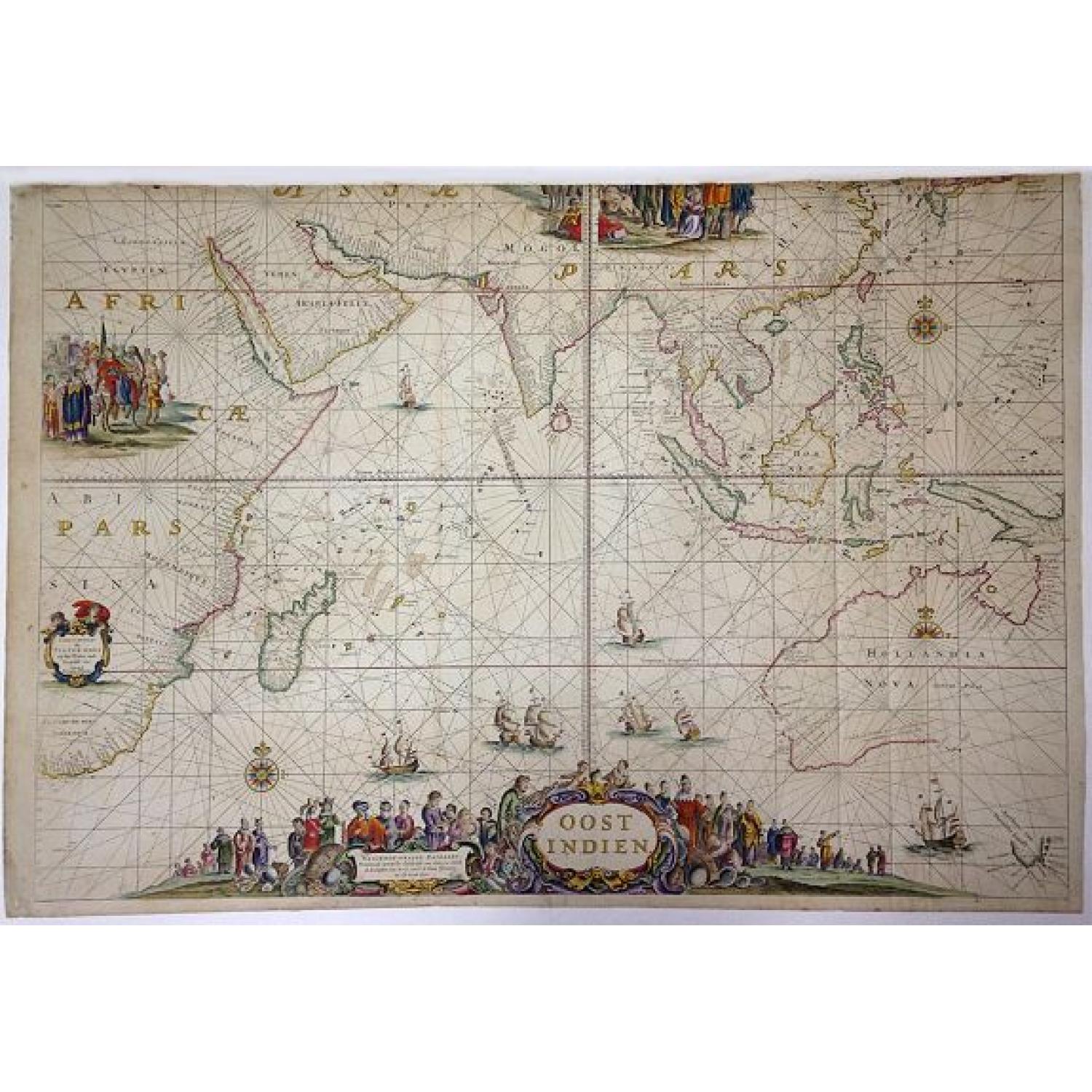
OOST INDIEN Wassende-Graade Paskaart, vertoonende nevens het Oosterlykste van Afrika, meede de Zeekusten van Asia, van C. de Bona Esperance tot Eso, boven Japan. . .
| Maker: | VAN KEULEN, J. | |
| Date: | Amsterdam, ca. 1690 | |
| Colored: | Colored. | |
| Size: | 610 x 805 mm / 24 x 31.7 inches | |
| Condition: | Printed on two sheets of paper, trimmed at the top, as is frequently the case, affecting vignette and part of coast of Japan and Korea ( the island of "Quelpaert" still visible). With new paper added in upper part to create a false margin. Some slight sp | |
 Add/Remove this item to MyCollection+




Description
With address : 't Amsterdam, by Pieter Goos op het Water inde Vergulde Zee-Spiegel. seyn nu te Bekoomen by Johannes van Kuelen.)
Naming all the Dutch discoveries in Australia, from the first landfall in 1616 and culminating in Abel Tasman's extremely important voyage of 1642-1644.
Very rare chart of the territory where the Dutch East India Company V.O.C. was active, from the east of Africa till the western and southern coasts of Australia. These charts were published in the Netherlands for use at sea and the Dutch vessels sailing to and from the Indies were equipped with these charts. Being an important mean for navigation they had to be kept up to date using the latest possible information. Being used on board ship they where due to parish easily and the remaining number of copies is therefor very small.
Engraved sea chart printed on ply-paper.
Interestingly the chart has a misspelling of the name : van Kuelen in stead of van Keulen. This fact is only mentioned by prof. Gunter Schilder in The van Keulen Cartography, Appendix 5, 211, page 186, he however does not mention the additional soundings and text in West Australia.
A most embellished map of the East Indies, showing the coastline of Australia as established by Abel Tasman in 1644.
This chart was first published by Pieter Goos c. 1660. Schilder notes that "this map contains a complete survey of Dutch expansion in the East Indies and takes into account Tasman's two voyages of exploration".
The plates for this and other of Goos's charts passed to Johannes van Keulen, the pre-eminent Dutch maritime publisher of the next generation, who sometimes included these oversize charts in his sea-atlases, which would account for the careless trimming to the upper border.
The map appears very infrequently on the market. A copy of the Goos map on Vellum (which was also trimmed even more than the present example) sold at Sothebys in May 2010 for approximately $350,000 USD (Sale L10401, Lot 67)
This chart is very interesting as it is updated along Australia's West coast. Extensive soundings are added offshore of present-day the coast of Geraldton, Western Australia.
Beside this the following text is added where we find present-day Perth : Duinig land boven Lage Ruigte Gelijk Verdronk Boomen en Boschaghe a text also used by Hessel Gerritsz, but only now inserted.
The update of the soundings was very important as many Dutch ships were shipwrecked at the West Australian coast.
The VOC flagship Batavia (1629), under the command of Commander Francois Pelsaert, was wrecked on the Abrolhos Islands, just 60 kilometers off the coast of Geraldton, Western Australia.
The Ridderschap van Holland (1694) was shipwrecked on the west coast, probably on the Abrolhos Islands. The VOC dispatched a fleet under Willem Vlamingh to search for survivors. There were none found. Could it be that Van Keulen added after this event the soundings to his chart ! ?
An advertisement of sea atlases, pilot books, charts, etc. sold by Joh. van Keulen, printed in the "Zee-Alas" of 1695 is known and mentions "als meede vier groote Paskaarten op Perkement, die voor desen Pieter Goos totsijn gebruyk gehad heeft, te weten OostIndien Wassende graden, ... (See Atlantes Neerlandici, Volume 4, page 278, Y). In fact charts of this format printed on paper are much rarer than those printed on vellum.
The charts printed on paper are sometimes added to "made to order" copies of the "Zee Fakkel".
Interestingly the re-issued Goos/van Keulen charts were used on ships of the British and French East India Company, as late as the 1740.
Johannes Van Keulen
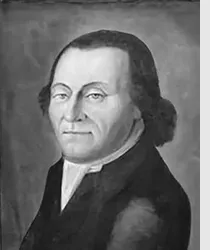 The van Keulen family operated a chart-making and publishing firm in Amsterdam for nearly 200 years. Johannes van Keulen founded it and registered his business as a "bookseller and cross-staff maker." Under his management, he began the Nieuwe Lichtende Zee-Faakel (New Shining Sea Torch) in 1681. It expanded to five volumes, then finally to six, adding material from the secret files of the East India Company.
In 1693, van Keulen acquired Hendrik Doncker's stock. In 1678, Johannes registered with the Amsterdam Booksellers Guild as a "bookseller and Cross-staff maker."
By this time, most Amsterdam chart makers and instrument makers, like Blaeu, Janssonius, Hondius, Goos, and Doncker, had either closed down or were past their prime. As a result, Johannes van Keulen could obtain copperplates, privileges, and stocks from many of his former competitors. Besides manuals and cross-staffs, Johannes produced his famed "ZeeAtlas" (Sea Atlas, 5 volumes), and "ZeeFakkel" (Sea pilot book, 5 volumes). ZeeFakkel was produced in numerous languages, including English, French, Italian, and Spanish. Gerard van Keulen, son of Johannes, born in 1678, took over from his father in 1714 and continued to expand the flourishing firm. Gerard produced hundreds of manuscript charts, now held in several European collections.
In 1726, Johannes van Keulen, Gerard's son, took over the business.
In 1743, Johannes was appointed "Official Chartmaker of the Dutch East Indies Company". The title appears to be nothing more than a formality, however, since the firm had supplied charts to the East Indies Company for many years, and the van Keulen family of Amsterdam had an interest in the East Indies Company. Still, van Keulen Chartmakers held the official title until the East Indies Company was dissolved in 1799. In 1753, Johannes finished his grandfather's work by publishing the sixth volume of "ZeeFakkel". This volume contained the previously kept 'secret' cartography of the East India Archipelago collected and used by the V.O.C. (THE DUTCH EAST INDIA COMPANY).
Jan de Marre, the examiner of the Amsterdam Chamber of the East India Company, provided van Keulen with the data for the ZeeFakkel's sixth volume, and de Marre is also believed to have influenced the van Keulen chart makers' decision to start producing the newly invented Hadley’s Octants in 1744. The company distributed these maps only internally and never sold them. Merchants had to return the maps after each journey to keep trade routes secret. Until van Keulen II printed the Atlas in 1753, the Dutch East India Company used costly, error-prone manuscript versions. Johannes II became the Dutch East India Company's official mapmaker in 1743, a title his family held until the company's dissolution in 1799.
After Johannes van Keulen's death (1770), his widow and their two sons, Cornellis Buys and Gerard Hulst van Keulen, ran the company. By then, they also owned an anchor factory, which they managed separately. In 1778, after brother Cornellis's death, Gerard Hulst van Keulen took leadership of the chart-making firm and added sextants to their inventory for sale. Gerard was one of the three original members of the "Dutch Commission for Longitude at Sea", installed by the Dutch Admiralty in 1787. In 1788, Gerard van Keulen published the first "Dutch Nautical Almanac", an annual publication that continued until 1885. When Gerard Hulst van Keulen died in 1801, his widow ran the firm until her death in 1810, when Johannes Hulst van Keulen became the last van Keulen to run it. In 1823, Jacob Swart entered the van Keulen firm's service, and in 1844, with the death of Johannes Hulst van Keulen, head of the van Keulen Chartmakers, the headship passed to Jacob Swart. When Jacob died in 1866, his son, Jacob Swart, Jr., succeeded him.
Under Jacob Jr’s reign, the firm lost all of its standing in the Nautical world, and the possessions of the firm were sold at auction in 1885, bringing 200 years of "DeGekroonde Lootsman" to an end.
FAQ - Guarantee - Shipping
Buying in the BuyNow Gallery
This item is available for immediate purchase when an "Add to Cart" or "Inquire Now" button is shown.
Items are sold in the EU margin scheme.
Payments are accepted in Euros or US Dollars.
Authenticity Guarantee
 We provide professional descriptions and a condition report (based on 45 years experience in the map business).
Paulus Swaen warrants the authenticity of our items and a certificate of authenticity is provided for each acquired lot.
Condition and Coloring
We indicate the condition of each item and use our unique HiBCoR grading system in which four key items determine a map's value:
Historical Importance, Beauty, Condition/Coloring and Rarity.
We offer many maps in their original black and white condition. We do not systematically color-up maps to make them more sellable to the general public or buyer.
Copper engraved or wood block maps are always hand colored. Maps were initially colored for aesthetic reasons and to improve readability.
Nowadays it is becoming a challenge to find maps in their original colors, and these are therefore more valuable.
We use the following color keys in our catalog:
- Original colors: the colors were applied around the time the map was issued.
- Original o/l colors: only the borders were colored at the time of publication.
- Colored: the colors were applied recently or at the end of the 20th century ("attractive colors" may also be used).
Read more about coloring of maps [+]
Shipping fee
A flat shipping fee of $30 is added to each shipment by DHL within Europe and North America. This covers international priority shipping, packing and insurance (up to the invoice amount).
Shipments to Asia are $40 and rest of the world $50.
We charge only one shipping fee when you have been successful on multiple items or when you want to combine gallery and auction purchases.
Read more about invoicing and shipping
FAQ
Please have a look for more information about buying in the BuyNow gallery.
Many answers are likely to be found in the general help section.
MyCollection+

With MyCollection+ you can collect all your favorite items in one place. It is free, and anyone can create his or her virtual collection.
Unless you are logged in, the item is only saved for this session. You have to be registered and logged in if you want to save this item permanently.
Read more [+]
Register here, it is free and you do not need a credit card.
Add this item to
MyCollection+
or see MyCollection+.
Paulus Swaen maintains an archive of most of our high-resolution rare maps, prints, posters and medieval manuscript scans.
We make them freely available for download and study.
Read more about free image download
Click the image for a free small image download.

YOUR RIGHT TO CANCEL THE PURCHASE OF A LOT
In accordance with the EU Consumer Rights Directive and habitually reside in the European Union you have the right to cancel the contract for the purchase of a lot, without giving any reason.
The cancellation period will expire 14 calendar days from the day after the date on which you or a third party (other than the carrier and indicated by you) acquires, physical possession of the lot. To exercise the right to cancel you must inform Paulus Swaen Inc, of your decision to cancel this contract by a clear statement (e.g. a letter sent by post, or e-mail.
To meet the cancellation deadline, it is sufficient for you to send your communication concerning your exercise of the right to cancel before the cancellation period has expired.
