Subscribe to be notified if similar examples become available.
1575 BRAUN, G. / HOGENBERG, F. - Nurnberg - Norenberga, Urbs nobilissima . . . [Nuremberg]
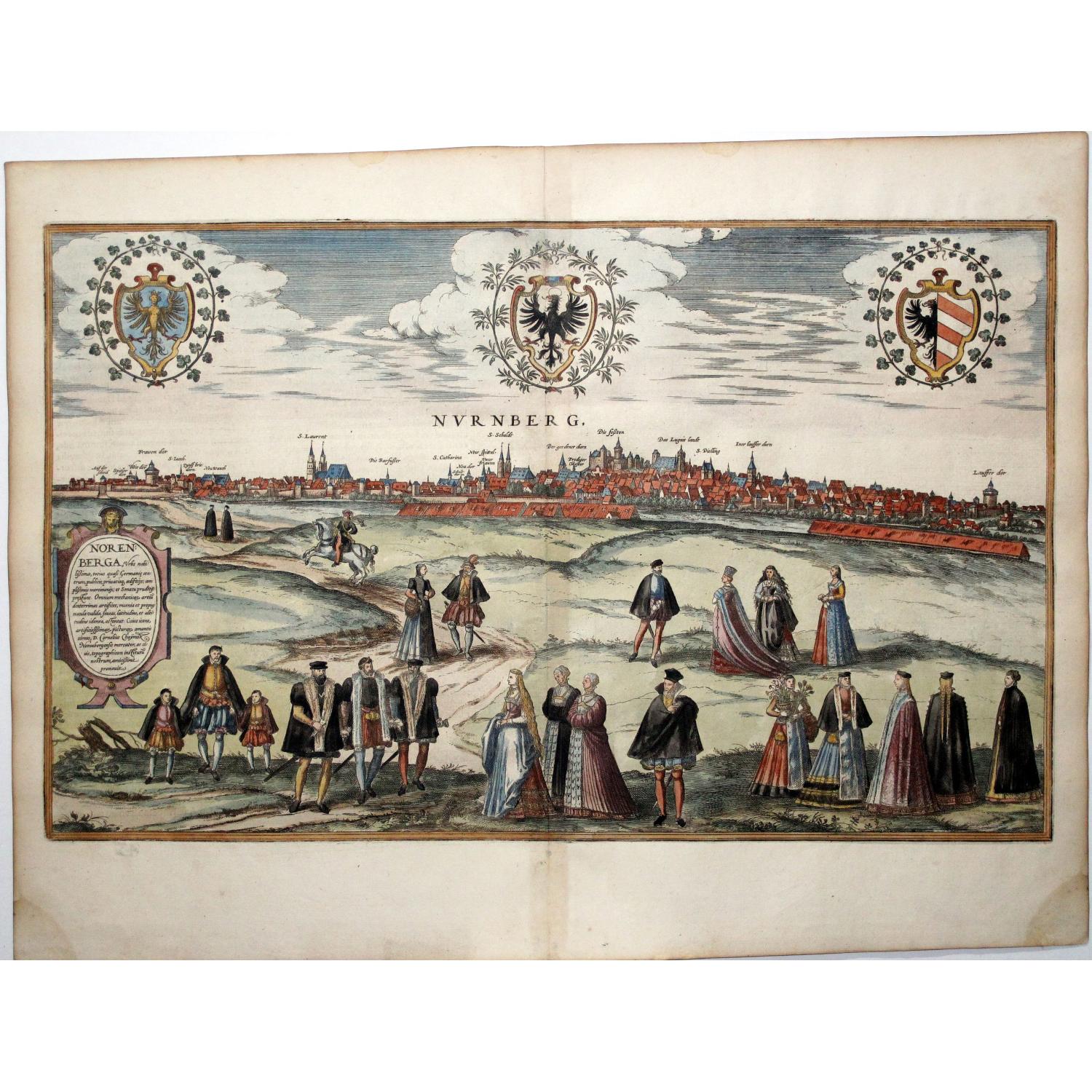
Nurnberg - Norenberga, Urbs nobilissima . . . [Nuremberg]
| Maker: | BRAUN, G. / HOGENBERG, F. | |
| Date: | Cologne, 1575 | |
| Colored: | Colored. | |
| Size: | 308 x 492 mm / 12.1 x 19.4 inches | |
| Condition: | Paper slightly browned. Some foxing and a stain. Excellent restoration across centerfold. Latin text on verso. | |
Selling price: $ Please login to see price!
Sold in 2020
Missed this item !
Add your name to our mailing list and be the first to get notified about our newly added listings.
.
You can choose from more than 30,000 items from our BuyNow Catalog or Archive.
It's free, and you can delete items anytime.
 Add/Remove this item to MyCollection+




Description
A panoramic view of Nuremberg by Braun and Hogenberg. TRANSLATION OF CARTOUCHE TEXT: The well-known city of Nuremberg is effectively the centre of all Germany and is distinguished by public and private buildings, very rich merchants and a wise council; it has skilled master craftsmen of all kinds, is fortified by strong city walls, castles and moats of sufficient width and depth.
The lover of the fine arts D. Cornelius Chaymox, a Nuremberg merchant, has very kindly supported our topographical project with this plate.
COMMENTARY BY BRAUN (on the verso): "The Altmühl flows through Eichstätt towards Kehlheim into the Danube, the Pegnitz flows in the north towards Schwabach and joins the Main at Bamberg. The Emperor Charles therefore began construction work, ordering many thousand men to take part, and had a channel dug between these two rivers, which was over 2,000 paces long and 300 feet wide, but the work was in vain, for it rained very much at the time and the ground at that place was marshy, so that the work was not completed."
In neither view of Nuremberg does the castle above the city dominate the city, for the hills have been flattened out, especially in this view. Yet one can clearly make out the well-fortified city wall, the mighty castle and the main churches of SS Lawrence and Sebald, as landmarks of the two original parts of the city. The imposing city towers, the Arsenal, the Salt House and the monastery of St Giles are visually emphasized.
The present plate is dominated by the figures of patricians in local dress. The two elegantly dressed children to the right of the cartouche are striking, for there are no comparable cases of children as staffage figures. In the 16th century, although Nuremberg had no university, the city was a centre of book printing (Anton Koberger), of art (Michael Wolgemut, Albrecht Dürer, Adam Krafft, Veit Stoss), of literature (Hans Sachs), of geography (Martin Behaim), of educated patrician families (including Pirckheimer, Löffelholz) and of trade. In addition to Augsburg, Nuremberg was the most influential trade city in central Europe.
Reference: Van der Krogt 4 - #3127, Fauser - #10035, Taschen, Br. Hog. - p.174
Civitates Orbis Terrarum
The Civitates Orbis Terrarum (Atlas of Cities of the World) was the second-oldest printed atlas in world cartography and the first atlas of towns. Its principal creators and authors were the theologian and editor Georg Braun, the most important engraver and publisher Frans Hogenberg, the engraver Simon van den Neuvel, the artist and draftsman Georg (Joris) Hoefnagel, the topographer Jacob van Deventer and others. Although published outside the Netherlands, the Civitates is nevertheless one of the best examples of the Antwerp school of cartography.Key figures in the school included Abraham Ortelius, Gerardus Mercator, and several other geographers. The Civitates reflects the Flemish engraving style typical of Dutch atlases of the period. In addition, correspondence among Braun, Hogenberg, and Ortelius clearly indicates that they conceived the atlas in Antwerp.
The atlas contains more than 500 maps and represents an entire era in the history of town mapping. The atlas was published in six volumes between 1572 and 1617. To obtain the originals for his work, Braun corresponded extensively with map sellers and scholars in different cities and countries. The authors also conducted their own investigations.
However, these were not true geodetic surveys, but detailed on-location drawings of panoramic views of the towns made from some high point. Georg Hoefnagel made most of the engravings that decorate the Civitates, from its first volume to its last, from such drawings. Hoefnagel drew images of many towns in France, Italy, England, and Spain.
He and his son Jacob subsequently created representations of Austrian and Hungarian towns for the Civitates. In addition to these overview plans, the atlas includes more detailed maps based on topographic surveys, particularly those of Jacob van Deventer (15??-1575). Accordingly, the maps show the systematic structure of the towns' layout, with perspective representations of various quarters and individual buildings.
The town usually appears in the background, while the foreground shows the surrounding countryside and detailed depictions of typical town inhabitants.
These visual representations of people not only augmented the maps' content but also served another purpose. Braun and Hogenberg illustrated the Civitates pages with figures of local inhabitants to prevent Turks from using the maps for military purposes, since Islam forbids images of humans.
Of the total number of towns, only a couple of dozen lie outside Europe, in Asia, Africa, and South America. This shows extremely limited cartographic knowledge of the world, due to the insufficient development of science and mapmaking practices in the second half of the sixth century. At the same time, one cannot help but be astonished by the huge quantity of material included in the atlas by the standards of the time.
Braun and Hogenberg's Civitates was an enormous success. It was republished many times and supplemented with new sections. Its maps became exemplary; other publishers frequently reproduced them in smaller formats as illustrations for books and maps.
After Franz Hogenberg's death, Abraham Hogenberg kept the atlas's typographic plates in Cologne. When Abraham died in 1653, his heirs evidently sold them to Johannes Janssonius, an active and skilled publisher of books and atlases in Amsterdam. In 1657, Janssonius issued the atlas in eight volumes in a completely revised edition, with illustrations arranged by country. A large number of quite new engravings were added to it, while outdated prints were omitted. After Janssonius's death in 1664, his grandson Johannes Janssonius van Waesberge acquired the engravings and used some to compile his own atlas, which appeared in 1682. In 1694, the energetic Amsterdam publisher Frederick de Wit purchased van Waesberge's copper plates and equipment at auction; he was well known for his numerous maps and atlases. De Wit organized a new edition, enriched with new engravings.
After de Wit's time, at the turn of the eighteenth century, the copper plates for the atlas passed to the publisher Pieter van der Aa (1659 - 1733). He acquired them in Leyden and used them for an atlas published in 1729. This publication included a diverse mixture of engravings from the sixteenth to eighteenth centuries.
After van der Aa, the publishing house of Covens and Mortier acquired town maps bearing the publisher's imprint of de Wit. Over the centuries, various publishers reproduced these 16th-century perspective views and maps because of their rich historical and geographical content. At the same time, no atlas of the world's cities in the history of global cartography matches the Civitates Orbis Terrarum in size and fullness.
Beyond its historical, geographical, and cartographic significance, the Civitates is also highly artistic. That is why, to this day, the atlas's town maps have adorned the most exquisite interiors and attracted not only specialists in the field but also admirers of fine art.
FAQ - Guarantee - Shipping
This item is available for immediate purchase when a "Add to Cart" or "Inquire Now" button is shown.
Items are sold in the EU margin scheme
Payments are accepted in Euros or US Dollars.
Authenticity Guarantee
 We provide professional descriptions, condition report (based on 45 years experience in the map business)
Paulus Swaen warrants the authenticity of our items and a certificate of authenticity is provided for each acquired lot.
Condition and Coloring
We indicate the condition of each item and use our unique HiBCoR grading system in which four key items determine a map's value: Historical Importance, Beauty, Condition/Coloring and Rarity.
Color Key
We offer many maps in their original black and white condition. We do not systematically color-up maps to make them more sellable to the general public or buyer.
Copper engraved or wood block maps are always hand colored. Maps were initially colored for aesthetic reasons and to improve readability. Nowadays, it is becoming a challenge to find maps in their original colors and are therefor more valuable.
We use the following color keys in our catalog:
Original colors; mean that the colors have been applied around the time the map was issued.
Original o/l colors; means the map has only the borders colored at the time of publication.
Colored; If the colors are applied recently or at the end of the 20th century.
Read more about coloring of maps [+]
Shipping fee
A flat shipping fee of $ 30 is added to each shipment by DHL within Europe and North America. This covers : International Priority shipping, Packing and Insurance (up to the invoice amount).
Shipments to Asia are $ 40 and rest of the world $50
We charge only one shipping fee when you have been successful on multiple items or when you want to combine gallery and auction purchases.
Read more about invoicing and shipping
FAQ
Please have a look for more information about buying in the BuyNow gallery
Many answers are likely to find in the general help section.
MyCollection+

With My Collection+ you can collect all your favorite items in one place. It is free, and anyone can create his or her virtual collection.
Unless you are logged in, the item is only saved for this session. You have to be registered and logged-in if you want to save this item permanently to My Collection+. Read More[+]
Register here, it is free and you do not need a credit card.
Add this item to My Collection+ or click the following link to see My Collection+.
|
Digital Image Download Paulus Swaen maintains an archive of most of our high-resolution rare maps, prints, posters and medieval manuscript scans. We make them freely available for download and study. Read more about free image download |
Click the image for a free small image download. |

YOUR RIGHT TO CANCEL THE PURCHASE OF A LOT
In accordance with the EU Consumer Rights Directive and habitually reside in the European Union you have the right to cancel the contract for the purchase of a lot, without giving any reason.
The cancellation period will expire 14 calendar days from the day after the date on which you or a third party (other than the carrier and indicated by you) acquires, physical possession of the lot. To exercise the right to cancel you must inform Paulus Swaen Inc, of your decision to cancel this contract by a clear statement (e.g. a letter sent by post, or e-mail.
To meet the cancellation deadline, it is sufficient for you to send your communication concerning your exercise of the right to cancel before the cancellation period has expired.
