1834 DAUMIER, H. - Les désabonnemens et la caricature font le cauchemar du pauvre constitutionnel.
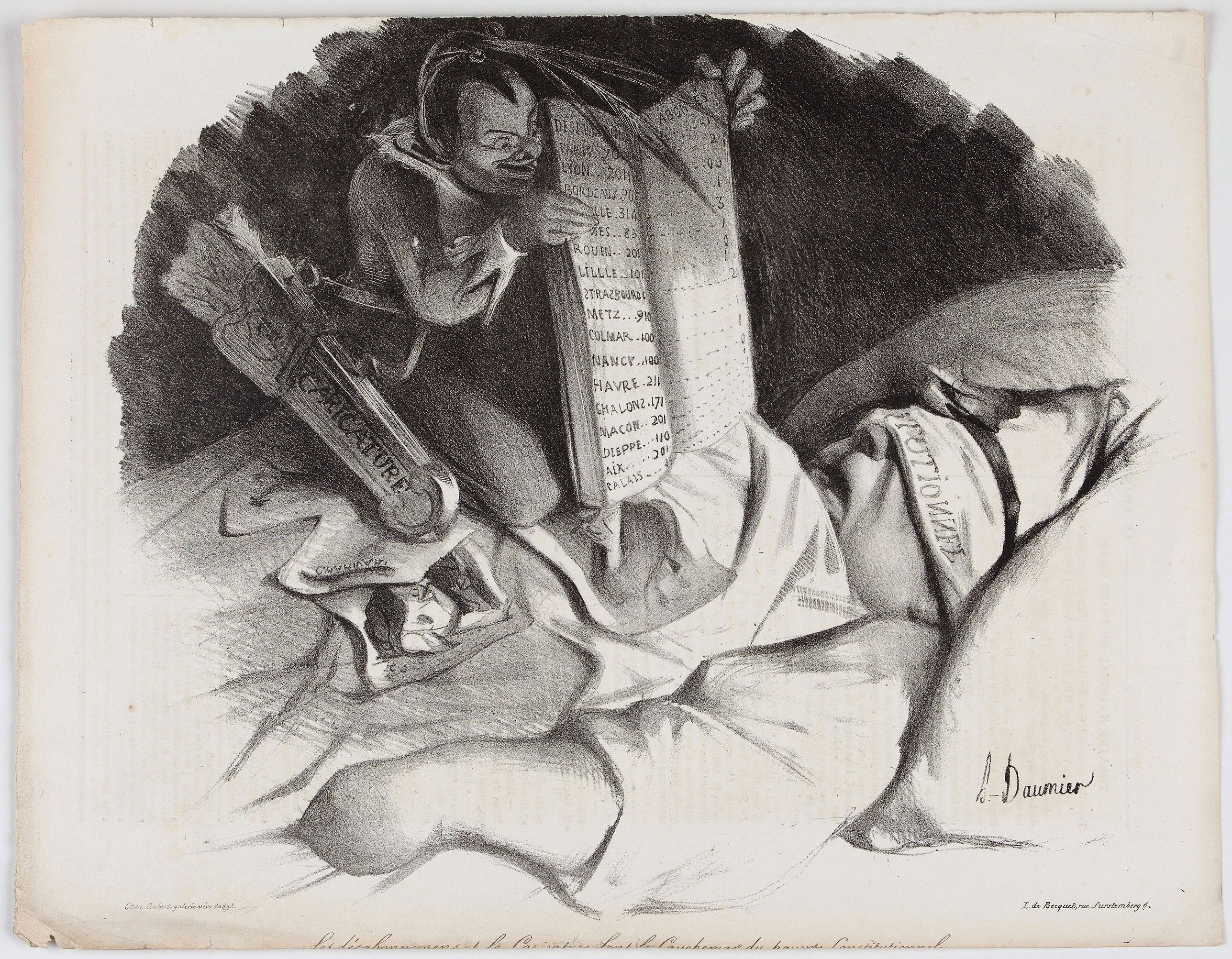
Les désabonnemens et la caricature font le cauchemar du pauvre constitutionnel.
| Maker: | DAUMIER, H. | |
| Date: | Paris, Le Charivari, January 26, 1834 | |
| Colored: | Uncolored. | |
| Size: | 240 x 305 mm / 9.4 x 12 inches | |
| Condition: | Lithography with text on the verso. Upper part and title cut on lower margin cut. Else in good condition. | |




Description
Title in lower margin cut "Les désabonnemens et la caricature font le cauchemar du pauvre constitutionnel". [Cancelled subscriptions and La Caricature gives the poor Constitutionnel a nightmare.] from Le Charivari.
The print shows "La Caricature" as a joker holding a book that contains a list of cancelled subscriptions. The book lies heavily on the chest of the man with the nightcap labelled "Constitutionnel" (Etienne). The clown is a figure from Victor Hugo's "Le Roi s'amuse".
Honoré Victorin Daumier, born February 26, 1808 in Marseille and died February 10, 1879 in Valmondois, is a French engraver, caricaturist, painter and sculptor, whose works commented on social and political life in France in the 19th century.
The great caricaturist of late nineteenth century Paris, Honoré Daumier, lived through turbulent times. His productive life started at the same time that Louis Philippe I became king of France in 1830 after the overthrow of Charles X. Among Louis Philippe’s liberal policies was a relaxation of censorship of the press. This allowed Daumier the unprecedented opportunity to directly caricature the king. In Europe, only English caricaturists enjoyed similar freedom.
Daumier’s gleeful caricatures frequently portrayed the king as a pear, and often as corrupt, and by 1835, the king had reinstituted censorship of images, so Daumier could no longer caricature the king. Many of his prints are of the foibles of Parisians, fads of the bourgeoisie, lawyers, and feminists were all regular targets. They are not personal caricature, but pokes at types of his fellow Parisians.
Daumier also created a cast of recurring characters including Robert Macaire, an unrepentant confidence artist always running a new, outrageously fraudulent company. Political events slipped in as well, when the streets of Paris crumbled as the result of poorly made asphalt, Macaire was shown as a corner-cutting contractor.
When Daumier wanted to criticize conservative politics, he frequently portrayed the editor of a conservative newspaper—not a government official, but a well-known apologist for conservative causes.
Eventually, politicians (especially conservative politicians) re-appeared in his satires. Even Louis Phillipe made a final appearance after his abdication, fleeing Paris with chests of money. When Napoleon III took the throne, Daumier found a new way to criticize the government without satirizing the king, he invented Ratapoil.
Ratapoil was the political henchman of the new king: a vehement, paid supporter always shown with a cudgel, his preferred tool for political debate.
Reference: DR Number 188.
Honoré Daumier (1808-1879)
Honoré Daumier was born in Marseille and died in Valmondois and his most active years were 1830 - 1879. Known as the "Michelango of Caricature", Honoré Daumier was a prolific painter, printmaker, sculptor, and caricaturist.He produced over 400 lithographs in his lifetime, known for their satires of political figures and bourgeois behavior in society. As a boy, he showed an inclination towards art, which his father tried to discourage, and so he put him to work as an usher. But, Daumier’s talents could not be dissuaded, and he later works at a bookseller, eventually landing in the employ of Alexandre Lenoir, an artist and archaeologist, and becoming his protégé.
It was here that he began making his first attempts at lithography and began a career producing plates for music producers and advertisement illustrations.
Through Daumier's drawings and Philipon's texts, the public learned of Macaire's wrongdoings without names ever being mentioned.
The plate was published in Caricaturana, which appeared between August 1836 and November 1838, and various books were published in 1839 by Aubert, using mirror images, reduced and redrawn versions of the originals after Daumier and copied by Menut-Alophe.
After the July Revolution and the reinstatement of the Freedom of the Press, CHARLES PHILIPON (1800-1862) recognized the growing desire of the public for information. In 1830, he founded the political satirical illustrated paper LA CARICATURE.
PHILIPON's brother-in-law GABRIEL AUBERT was responsible for the distribution and sale of the publication.
LA CARICATURE can be considered the first political and satirical French newspaper of that period, combining politics and contemporary art. In total, there appeared 251 editions of LA CARICATURE from Nov.4, 1830 to Aug.27, 1835 featuring 524 caricatures of various artists, of which 91 by Daumier. Each edition ranged from 750 to 2,000 copies.
2008 marked the 200th anniversary of Honoré Daumier's birth.
FAQ - Guarantee - Shipping
This item is available for immediate purchase when a "Add to Cart" or "Inquire Now" button is shown.
Payments are accepted in Euros or US Dollars. We accept most major credit cards, PayPal and bank transfer.
Authenticity Guarantee
 We provide professional descriptions, condition report and HiBCoR rating (based on 45 years experience in the map business)
We fully guarantee the authenticity of items we sell. We provide a certificate of authenticity for each purchased item.
Condition / Coloring
We indicate the condition of each item and use our unnique HiBCoR grading system in which four key items determine a map's value: Historical Importance, Beauty, Condition/Coloring and Rarity.
We offer many maps in their original black and white condition. We do not systematically color-up maps to make them more sellable to the general public or buyer.
Copper engraved or wood block maps are always hand colored. Maps were initially colored for aesthetic reasons and to improve readability. Nowadays, it is becoming a challenge to find maps in their original colors and are therefor more valuable.
We use the following color keys in our catalog:
Original colors; mean that the colors have been applied around the time the map was issued.
Colored; If the colors are applied recently or at the end of the 20th century, then "colored", or "attractive colors" will be used.
Original o/l colors; means the map has only the borders colored at the time of publication.
Read more about coloring of maps [+]
FAQ
Please have a look for more information about buying in the BuyNow gallery.
Many answers are likely to find in the general help section.
MyCollection+

With MyCollection+ you can collect all your favorite items in one place. It is free, and anyone can create his or her virtual map collection.
Unless you are logged in, the item is only saved for this session. You have to be registed and logged-in if you want to save this item permanently to MyCollection+. Read More [+]
If you want to save the items permanently, please sign in
or create account first.

Registering Here, it is and you do not need a credit card.
Add this item to MyCollection+ or click the following link to see MyCollection+.
Invoice
The invoice and certificates of authenticity are available in the client center >Invoices
|
Digital Image Download Paulus Swaen maintains an archive of most of our high-resolution rare maps, prints, posters and medieval manuscript scans. We make them freely available for download and study. Read more about free image download |
Click the image for a free small image download. |
YOUR RIGHT TO CANCEL THE PURCHASE OF A LOT
In accordance with the EU Consumer Rights Directive and habitually reside in the European Union you have the right to cancel the contract for the purchase of a lot, without giving any reason.
The cancellation period will expire 14 calendar days from the day after the date on which you or a third party (other than the carrier and indicated by you) acquires, physical possession of the lot. To exercise the right to cancel you must inform Paulus Swaen Inc, of your decision to cancel this contract by a clear statement (e.g. a letter sent by post, or e-mail.
To meet the cancellation deadline, it is sufficient for you to send your communication concerning your exercise of the right to cancel before the cancellation period has expired.
