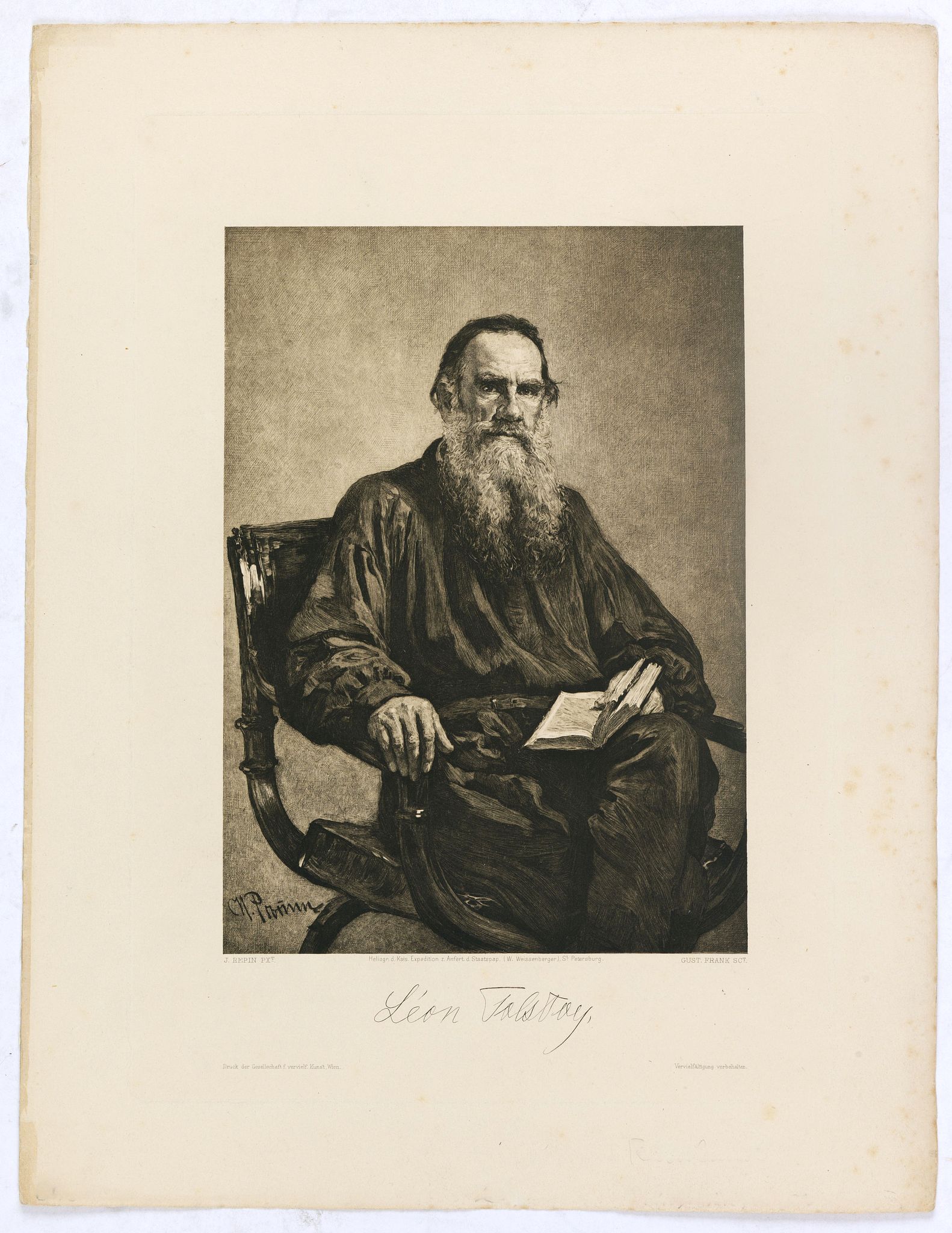
1900 FRANK, G. - Léon Tolstoy.
Léon Tolstoy.
| Maker: | FRANK, G. | |
| Date: | Vienna, 1900 | |
| Colored: | Uncolored. | |
| Size: | 290 x 177 mm / 11.4 x 7 inches | |
| Condition: | Etching in good condition. Wide margins. | |
 Add/Remove this item to MyCollection+



Description
In 1890 he went to St Petersburg, here he first worked as a teacher in tsarist artistic authority. In 1896 he became a member of the editorial committee of art in St Petersburg, where the made pictorial publications of the Moscow tsar coronation.
Frank lived in St Petersburg between 1890 and 1911, having accepted an invitation from the State Papers Office in St Petersburg to help improve the artistic quality of its work. Frank made portraits in crayon of the Emperors Alexander III and Nicolas II, and etchings of Leo Tolstoy and Eleonora Duse, and in 1899 became a member of the Royal Academy of Arts.
Ilya Repin was a talented Russian painter of the Peredvizhniki School, who was held up by the Soviet government as an artist to be imitated by the new school of Socialist Realists. At the age of 22, Repin began his art career at the Imperial Academy of Arts in St. Petersburg, the same time as the “Rebellion of the Fourteen,” when 14 young artists left the school after refusing to paint mythological paintings for their diplomas.
These artists would later form the Society of the Peredvizhniki, which Repin joined in 1878. Repin and the free thinking “itinerants,” as they were also called, rebelled against the formal academy, insisting that art should reflect real life.
As an art student, his travels took him to Italy, Paris and Impressionist Exhibitions, and although he was exposed to the vivid colors and quick brush strokes of the impressionist style, he remained true to his unique form of realism. Many of the subjects Repin painted were common people, like himself, although he did on many occasions paint the Russian elite, intelligentsia, and Tsar Nicholas II.
He also painted many of his contemporary compatriots, including novelist Leo Tolstoy, composer Modest Mussorgsky, scientist Dmitri Mendeleev, and Ukranian painter Taras Schevchenko. A common recurring theme in his paintings was the Russian Revolutionary Movement, and as a result his works are often classified as a “Russian national style.” In his later life, he lived in a house in Kuokkala, Finland, called the Penates, which he designed and built himself. After the October Revolution of 1917, Finland declared Independence, and Repin was invited to return to the Soviet Union. He refused, saying that he was too old to make the journey, and remained in Finland until his death thirteen years later.
In 1940, the Penates house was opened to the public as a museum.
FAQ - Guarantee - Shipping
Buying in the BuyNow Gallery
This item is available for immediate purchase when an "Add to Cart" or "Inquire Now" button is shown.
Payments are accepted in Euros or US Dollars. We accept most major credit cards, PayPal and bank transfer.
Authenticity Guarantee
 We provide professional descriptions, condition report and HiBCoR rating (based on 45 years experience in the map business).
We fully guarantee the authenticity of items we sell. We provide a certificate of authenticity for each purchased item.
Condition and Coloring
We indicate the condition of each item and use our unique HiBCoR grading system in which four key items determine a map's value:
Historical Importance, Beauty, Condition/Coloring and Rarity.
We offer many maps in their original black and white condition. We do not systematically color-up maps to make them more sellable to the general public or buyer.
Copper engraved or wood block maps are always hand colored. Maps were initially colored for aesthetic reasons and to improve readability.
Nowadays it is becoming a challenge to find maps in their original colors, and these are therefore more valuable.
We use the following color keys in our catalog:
- Original colors: the colors were applied around the time the map was issued.
- Original o/l colors: only the borders were colored at the time of publication.
- Colored: the colors were applied recently or at the end of the 20th century ("attractive colors" may also be used).
Read more about coloring of maps [+]
FAQ
Please have a look for more information about buying in the BuyNow gallery.
Many answers are likely to be found in the general help section.
MyCollection+

With MyCollection+ you can collect all your favorite items in one place. It is free, and anyone can create his or her virtual collection.
Unless you are logged in, the item is only saved for this session. You have to be registered and logged in if you want to save this item permanently.
Read more [+]
To save permanently, please
sign in or
create an account first.
Register here, it is free and you do not need a credit card.
Add this item to
MyCollection+
or see MyCollection+.
Invoice
Invoices and certificates of authenticity are available in the
client center > Invoices.
Paulus Swaen maintains an archive of most of our high-resolution rare maps, prints, posters and medieval manuscript scans.
We make them freely available for download and study.
Read more about free image download
Click the image for a free small image download.
YOUR RIGHT TO CANCEL THE PURCHASE OF A LOT
In accordance with the EU Consumer Rights Directive and habitually reside in the European Union you have the right to cancel the contract for the purchase of a lot, without giving any reason.
The cancellation period will expire 14 calendar days from the day after the date on which you or a third party (other than the carrier and indicated by you) acquires, physical possession of the lot. To exercise the right to cancel you must inform Paulus Swaen Inc, of your decision to cancel this contract by a clear statement (e.g. a letter sent by post, or e-mail.
To meet the cancellation deadline, it is sufficient for you to send your communication concerning your exercise of the right to cancel before the cancellation period has expired.
