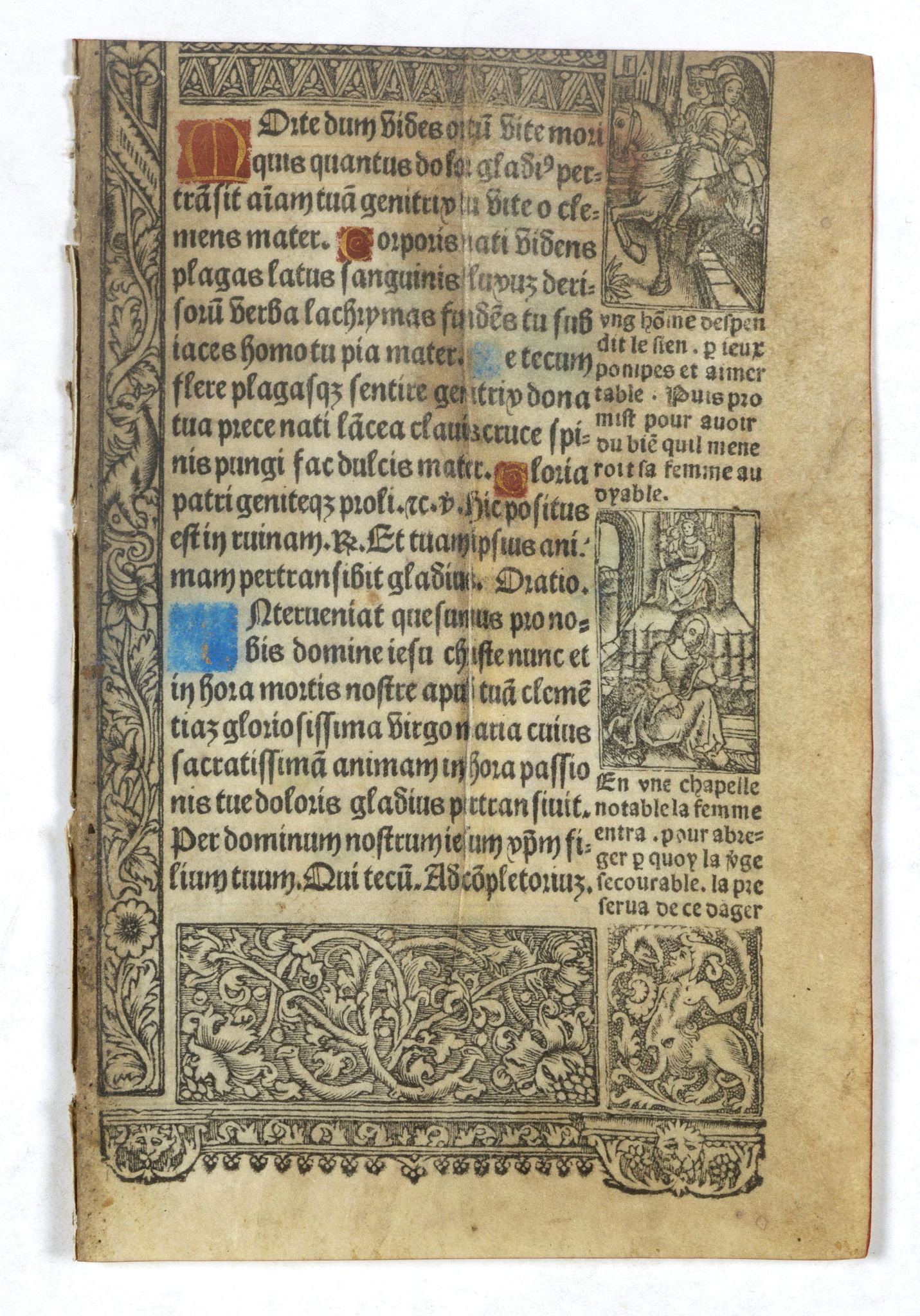
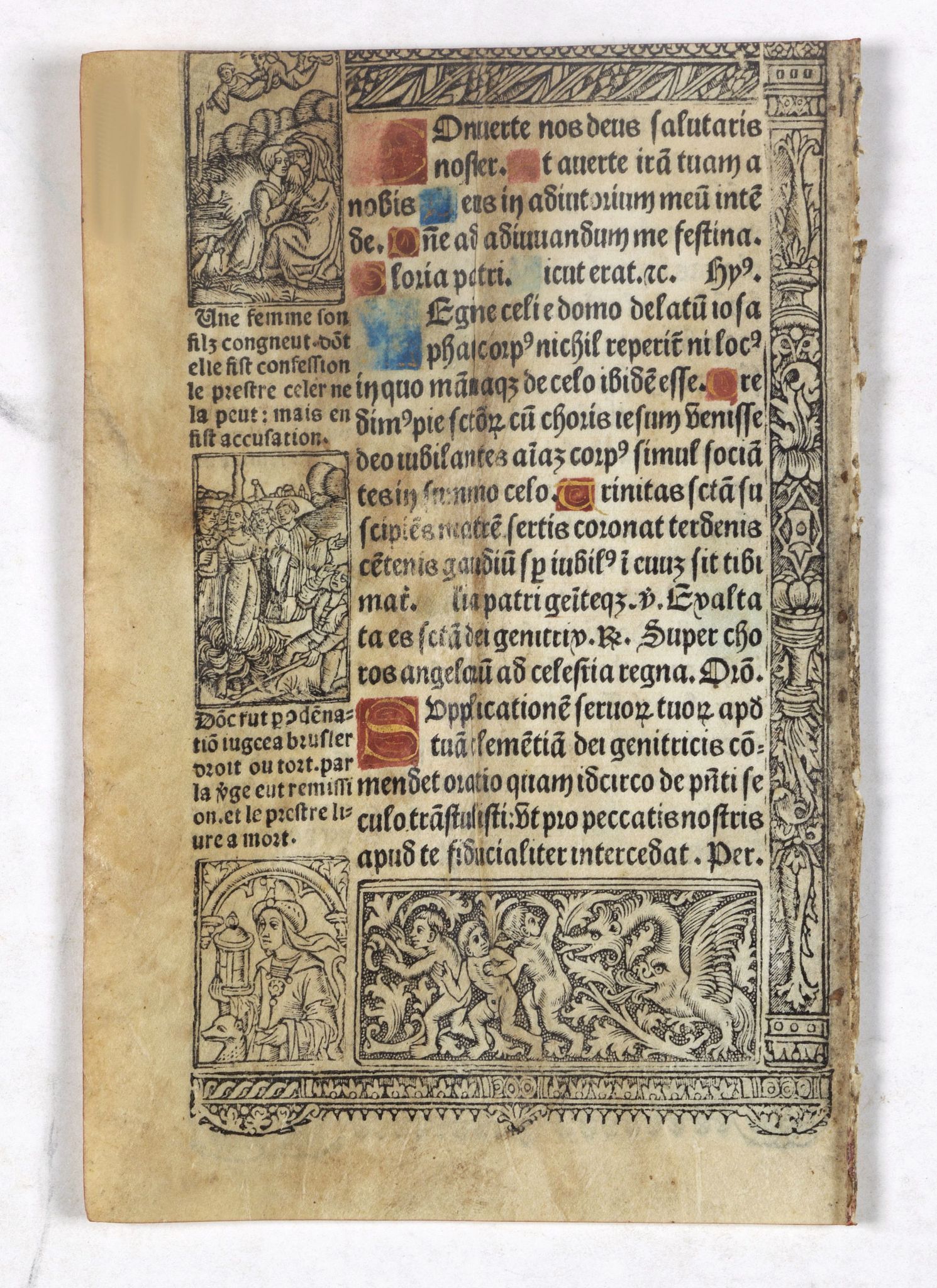
1540 BOOK OF HOURS - Leaf on vellum from a printed Book of Hours.
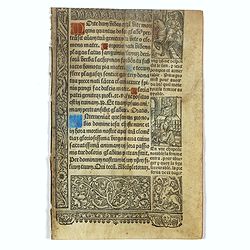
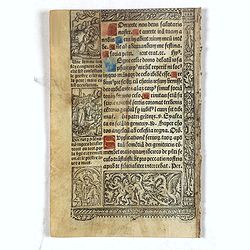
Leaf on vellum from a printed Book of Hours. |
||||||||||||||||||||
|
||||||||||||||||||||
|
|
||||||||||||||||||||
$100 / ≈ €89This item is available for immediate sale! Questions before Buying ?
We are happy to answer your questions. |
My Collection +
Add this or any of your favorite items in one place. If you want to save the items permanently, you have to sign in or create an account first.   Add/Remove
 |
|||||||||||||||||||



Description
21 lines of printed text, surrounded by Renaissance borders decorated with flowers and little miniatures with figures on both sides.
From the press of the leading Parisian publisher and illuminator Germain Hardouyn, active from c.1500/1505 to 1539/1541.
Between the end of the fifteenth century and the early sixteenth century, Paris was the principal center of production and trade for printed Books of Hours, which followed the manuscript examples from a textual point of view.
Germain Hardouyn, together with his brother Gilles, printed almost exclusively Books of Hours, producing at least two or three editions per year.
He produced handsome presentation copies of the Heures for special clients, printed on vellum and decorated with illuminations, like the copy offered here. It closely resembles an illuminated manuscript: it is printed on vellum in Gothic type, with colophon but no title page, illustrated with illuminated woodcuts and decorated with numerous hand-painted initials and line endings.
Hardouyn continued to produce illuminated copies of Hours even after other Parisian publishers had abandoned this production.
Medieval manuscripts
The medieval Book of Hours evolved from the monastic cycle of prayer, which divided the day into eight segments, or "hours." Those of: Matins, Lauds, Prime, Terce, Sext, Nones, Compline, and Vespers. By the early fifteenth century, the Book of Hours had developed to meet the demands of private, rather than communal, devotion. These portable books are smaller than their monastic forebears, designed for individual use, with a liturgical system somewhat less complicated than monastic liturgy and more "user-friendly." A Book of Hours invariably begins with a liturgical calendar, listing feast days in chronological order along with a complicated method of calculating the date of Easter.The seven Penitential Psalms are usually included as well, and additional prayers (devoted to particular saints or personal issues) according to the desires and needs of the owner.
Books of Hours preserve some of the finest works of medieval art. Each section of the manuscript traditionally begins with an illuminated miniature that complements the prayers and stimulates contemplation and meditation in the reader. Because they were expensive and spectacular works of art, the ownership of these manuscripts was limited mainly to royalty, nobility and the very wealthy. They are often adorned with coats of arms, and portraits of patrons may sometimes appear in the miniatures. As their popularity increased, an efficient system of book production and trade developed to match the demand for Books of Hours. Professional scribes produced the texts in one location, artists painted the miniatures in their workshops, and the two were brought together in the bookbinder's hall. Patrons could choose the texts and miniatures they wanted, or buy complete, generic manuscripts in stationers' bookshops. A thriving economy developed around the production of Books of Hours, especially in centers such as Paris, Bruges and Utrecht.
What is an illuminated manuscript?
An illuminated manuscript is a book written and decorated by hand. Its name is derived from the Latin manus, meaning hand and "scriptus" meaning writing. Manuscripts decorated with gold, silver, or bright paint are called illuminated, from the Latin "illuminare," meaning to lighten or brighten.
A large number of manuscripts are covered with painted ornaments which may be presented under several forms:
* initials of chapters or paragraphs, ornamented sometimes very simply, sometimes on the other hand with a great profusion of interlacings, foliage, and flowers; these are developed along the the whole length of the page and within are sometimes depicted persons or scenes from everyday life;
* paintings on the margin, in which some scene is carried over several pages;
* borders around the text (interlacing colonnades, etc.), the most remarkable example is that of the evangelistic canons of the Middle Ages;
* full-page paintings (or such as cover only a part of the page), but forming real pictures, similar to frescoes or easel pictures; these are chiefly found on very ancient or very recent manuscripts (fourteenth and fifteenth centuries).
FAQ - Guarantee - Shipping
This item is available for immediate purchase when a "Add to Cart" or "Inquire Now" button is shown.
Items are sold in the EU margin scheme
Payments are accepted in Euros or US Dollars.
Authenticity Guarantee
 We provide professional descriptions, condition report (based on 45 years experience in the map business)
Paulus Swaen warrants the authenticity of our items and a certificate of authenticity is provided for each acquired lot.
Condition and Coloring
We indicate the condition of each item and use our unnique HiBCoR grading system in which four key items determine a map's value: Historical Importance, Beauty, Condition/Coloring and Rarity.
Color Key
We offer many maps in their original black and white condition. We do not systematically color-up maps to make them more sellable to the general public or buyer.
Copper engraved or wood block maps are always hand colored. Maps were initially colored for aesthetic reasons and to improve readability. Nowadays, it is becoming a challenge to find maps in their original colors and are therefor more valuable.
We use the following color keys in our catalog:
Original colors; mean that the colors have been applied around the time the map was issued.
Original o/l colors; means the map has only the borders colored at the time of publication.
Colored; If the colors are applied recently or at the end of the 20th century.
Read more about coloring of maps [+]
Shipping fee
A flat shipping fee of $ 30 is added to each shipment by DHL within Europe and North America. This covers : International Priority shipping, Packing and Insurance (up to the invoice amount).
Shipments to Asia are $ 40 and rest of the world $50
We charge only one shipping fee when you have been successful on multiple items or when you want to combine gallery and auction purchases.
Read more about invoicing and shipping
FAQ
Please have a look for more information about buying in the BuyNow gallery
Many answers are likely to find in the general help section.
My Collection+

With My Collection+ you can collect all your favorite items in one place. It is free, and anyone can create his or her virtual collection.
Unless you are logged in, the item is only saved for this session. You have to be registed and logged-in if you want to save this item permanently to My Collection+. Read More[+]
Register here, it is free and you do not need a credit card.
Add this item to My Collection+ or click the following link to see My Collection+.
|
Digital Image Download Paulus Swaen maintains an archive of most of our high-resolution rare maps, prints, posters and medieval manuscript scans. We make them freely available for download and study. Read more about free image download |
Click the image for a free small image download. |
YOUR RIGHT TO CANCEL THE PURCHASE OF A LOT
In accordance with the EU Consumer Rights Directive and habitually reside in the European Union you have the right to cancel the contract for the purchase of a lot, without giving any reason.
The cancellation period will expire 14 calendar days from the day after the date on which you or a third party (other than the carrier and indicated by you) acquires, physical possession of the lot. To exercise the right to cancel you must inform Paulus Swaen Inc, of your decision to cancel this contract by a clear statement (e.g. a letter sent by post, or e-mail.
To meet the cancellation deadline, it is sufficient for you to send your communication concerning your exercise of the right to cancel before the cancellation period has expired.
