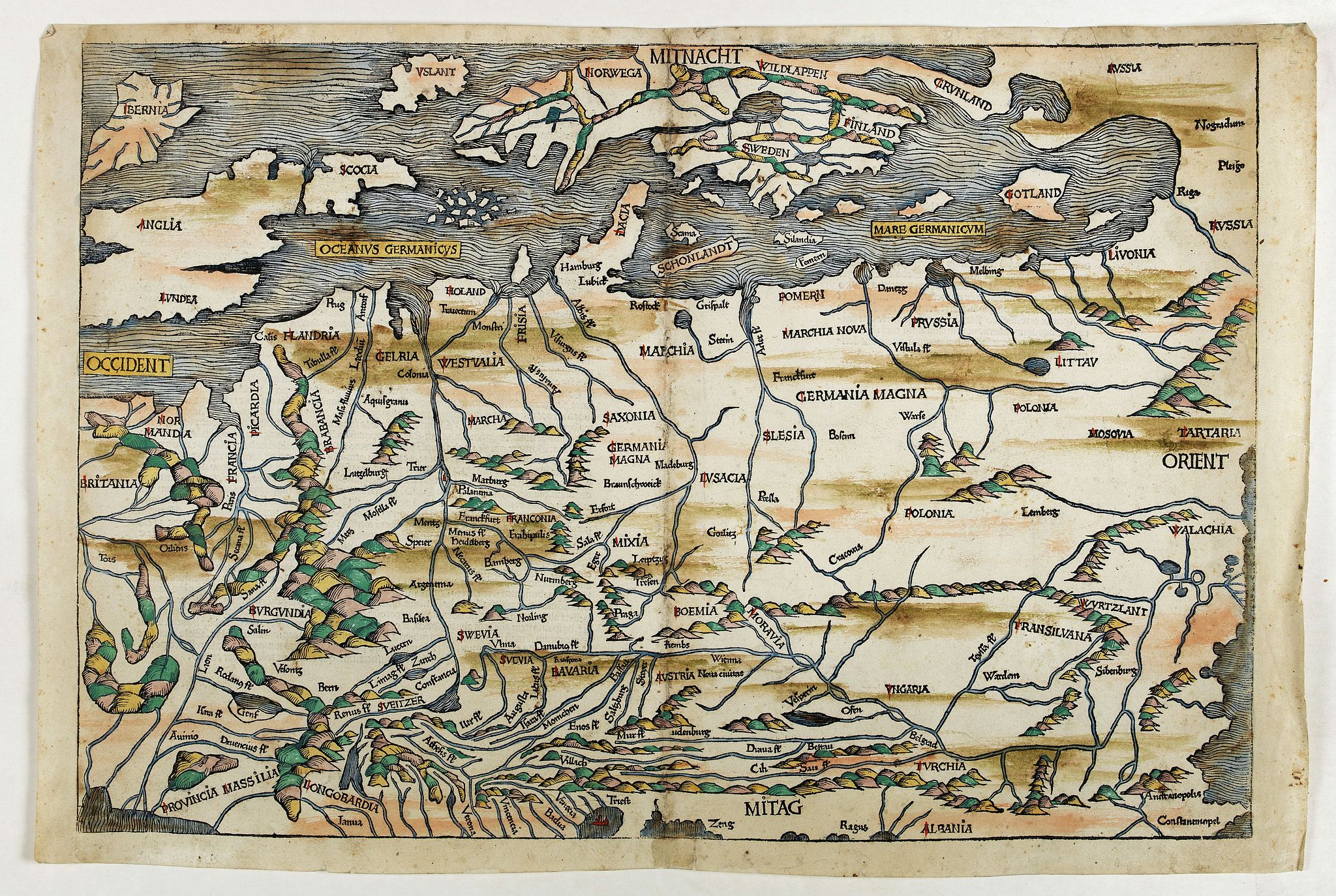
1493 SCHEDEL, H. - This is the second time Iceland appears on a printed map, authored by Hieronymus Münzer. A woodcut printed map, published in 1493, in Hartmann Schedel’s Liber Chronicum, or The Nuremberg Chronicle.
Germania Magna (Europe continent map, folio XXVI) |
||||||||||||||||||||
|
||||||||||||||||||||
|
|
||||||||||||||||||||
$5000 / ≈ €4459This item is available for immediate sale! Questions before Buying ?
We are happy to answer your questions. |
My Collection +
Add this or any of your favorite items in one place. If you want to save the items permanently, you have to sign in or create an account first.   Add/Remove
 |
|||||||||||||||||||



Description
A woodcut colored map of much of Europe, from the Black Sea to France and from the Adriatic to Scandinavia and Iceland. Scandinavia resembles that of the Ulm Scandinavia, but Greenland, seemingly lacking space North of Scandinavia, has been moved to the East!
The first modern map of the area. The second printed map of the North, and the second time Iceland appears on a printed map. Published in 1493 in Hartmann Schedel ’s Liber Chronicum, or The Nuremberg Chronicle.
With Latin text colophon on verso. The map is also deemed to be the first printed map of Germany, even if it shows a larger area, including all of Poland, Lithuania etc.
One of the earliest depictions of Iceland on a printed map.
W. B. Grinsberg characterized this map as the first modern map of northern and central Europe. The map ranges from the British Isles to Constantinople. The designer has been identified as Hieronymus Münzer (1437-1508), who trained as a physician. The Münzer map is one of the earliest to depict the Scandinavia peninsula.
Nordenskold credits the map of the north in the Zamoyski codes as the prototype for this map. The source for the central European portion is a 1460 manuscript map of Germany by Cardinal Nicolas Cusanus (also Nicholas of Cusa), printed posthumously at Eichstätt in 1491.
The woodblock cutter was Michael Wolgemut, the well-known teacher of Albrecht Dürer. Wohlgemut was Albrecht Dürer's tutor between 1486-1490. Since the young Dürer was active in Wohlgemut's printers shop during the time the woodblock for the Nuremberg Chronicle was produced, he may also have collaborated, since some of the cuts bear a remarkably close resemblance to his Apocalypse illustrations.
Read more about the Liber chronicarum or Nuremberg Chronicle. [+]
Nuremberg Chronicle
The LiberChronicarum or the Nuremberg Chronicle, as it is also known, is a history of the world from creation to 1493, dividing earthly history into six ages: from the creation to Noah, from Noah to Abraham, from Abraham to David, from David to the Babylonian captivity, from the Babylonian captivity to the birth of Christ and from the birth of Christ to the end of the world (or 1493 - blank pages were left for owners to fill in events after publication).Two further ages present future events. The Seventh Age is the age of the Antichrist and the Ultimate Age is the Last Judgment. It is one of the finest illustrated books of the fifteenth century, with illustrations of biblical scenes, major cities, characters from myths and fables, the genealogical tables of emperors, kings, and popes, as well as maps.
The Liber Chronicarum was commissioned by two wealthy Nuremberg merchants and brothers-in-law, Sebald Schreyer and Sebastian Kammermaister.
They contracted Michael Wohlgemut (1434-1519) and his stepson Wilhelm Pleydenwurff (c.1460-1494) to make the woodcuts for the book and draw up layouts showing the setting of the type and the placement of the woodcuts. Hartman Schedel (1440-1514), a physician and humanist scholar, supplied the text. Schedel supplied little original material but relied heavily on others, including Jacob Philip Foresti of Bergamo, whose Supplementum Chronicarumn was reproduced almost word for word. For some of the contemporary material, he drew heavily upon Historia Bohemica, Rome 1475, by Aneas Sylvius Piccolomini.
While Liber Chronicarum contains much historical material, it also leaves room for accounts of curiosities, myths, and fables.
As notable as the material contained in Liber Chronicarum is what it leaves out. For example, it does not record the death of Lorenzo di Medici, nor the adoption of Roman law in Germany. The famous printer, Anton Koberger (1445-1513), the largest printer and publisher in Germany at the time, was employed to print the book.
At his height, Koberger ran 24 presses and employed 100 craftsmen.
The Latin edition was published on 12 July 1493, and a German edition, translated by George Alt, the city scribe of Nuremberg, was published on 23 December 1493.
Perhaps the most important features of the Liber Chronicarum are its design
and illustrations. The layouts for the illustration and typesetting of the book survive and show that the woodblock subjects were sketched at first and the text was then inscribed to fit within the
remaining space. The result is a marriage of text and illustration unlike anything seen before.
The artists produced 14 basic page layouts, with several variations, for the book. They cut
645 different blocks and used them several times for the final 1809 illustrations, often using the same cut to illustrate different towns or people. For example, the woodcut that is used to
represent Damascus on fol. XVIII is used to represent Verona on fol. LVII and is also used to represent Mantua and Naples elsewhere in the work.
However, in some depictions of the more important cities, such as Jerusalem and Constantinople, an effort has been made to include recognizable landmarks. For example, the woodcut of Biblical Jerusalem depicts the Temple of Solomon and other landmarks.
Some see evidence of the hand of Albrecht Dürer in some of the illustrations. Although this is possible, as he was apprenticed to Wohlgemut, other scholars doubt it.
In 1552, Schedel's grandson, Melchior Schedel, sold about 370 manuscripts and 600 printed works from
Hartmann Schedel's library to Johann Jakob Fugger. Fugger later sold his library to
Duke Albert V of Bavaria in 1571. This library, one of the largest formed by an individual in the 15th century, is now mostly preserved in the Bayerische Staatsbibliothek in Munich.
Among the surviving portions of Schedel's library are records of the work's publication, including Schedel's contract with Koberger for publication and the financing by Sebald Schreyer and Sebastian Kammermeister, as well as the contracts with Wohlgemut and Pleydenwurff for the original artworks and engravings. The collection also includes the original manuscript copies of the work in Latin and German.
The Nuremberg Chronicle receives much scholarly attention nowadays, but the fact that some 800 examples of the Latin edition and 400 of the German edition still exist also testifies to the popularity of the Liber Chronicarum in its own time.
In fact, it is estimated that around 1500 copies of the Latin edition and 1000 of the German edition were printed. It was popular enough to be pirated.
Three years after the first edition was complete, Johann Schönsperger (d. 1520) of Augsburg printed a German version and went on to produce a Latin edition and another in German.
Further reading and books used in the compilation of this piece:
Adrian Wilson. The making of the Nuremberg chronicle. Amsterdam: Nico Israel, 1977.
Hartmann Schedel. Chronicle of the world: the complete and annotated Nuremberg chronicle of 1493, introduction and appendix by Stephan Füssel. Köln, London : Taschen, 2001.
Text by Hugh Cahill, Senior Information Assistant, Foyle Special Collections Library
FAQ - Guarantee - Shipping
This item is available for immediate purchase when a "Add to Cart" or "Inquire Now" button is shown.
Items are sold in the EU margin scheme
Payments are accepted in Euros or US Dollars.
Authenticity Guarantee
 We provide professional descriptions, condition report (based on 45 years experience in the map business)
Paulus Swaen warrants the authenticity of our items and a certificate of authenticity is provided for each acquired lot.
Condition and Coloring
We indicate the condition of each item and use our unnique HiBCoR grading system in which four key items determine a map's value: Historical Importance, Beauty, Condition/Coloring and Rarity.
Color Key
We offer many maps in their original black and white condition. We do not systematically color-up maps to make them more sellable to the general public or buyer.
Copper engraved or wood block maps are always hand colored. Maps were initially colored for aesthetic reasons and to improve readability. Nowadays, it is becoming a challenge to find maps in their original colors and are therefor more valuable.
We use the following color keys in our catalog:
Original colors; mean that the colors have been applied around the time the map was issued.
Original o/l colors; means the map has only the borders colored at the time of publication.
Colored; If the colors are applied recently or at the end of the 20th century.
Read more about coloring of maps [+]
Shipping fee
A flat shipping fee of $ 30 is added to each shipment by DHL within Europe and North America. This covers : International Priority shipping, Packing and Insurance (up to the invoice amount).
Shipments to Asia are $ 40 and rest of the world $50
We charge only one shipping fee when you have been successful on multiple items or when you want to combine gallery and auction purchases.
Read more about invoicing and shipping
FAQ
Please have a look for more information about buying in the BuyNow gallery
Many answers are likely to find in the general help section.
My Collection+

With My Collection+ you can collect all your favorite items in one place. It is free, and anyone can create his or her virtual collection.
Unless you are logged in, the item is only saved for this session. You have to be registed and logged-in if you want to save this item permanently to My Collection+. Read More[+]
Register here, it is free and you do not need a credit card.
Add this item to My Collection+ or click the following link to see My Collection+.
|
Digital Image Download Paulus Swaen maintains an archive of most of our high-resolution rare maps, prints, posters and medieval manuscript scans. We make them freely available for download and study. Read more about free image download |
Click the image for a free small image download. |
YOUR RIGHT TO CANCEL THE PURCHASE OF A LOT
In accordance with the EU Consumer Rights Directive and habitually reside in the European Union you have the right to cancel the contract for the purchase of a lot, without giving any reason.
The cancellation period will expire 14 calendar days from the day after the date on which you or a third party (other than the carrier and indicated by you) acquires, physical possession of the lot. To exercise the right to cancel you must inform Paulus Swaen Inc, of your decision to cancel this contract by a clear statement (e.g. a letter sent by post, or e-mail.
To meet the cancellation deadline, it is sufficient for you to send your communication concerning your exercise of the right to cancel before the cancellation period has expired.
