Subscribe to be notified if similar examples become available.
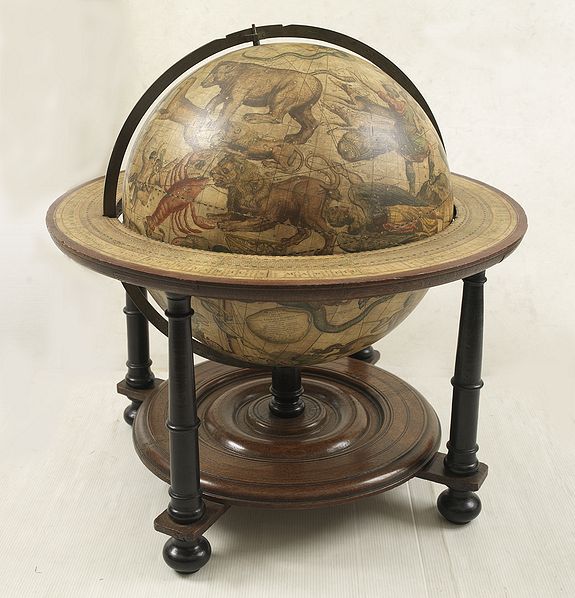
1750 VALK, G. / L. - Celestial globe 15 inch, only 3 other copys known.
Celestial globe 15 inch, only 3 other copys known.
| Maker: | VALK, G. / L. | |
| Date: | Amsterdam, after 1750 | |
| Colored: | In original colors. | |
| Size: | 550 x 550 mm / 21.7 x 21.7 inches | |
| Condition: | A very rare 15 inch (39cm.) diameter celestial globe made up of two sets of twelve finely engraved and hand-colored gores and two polar calottes (70°) laid to the ecliptic poles of a papier-maché and plaster sphere, the axis through the celestial poles, | |
 Add/Remove this item to MyCollection+




Description
Giving the celestial globe its own name is a striking novelty by Valk, which was not imitated by others. "Uranographia" is the title of Johannes Hevelius 1687 celestial atlas, which was also the source for Valk's celestial globes.
With this, Valk introduced a new graphic style for the constellations, abandoning the 'old-fashioned' Saenredam style of the Blaeu and Hondius globes. The engraving of the globe was done by the master engraver Carolus de La Haye, based on Andreas Stech's design.
The date of the epoch ('et ad annum 1700 Completum') has been altered by pasting on a '50'. A new advice to the reader is pasted next to the title cartouche: Propter motum, Stellarum fixarum versus ortum post Annum 1750 additione ¾ gr : Correctio Longitudium ut instituatur, monendus Uranophilus.
advise to the reader between hydr and argo: monitum novis hisce sphaeris novissimus, ex proesriptio lotharii zum bach md: doct.unus, et alter additus horizon: quorum is, qui huic caelesti singularis, praeter communes atq. bissextilem, ut exactior luminarium indagetur locus="" ad meridianum amstelodamens. plus, quam per ducentos annos, suis mensum diebus appositas lunae syzygias, medio tempore="" medias,="" ingeniosa methodo eruit," exhibet a further pasted cartouche in manuscrip propter motum="" stellarum fixarum verses="" ortum post annum 1750 additione ¾ gr: correctis longitudinum instituatur monendus uranophilus.
The constellations are finely depicted by mythical beasts and figures, a table entitled SUPER EMINET OMNES around a sun face showing the stars to six orders of magnitude, also with symbols for nebulae, all the stars picked out in gilt paint within the finely-engraved constellations depicted by mythical beasts and figures, the constellations and some individual stars labeled in Latin.
With stamped brass meridian circle divided into four quadrants, further stamped with the fabrication serial number 1 on the reverse at the North Pole. (See v.d.Krogt Globi Neerlandici, manufacturing numbers, pp.353-357) The brass hour dial is missing.
A minuscule piece of paper bearing "50" is pasted over the date 1700 in the title cartouche to suggest an updated globe. The change of date to 1750 did not necessarily occur in 1750; it is certain that it occurred before 1763. In that year, the Utrecht van Renwoude Foundation bought a pair of 15-inch globes from Valk's widow. The celestial globe of the pair survived and is updated this way. The person who thought to change the date this way must have been Petrus Schenk II or his son, Petrus Schenk Jr. In whose house was the globe factory established after 1770?
The oak horizon ring with hand-colored paper ring showing degrees and days of the houses of the Zodiac, and with four scales for the Gregorian calendar for leap years and the three intervening years, with dominical letters and a scale for the old and new moon in Amsterdam, edged in red, and Lotharius Zumbach's innovative Almanac, with data for leap years and for each of the three intervening years. Gilt stars retouched, with repair of the usual small dents, with some minor manuscript in fill in the globe. The surface of the horizon with substantial surface fading, now carefully redrawn in manuscript.
On a 18th-century oak stand with four turned ebonized legs united by cross-stretchers supporting a circular base and meridian support, with four bun feet.
The cartography of the gores on Valk's celestial globe, as stated in the cartouche, is based closely on the celestial atlas Uranographia, published in 1687 by the Polish astronomer Johannes Hevelius (1611-1687), who was notable for being the last great astronomer to conduct his work without the use of a telescope. Hevelius was also notable for designing his celestial maps with globes in mind, and as such, they were easily transferred onto spheres.
Reference: v.d.Krogt, Globi Neerlandici, pp. 313-323, VAL III, state 4. V.d.Krogt only mentions three other copies (Sheepvaart Museum, Amsterdam 2x, Van de Vrij-Vrouwe van Renswoude Foundation, Utrecht)
FAQ - Guarantee - Shipping
Buying in the BuyNow Gallery
This item is available for immediate purchase when an "Add to Cart" or "Inquire Now" button is shown.
Items are sold in the EU margin scheme.
Payments are accepted in Euros or US Dollars.
Authenticity Guarantee
 We provide professional descriptions and a condition report (based on 45 years experience in the map business).
Paulus Swaen warrants the authenticity of our items and a certificate of authenticity is provided for each acquired lot.
Condition and Coloring
We indicate the condition of each item and use our unique HiBCoR grading system in which four key items determine a map's value:
Historical Importance, Beauty, Condition/Coloring and Rarity.
We offer many maps in their original black and white condition. We do not systematically color-up maps to make them more sellable to the general public or buyer.
Copper engraved or wood block maps are always hand colored. Maps were initially colored for aesthetic reasons and to improve readability.
Nowadays it is becoming a challenge to find maps in their original colors, and these are therefore more valuable.
We use the following color keys in our catalog:
- Original colors: the colors were applied around the time the map was issued.
- Original o/l colors: only the borders were colored at the time of publication.
- Colored: the colors were applied recently or at the end of the 20th century ("attractive colors" may also be used).
Read more about coloring of maps [+]
Shipping fee
A flat shipping fee of $30 is added to each shipment by DHL within Europe and North America. This covers international priority shipping, packing and insurance (up to the invoice amount).
Shipments to Asia are $40 and rest of the world $50.
We charge only one shipping fee when you have been successful on multiple items or when you want to combine gallery and auction purchases.
Read more about invoicing and shipping
FAQ
Please have a look for more information about buying in the BuyNow gallery.
Many answers are likely to be found in the general help section.
MyCollection+

With MyCollection+ you can collect all your favorite items in one place. It is free, and anyone can create his or her virtual collection.
Unless you are logged in, the item is only saved for this session. You have to be registered and logged in if you want to save this item permanently.
Read more [+]
Register here, it is free and you do not need a credit card.
Add this item to
MyCollection+
or see MyCollection+.
Paulus Swaen maintains an archive of most of our high-resolution rare maps, prints, posters and medieval manuscript scans.
We make them freely available for download and study.
Read more about free image download
Click the image for a free small image download.
YOUR RIGHT TO CANCEL THE PURCHASE OF A LOT
In accordance with the EU Consumer Rights Directive and habitually reside in the European Union you have the right to cancel the contract for the purchase of a lot, without giving any reason.
The cancellation period will expire 14 calendar days from the day after the date on which you or a third party (other than the carrier and indicated by you) acquires, physical possession of the lot. To exercise the right to cancel you must inform Paulus Swaen Inc, of your decision to cancel this contract by a clear statement (e.g. a letter sent by post, or e-mail.
To meet the cancellation deadline, it is sufficient for you to send your communication concerning your exercise of the right to cancel before the cancellation period has expired.
