The piscatorial atlas of the North sea, English and St Georges Channels.
Euros 3050
The atlas was published under a joint London and Grimsby imprint. By the 1850s the railway carried fresh Grimsby fish to Billingsgate and beyond, and in the second half of the nineteenth century Grimsby became one of the greatest fishing ports in the country - at the forefront of technological developments in the fishing industry. It was here that Ole Theodor Olsen (1838-1925) made his home.
Atlas is one of the first atlas publications on the North Sea, English and St. George’s Channels fisheries. It illustrates the fishing ports, boats, gear, fish species, and other information concerning fish and fisheries, based on Olsen’s comprehensive statistical information collected over many years. The Piscatorial Atlas is significant not only for its visual appeal but also for its historical and environmental interest.
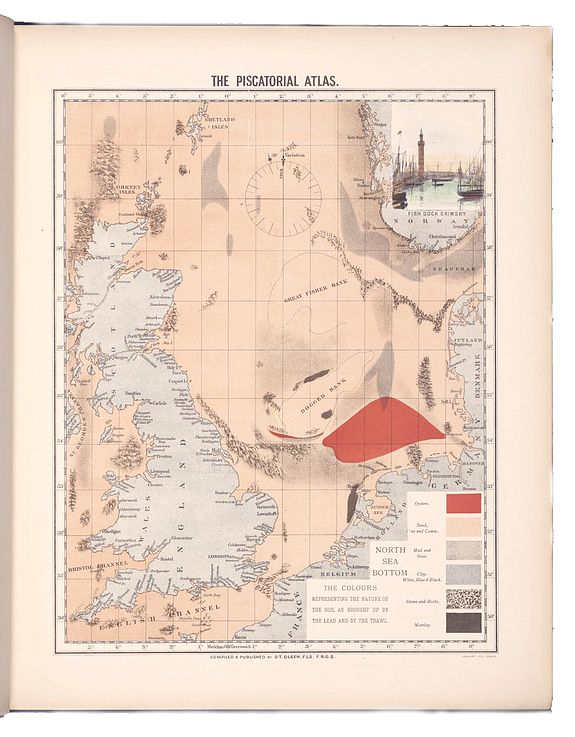
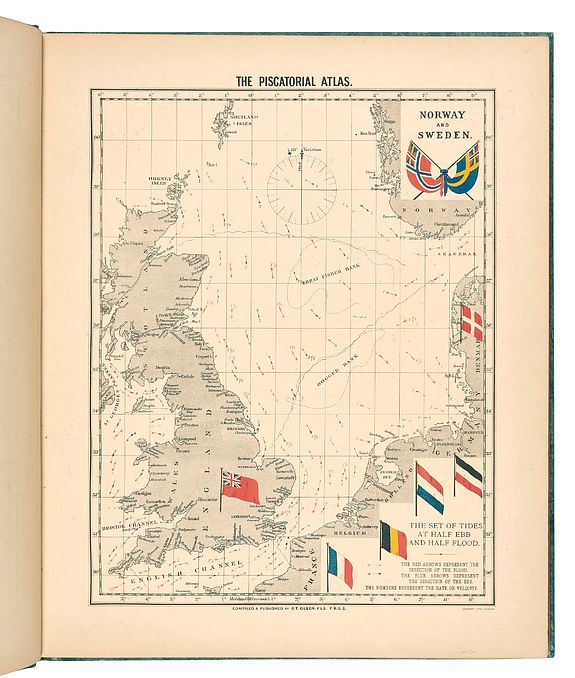
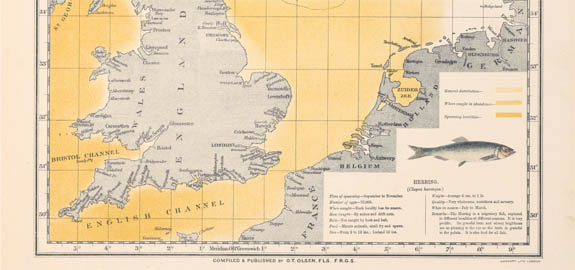
The Atlas contains fifty colored maps of the North Sea fisheries. The first four illustrate the tides, depths, composition of the seabed, and the names of the grounds. Each of the other 46 maps is dedicated to a species important to the fishery industry (including Mackerel, Cod, Sturgeon, Sole, Plaice, Lobster and Oyster), listing their locations, spawning grounds and how they are caught, with a vignette of the typical boat used to catch them.
The Piscatorial Atlas, published as fishing boats were switching from sail to steam, is a disturbing reminder of how industrial techniques have all but destroyed the fishing stocks in less than 150 years.
O.T. Olsen was a Fellow of the Royal Astronomical Society. His obituary in the society’s transactions reveals that he was born in Christansand, Norway, went to sea at an early age and learned navigation on an English ship trading with India: “Although he never lost touch with Scandinavia, he became completely English in his sympathies. He had an extensive knowledge, gained from his own investigations, of the movements of fish in the North Sea, and he collected and collated deep-sea soundings, so that he was often able to settle disputes as to the depth of ocean beds.
After his life at sea, he settled down in Grimsby as a maker of nautical instruments and a publisher of books for fishermen. He received honors in several countries, including Norway, Sweden and Japan.”