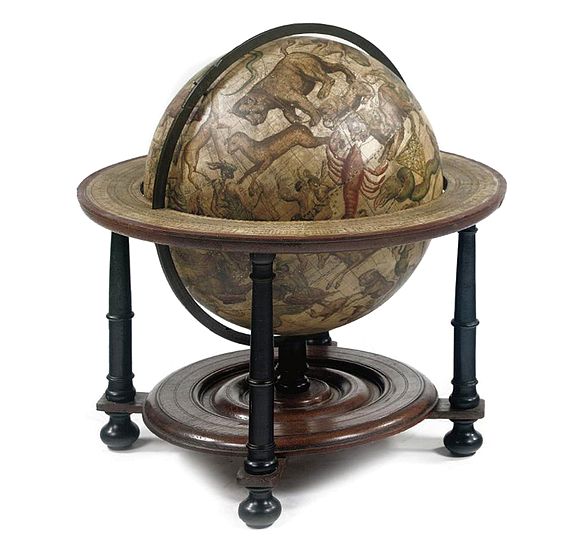
Celestial globe by Valk in 15 inch.
Sold
Title below Cetus in a cartouche : Uranographia Caelum omne hic Complectens, Illa pro ut aucta et ad annum 1750 Completum MAGNO ab HEVELIO correcta est: ita, ejus ex Prototypis, sua noviter haec Ectypa veris Astronomiae culturibus exhibet et consecrat GER. Et LEON VALK, Amsterdaedamensis Cum Priviligio. Giving the celestial globe its own name is a striking novelty by Valk, which was not imitated by others. "Uranographia" is the title of Johannes Hevelius 1687 celestial atlas, which was also the source for Valk's celestial globes.With this, Valk introduced a new graphic style for the constellations, abandoning the 'old-fashioned' Saenredam style of the Blaeu and Hondius globes. The engraving of the globe was done by the master engraver Carolus de La Haye, based on Andreas Stech's design.
The date of the epoch ('et ad annum 1700 Completum') has been altered by pasting on a '50'. A new advice to the reader is pasted next to the title cartouche: Propter motum, Stellarum fixarum versus ortum post Annum 1750 additione ¾ gr : Correctio Longitudium ut instituatur, monendus Uranophilus.
Advise to the reader between hydr and argo: monitum novis hisce sphaeris novissimus, ex proesriptio lotharii zum bach md: doct.unus, et alter additus horizon: quorum is, qui huic caelesti singularis, praeter communes atq. bissextilem, ut exactior luminarium indagetur locus="" ad meridianum amstelodamens. plus, quam per ducentos annos, suis mensum diebus appositas lunae syzygias, medio tempore="" medias,="" ingeniosa methodo eruit," exhibet a further pasted cartouche in manuscrip propter motum="" stellarum fixarum verses="" ortum post annum 1750 additione ¾ gr: correctis longitudinum instituatur monendus uranophilus.
The constellations are finely depicted by mythical beasts and figures, a table entitled SUPER EMINET OMNES around a sun face showing the stars to six orders of magnitude, also with symbols for nebulae, all the stars picked out in gilt paint within the finely-engraved constellations depicted by mythical beasts and figures, the constellations and some individual stars labeled in Latin.
With stamped brass meridian circle divided into four quadrants, further stamped with the fabrication serial number 1 on the reverse at the North Pole. (See v.d.Krogt Globi Neerlandici, manufacturing numbers, pp.353-357) The brass hour dial is missing.
A minuscule piece of paper bearing "50" is pasted over the date 1700 in the title cartouche to suggest an updated globe. The change of date to 1750 did not necessarily occur in 1750; it is certain that it occurred before 1763. In that year, the Utrecht van Renwoude Foundation bought a pair of 15-inch globes from Valk's widow. The celestial globe of the pair survived and is updated this way. The person who thought to change the date this way must have been Petrus Schenk II or his son, Petrus Schenk Jr. In whose house was the globe factory established after 1770?
The oak horizon ring with hand-colored paper ring showing degrees and days of the houses of the Zodiac, and with four scales for the Gregorian calendar for leap years and the three intervening years, with dominical letters and a scale for the old and new moon in Amsterdam, edged in red, and Lotharius Zumbach's innovative Almanac, with data for leap years and for each of the three intervening years. Gilt stars retouched, with repair of the usual small dents, with some minor manuscript in fill in the globe. The surface of the horizon with substantial surface fading, now carefully redrawn in manuscript. On an 18th-century oak stand with four turned ebonized legs united by cross-stretchers supporting a circular base and meridian support, with four bun feet.
The cartography of the gores on Valk's celestial globe, as stated in the cartouche, is based closely on the celestial atlas Uranographia, published in 1687 by the Polish astronomer Johannes Hevelius (1611-1687), who was notable for being the last great astronomer to conduct his work without the use of a telescope. Hevelius was also notable for designing his celestial maps with globes in mind, and as such, they were easily transferred onto spheres.
Reference: v.d.Krogt, Globi Neerlandici, pp. 313-323, VAL III, state 4. V.d.Krogt only mentions three other copies (Sheepvaart Museum, Amsterdam 2x, Van de Vrij-Vrouwe van Renswoude Foundation, Utrecht)
