1720 - With 78 plates of the first banking crash, showing the shocking effects of the “South Sea Bubble” in France, England and Holland, and placing John Law with his Mississippi company scheme.


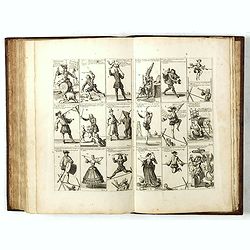
Het Groote Tafereel der Dwaasheid, vertoonende de opkomst, voortgang en ondergang der Actie, Bubbel en Windnegotie, in Vrankryk, Engeland, en de Nederlanden, gespleegt in den Jaare MDCCXX...
| Maker: | ANONYMOUS | |
| Date: | Amsterdam, 1720 | |
| Colored: | Uncolored. | |
| Size: | 365 x 250 mm / 14.4 x 9.8 inches | |
| Condition: | (2),25,(1),52,31,8,10 text pages, 74 (folding double-page) engraved plates, contemp. richly gilt marbled calf by the DOUBLE DRAWER HANDLE BINDERY (Amsterdam) with i.a. gilt central mirror piece and crown corner tools on both covers, folio. | |
-This item is available for immediate sale
$9000 / ≈ €8050
You can choose from more than 30,000 items from our BuyNow Catalog or Archive.
It's free, and you can delete items anytime.
 Add/Remove this item to MyCollection+




Description
AN EARLY ISSUE of this biting and vulgar satire on the Mississippi and South Sea Bubbles and an extraordinary visual record with 78 plates of the first banking crash, showing the shocking effects of the “South Sea Bubble” in France, England and Holland, and placing John Law (1671-1729), with his Mississippi company scheme, squarely at the center of the disastrous chain of events.
Of the two plates, each bearing four small engravings. (Cole 26 "Bombario" etc. and 29 "Verhens-beker" etc.) The engravings have been cut out and mounted on another (contemp) leaf; 5 plates (Cole 7, 9, 10, 13, 16) Tear on the middle fold in (partly blank) lower margin (2x repaired).
Cole 13 also with a repaired tear in the lower blank corner; title-page and a few plates yellowed/ trifle foxed. A fine copy in a nice contemp. binding.
Cole 2-45, 47-70, 72, 73, 3 extra plates (consisting of mounted engraved portraits (of Quinquenpoix, Madame Law and Jacques III Pretendent D'Angleterre (Cole suppl. plates 2, 3 and 4)) within the engraved border belonging to the absent first plate "Eere-Titel, of Gordyn voor het Schouburg" ("Een schoone Lofkrans (...)")) and a small extra map "Louisiana by de Rivier Mississippi" (Cole suppl. 6).
Without Cole 46 (De inventeur der windnegotie, op zyn zegekar), 71 (Koning en Koningin van de Mississippi) and 74 (second part of Toverkaart)).
Biting satirical caricatures of The Great Mirror of Folly. "In neither of these [France and England] did there appear such a stout and extravagant piece as this Dutch volume" (Cole).
This copy has 78 copper-engraved plates and maps, most double-page and a few folding on 73 pages. The set of 8 Bombario Auctionists, printed on separate paper, is mounted on two single pages, with 1-4 and 4-8.
The text provides the charters of important companies floated in various Dutch cities during the period of bubble fever, and the plates expose the principals of these companies to merciless ridicule. "The combination of such prosaic data with the numerous satirical engravings, with the reprint of comedies and satires, and with a description of bubble playing cards offers the student a unique historical document, the like of which was not thrown up by the speculative manias in either France or England" (Cole, The Great Mirror of Folly… An Economic-Bibliographical Study, p.1).
The Tafereel is perhaps an essential factor in the slow development of modern corporate organizations. "Against the joint-stock manner of business arrangements were thrown the fears engendered by this popular portrayal of the downfall of the 'windnegotie.' Possibly a mere book was an economic force" (Cole, p.20).
'The engravings, which illustrate the rise and fall of the great speculation, are full of humor; many are exceedingly ludicrous, and some very obscene… The number of plates in copies varies from 60 to 74" (Sabin).
Read more about Speculative bubbles - The First financial crisis.
Reference: Goldsmiths' 5879. Howes G442. Kress 3217. Sabin 28932.
Speculative bubbles - The First financial crisis
The three bubbles, French, British, and Dutch, started at different times but burst at about the same time: September 1720.1. The South Sea Bubble, named after the British South Sea Company, lasted from January to September 1720.
2. The Mississippi Bubble, after the Mississippi Company in France, had begun a little earlier, in 1719.
3. The Dutch bubble started in March 1720 and derived from the other two bubbles.
The Bubble.
Speculation in shares was known as 'the Bubble', and the trade was known as "Wind-Handel" and "Wind-Negotie" (both meaning Wind-Trade), because traders often didn't own the shares and tried to talk up the price. Dutch companies formed in the Bubble tended to be local affairs associated with the cities where they were founded. Stock offerings were often public in name only, with local officials and other insiders buying up most or all of the stock.
It couldn't last, of course. There was no real regulation; instead, there was government connivance.
The South Sea Co. was founded in 1711, nominally to trade in slaves in the Americas (the "South Sea" was the southern Atlantic), but was a means for the British government to convert its debt to stocks that could be traded on the market. By 1720, debt conversion was the Company's primary business.
The Mississippi Company. John Law (1671-1729), the son of
an Edinburgh banker and successful financier, who established the "Banque Générale" in France in 1715, founded the Compagnie de l'Occident for the exploitation of the resources of French Louisiana after Antoine Crozat had surrendered his charter in 1717.
Law's reputation caused the stock to sell readily, and the organization soon enlarged the scope of its activities by absorbing other commercial companies, after which its name was changed to the 'Company of the Indies'. Enormous profits were anticipated... and the increasing demand for its stock led to wild speculation.
In the summer of 1719, Law began comparing Louisiana to Ophir (the legendary site of King Solomon's mines). The stock went up from 500 livres per share to a peak of 18,000 in the summer of 1720, then collapsed in September, settling at about 500 in 1721.
In January of 1720, the directors of the South Sea Company similarly hyped a public offering. From 128 pounds per share, South Sea stock peaked at almost 1000 by the summer. Demand was high, but to attract even more buyers, the Company's directors sold stock on credit. Hundreds of British companies also sprang up, most of them dodgy or bogus, to take advantage of the boom.
Dutch investors came late to the party in the spring and summer of 1720. They mostly ignored Mississippi shares but eagerly went after South Sea shares when they hit the market. During the boom, some 40 Dutch companies raised capital. Most were legitimate and associated with one city or another. Very few Dutch companies traded on the Exchange (Beurs), so people traded French, British, and Dutch "bubble" companies in coffee houses.
In the 1600s, Frederik Hendrik, the Stadhouder of the Netherlands, declared that trading in shares one didn't own ("blanco") was legally invalid, but all cities except Amsterdam, Haarlem, and Leiden ignored it. Even in Amsterdam, the trade flourished at Kalverstraat No. 29, the coffee house Quincampoix, named after the Paris street where John Law was headquartered (No. 65). The place figures in many of the book's satires and is recognizable in some of the engravings.
FAQ - Guarantee - Shipping
This item is available for immediate purchase when a "Add to Cart" or "Inquire Now" button is shown.
Items are sold in the EU margin scheme
Payments are accepted in Euros or US Dollars.
Authenticity Guarantee
 We provide professional descriptions, condition report (based on 45 years experience in the map business)
Paulus Swaen warrants the authenticity of our items and a certificate of authenticity is provided for each acquired lot.
Condition and Coloring
We indicate the condition of each item and use our unique HiBCoR grading system in which four key items determine a map's value: Historical Importance, Beauty, Condition/Coloring and Rarity.
Color Key
We offer many maps in their original black and white condition. We do not systematically color-up maps to make them more sellable to the general public or buyer.
Copper engraved or wood block maps are always hand colored. Maps were initially colored for aesthetic reasons and to improve readability. Nowadays, it is becoming a challenge to find maps in their original colors and are therefor more valuable.
We use the following color keys in our catalog:
Original colors; mean that the colors have been applied around the time the map was issued.
Original o/l colors; means the map has only the borders colored at the time of publication.
Colored; If the colors are applied recently or at the end of the 20th century.
Read more about coloring of maps [+]
Shipping fee
A flat shipping fee of $ 30 is added to each shipment by DHL within Europe and North America. This covers : International Priority shipping, Packing and Insurance (up to the invoice amount).
Shipments to Asia are $ 40 and rest of the world $50
We charge only one shipping fee when you have been successful on multiple items or when you want to combine gallery and auction purchases.
Read more about invoicing and shipping
FAQ
Please have a look for more information about buying in the BuyNow gallery
Many answers are likely to find in the general help section.
MyCollection+

With My Collection+ you can collect all your favorite items in one place. It is free, and anyone can create his or her virtual collection.
Unless you are logged in, the item is only saved for this session. You have to be registered and logged-in if you want to save this item permanently to My Collection+. Read More[+]
Register here, it is free and you do not need a credit card.
Add this item to My Collection+ or click the following link to see My Collection+.
|
Digital Image Download Paulus Swaen maintains an archive of most of our high-resolution rare maps, prints, posters and medieval manuscript scans. We make them freely available for download and study. Read more about free image download |
Click the image for a free small image download. |


YOUR RIGHT TO CANCEL THE PURCHASE OF A LOT
In accordance with the EU Consumer Rights Directive and habitually reside in the European Union you have the right to cancel the contract for the purchase of a lot, without giving any reason.
The cancellation period will expire 14 calendar days from the day after the date on which you or a third party (other than the carrier and indicated by you) acquires, physical possession of the lot. To exercise the right to cancel you must inform Paulus Swaen Inc, of your decision to cancel this contract by a clear statement (e.g. a letter sent by post, or e-mail.
To meet the cancellation deadline, it is sufficient for you to send your communication concerning your exercise of the right to cancel before the cancellation period has expired.
Recently Viewed
Het Groote Tafereel der Dwaasheid, vertoonende de opkomst, voortgang en ondergang der Actie, Bubbel en Windnegotie, in Vrankryk, Engeland, en de Nederlanden, gespleegt in den Jaare MDCCXX...
1720 - With 78 plates of the first banking crash, showing the shocking effects of the “South Sea Bubble” in France, England and Holland, and placing John Law with his Mis...
Date: Amsterdam, 1720
