Henry Francis BLANFORD - Rainfall chart of India
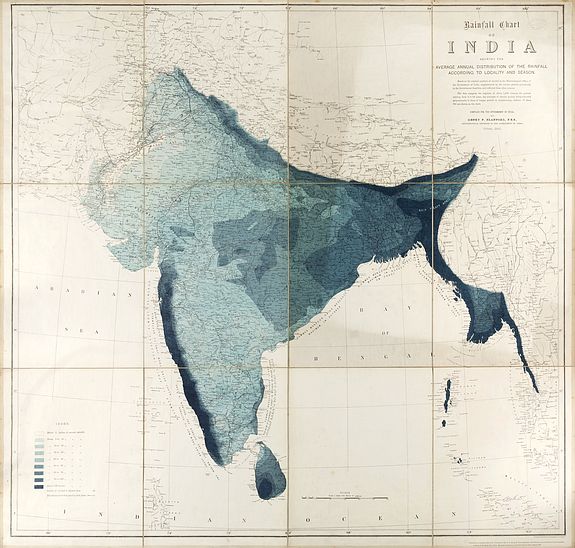
Calcutta, 1883/January 1884. 1000 x 960 mm. Folding map in 12 sections backed on canvas. Color lithograph. Fine condition.
Sold
Henry Francis Blanford, educated at Henry de la Beche’s Royal School of Mines, was one of the few men appointed to the skeleton staff of the Geological Survey of India, together with his brother William Blanford.Both of them arrived in Calcutta in 1855 and left immediately to examine and report upon coal fields in Orissa.
This resulted in the geological discovery of the Talchir Boulder Bed, where the first steps were taken towards the classification of the remarkable series of beds associated with Indian coal-bearing rocks (1855- 1866). In 1857, he was again dispatched to Madras to examine Cretaceous beds near Trichinopoly and Pondicherry, until he retired from the survey, partly for health reasons and partly because of strained personal relations with Thomas Oldham, the Superintendent of the Geological Survey.
Transborder travel beyond the northern temperate hemisphere played a key role in the re-education of these geologists, such that his older brother William Blanford writes in his memoir of the expeditions to the Indian Subcontinent, ‘it is to be regretted that all those geologists who disbelieve in the power of running water, as marine action and waves of translation, cannot see a few such marks of the handiwork of rain and rivers as are shown in the gorges of the subcontinent’.
He continued to research and write while teaching physics at Presidency College, Calcutta, from 1864 to 1870. In 1864, just as he became one of the honorary secretaries of the Asiatic Society of Bengal, Calcutta was hit by one of the historical cyclonic storms of the time, and it is at this time that Blanford took up the subject of Indian meteorology.
In 1867, he became the Imperial Metrological Reporter to the Government of Bengal, and the Indian metrological department was established with almost no staff and an annual budget of INR 45,000. His aim was to observe meteorological phenomena and collect scientific data to study the physical changes in the atmosphere. The introduction of scientific meteorology in India is remarkable. The British were the first to introduce organized meteorological and storm-warning systems in India to serve their imperial interests.
His personal initiative and the goodwill of the British Government led to the establishment of the Indian Meteorological Department in 1875. H.F. Blanford was appointed the first Imperial Meteorological Reporter and pioneered scientific meteorology in India. He proposed a plan to unify provincial meteorological systems under an imperial system.
He also sketched out general guidelines for conducting meteorological work in India. In addition to implementing changes to the department's administrative and operational procedures, he authored several research articles and books on India's weather and climate. Drawing on his intelligence and diligence, he discovered many unknown facts about India's meteorology. He examined irregularities in seasonal monsoon rainfall, the periodic recurrence of drought, and fluctuations in monsoon rainfall across the plains and foothills.
In fact, he introduced the study of tropical meteorology for the first time.
The Rudiments of Physical Geography for the Use of Indian Schools (1873), and An Elementary Geography of India, Burma and Ceylon (1890), while his academic scholarship included works like ‘Palaeontologica Indica’ in one of the earliest volumes of the Memoirs of the Geological Survey of India, and on ‘the former existence of an Indo-oceanic continent’ in the Quarterly Journal of the Geological Society of London.
Learn more about geological maps
