Philipp Franz Balthasar Von Siebold
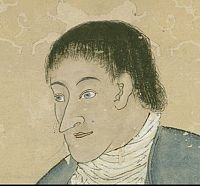 Philipp Franz Balthasar von Siebold was born on 17th February 1796 in Würzburg, Germany, to a family of doctors and professors of medicine. Siebold initially studied medicine at the University of Würzburg from November 1815 till 1820.
Invited to the Netherlands by a family acquaintance, Siebold applied for a position as a military physician, which would allow him to travel to the Dutch colonies. He entered the Dutch military service on June 19, 1822, and was appointed ship's surgeon aboard the frigate Adriana, sailing from Rotterdam to Batavia (present-day Jakarta) in Indonesia. He arrived in Batavia on February 18, 1823.
With his erudition, he impressed the Governor-General Baron Godert van der Capellen, and also the director of the botanical garden at Buitenzorg (now Bogor), Caspar Georg Carl Reinwardt, who sensed in Siebold a worthy successor to Engelbert Kaempfer and Carl Peter Thunberg, two former resident physicians at Dejima, a Dutch trading post in Japan.
Arrival in Japan.
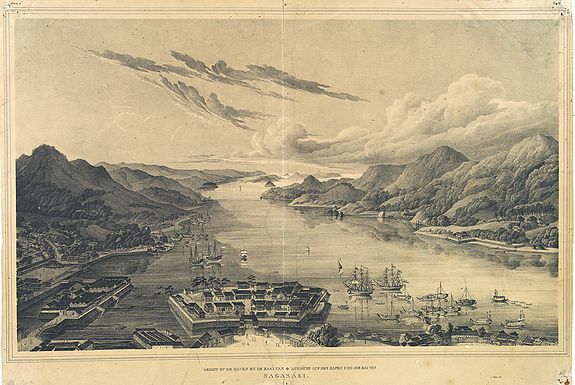
On June 28, 1823, after only a few months in the Dutch East Indies, Siebold was posted as a resident physician and scientist to Dejima, a small artificial island and trading post at Nagasaki, and arrived there on August 11, 1823. Because only a very small number of Dutch personnel were permitted to live on the island, the posts of physician and scientist had to be combined.
The European tradition of sending doctors with botanical training to Japan was longstanding. Sent on a mission by the Dutch East India Company, Engelbert Kaempfer (1651–1716), a German physician and botanist who lived in Japan from 1690 until 1692, ushered in this tradition of a combination of physician and botanist. The Dutch East India Company, however, did not employ the Swedish botanist and physician Carl Peter Thunberg (1743–1828), who had arrived in Japan in 1775.
Japanese scientists invited Siebold to demonstrate the marvels of Western science, and he, in turn, learned much from them about the Japanese and their customs. After curing an influential local officer, Siebold gained permission to leave the trading post. He used this opportunity to treat Japanese patients in the greater area around the trading post. Siebold is credited with introducing vaccination and pathological anatomy to Japan for the first time.
In 1824, Siebold established a medical school in Nagasaki, the Narutaki-juku, which grew into a meeting place for approximately 50 students. They helped him in his botanical and naturalistic studies. The Dutch language became the lingua franca (commonly spoken language) for these academic and scholarly contacts for a generation, until the Meiji Restoration.
His patients paid him in kind with a variety of objects and artifacts that would later gain historical significance. These everyday objects later became the basis of his large ethnographic collection, which consisted of everyday household goods, woodblock prints, tools and hand-crafted objects used by the Japanese people. and worked for the Netherlands government as a doctor on Java.
An opportunity to travel in Japan arose in 1826, when he accompanied a Dutch mission to the Imperial Court at Yedo (Tokyo),
he collected many plants and animals. But he also obtained from the court astronomer Takahashi Kageyasu several detailed maps of Japan and Korea (written by Ino Tadataka), an act strictly forbidden by the Japanese government.
When the Japanese discovered, by accident, that Siebold had a map of the northern parts of Japan, the government placed Siebold under house arrest and expelled him from Japan on October 22, 1829, and he did not return to Japan until 1859, when the country had finally given up its stringent isolation policy.
Satisfied that his Japanese collaborators would continue his work, he journeyed back on the frigate Java to his former residence, Batavia, in possession of his enormous collection of thousands of animals and plants, his books, and his maps. The botanical garden of Buitenzorg would soon house Siebold's surviving, living flora collection of 2,000 plants. He arrived in the Netherlands on July 7, 1830.
His stay in Japan and Batavia lasted eight years.
Philipp Franz von Siebold arrived in the Netherlands in 1830 and settled in Leiden, taking with him the major part of his collection. The "Philipp Franz von Siebold Collection", containing many type specimens, was the earliest botanical collection from Japan. The "Siebold collection" opened to the public in 1831. He founded a museum in his home in 1837. This small, private museum would eventually evolve into the National Museum of Ethnology in Leiden.
Nippon
The results of these travels and extensive research are embodied in his magnificent work, "Nippon, Archiv zur Beschreibung von Japan und dessen Neben- und Schutzlandern... " In 1832, the first part of a volume of this richly illustrated ethnographical and geographical work on Japan. He wrote six further parts, the last of which were published posthumously in 1882. It is clear that
Siebold sought to address all aspects of Japanese nature and
culture. An essential part of 'Nippon' was the illustrations, which in large part were drawn from objects in his
ethnographic collection.
His sons published an edited and lower-priced reprint in 1887.
We offer for sale several original prints from 'Nippon, Archiv zur Beschreibung ' or 'Flora Japonica' by Von Siebold.
Flora Japonica
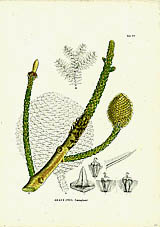
In 1835, the first installments of his 'Flora Japonica ' were finished. The 'Flora Japonica' was written in collaboration with Joseph Gerhard Zuccarini and issued in 30 volumes. Only the first volume was completed in 1841, and during Von Siebold's lifetime, only five installments of the second volume appeared. After Zuccarini's death in 1848, work on the Flora was virtually halted, though, based on Zuccarini's and Siebold's manuscripts, another five installments were edited by F.A. W. Miquel for publication in 1870.
Published works
(1832-1852) Nippon. Archiv zur Beschreibung von Japan und dessen Neben- und Schutzländern: Jezo mit den Südlichen Kurilen, Krafto, Koorai und den Liukiu-Inseln. 7 volumes, Leiden.
–(1838) Voyage au Japon Executé Pendant les Années 1823 à 1830 – French abridged version of Nippon – contains 72 plates from Nippon, with a slight variance in size and paper.
– Revised and enlarged edition by his sons in 1897: Nippon. Archiv zur Beschreibung von Japan ..., 2. veränderte und ergänzte Auflage, hrsg. von seinen Söhnen, 2 Bände, Würzburg und Leipzig.
(1829) Synopsis Hydrangeae generis specierum Iaponicarum. In: Nova Acta Physico-Medica Academiae Caesareae Leopoldino-Carolina vol 14, part ii.
(1835–1870) (with Zuccarini, J.G. von) Flora Japonica. Leiden.
(1843) (with Zuccarini, J.G. von) Plantaram, quas in Japonia collegit Dr. Ph. Fr. de Siebold genera nova, notis characteristicis delineationibusque illustrata proponunt. In: Abhandelungen der mathematisch-physikalischen Classe der Königlich Bayerischen Akademie der Wissenschaften vol.3, pp 717–750.
(1845) (with Zuccarini, J.G. von) Florae Japonicae familae naturales adjectis generum et specierum exemplis selectis. Sectio prima. Plantae Dicotyledoneae polypetalae. In: Abhandelungen der mathematischphysikalischen Classe der Königlich Bayerischen Akademie der Wissenschaften vol. 4 part iii, pp 109–204.
(1846) (with Zuccarini, J.G. von) Florae Japonicae familae naturales adjectis generum et specierum exemplis selectis. Sectio altera. Plantae dicotyledoneae et monocotyledonae. In: Abhandelungen der mathematischphysikalischen Classe der Königlich Bayerischen Akademie der Wissenschaften vol. 4 part iii, pp vol 4 pp 123–240.
(1841) Manners and customs of the Japanese, in the nineteenth century. From recent Dutch visitors of Japan and the German of Dr. Ph. Fr. von Siebold. London: Murray 1841. (compiled by an anonymous author, not by Siebold himself !)
