Map of Yangzi River across Shanghai used by Ever-Victorious Army
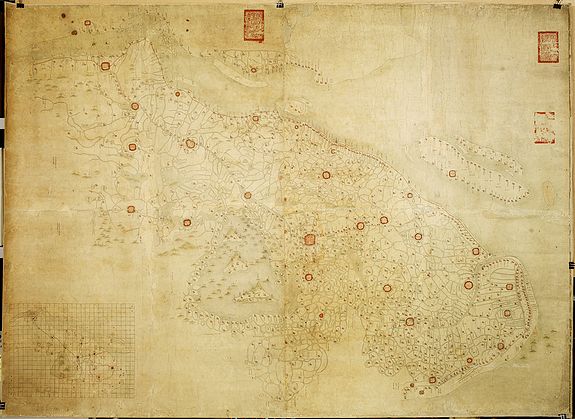
Military manuscript map of the Yangtze River at the end of the Yangzi River, across Shanghai, Jiangsu, and Zhejiang,
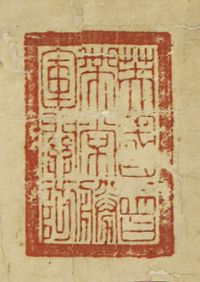
with 3 red seals of the "Ever-Victorious Army".
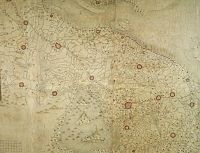
China, ca 1862. 1019 x 1600mm. Manuscript map in brown, red and green ink and wash color. More than a thousand houses with red flags are named in Chinese; military camps, mountains, forests, and battlefields are depicted. Many city and village names are translated into Pinyin and written in either brown ink or lead pencil. In the lower left corner a inset map of the area covering of Songjiang District with Shanghai (265x355mm.). A few holes and paper missing on old foldings. The map has been backed with thin paper for protective reasons. Generally in good condition.
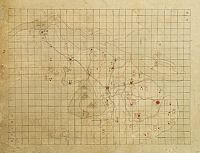 In lower left corner an inset plan of Songjiang District with Shanghai with a grid and the area is divided with red doted border lines.
The map has three red seals of the "Ever-Victorious Army", the first Chinese army to incorporate western-style training and tactics, modern weaponry, and, most importantly, the concept of light, fast-moving infantry units that could outpace their opponents. Therefore, an accurate map was of the highest importance!
The map is clearly a military map and likely served the army during the Taiping rebels' rule of the region and their two attacks on Shanghai. The rebels destroyed the city's eastern and southern suburbs, but failed to take the city. It is not unreasonable to assume that the Ever Victorious Army under Ward and Gordon saved Shanghai from destruction during the
Taiping Rebellion.
Contact for price
Shanghai and the Ever Victorious Army
Less than a century ago Shanghai was little more than an anchorage for junks, with a few villages scattered along the low, muddy banks of the river. What it will be a hundred years from now is a test for the imagination. As the principal gateway to China, serving a hinterland population of more than 200,000,000, many close observers believe it will become the largest city in the world.
Treaty Ports
What was probably the first definite attempt to open Shanghai to foreign trade came in 1832 when Hugh Hamilton Lindsay was entrusted with a commercial mission to the North from Macao by the East India Company. He was denied entry to Amoy, Foochow, and Ningpo, but succeeded in obtaining a hearing from Chinese authorities in Shanghai. The decision, however, was to restrict foreign trade to Canton. In his report on the voyage, Lindsay said Shanghai had great potential as a commercial center. He was right.
 Pressing their way up the Yangtsze River, the British reached Nanking and the Treaty of Nanking was signed on board a British warship on August 29, 1842.
The most important provision of this pact between Great Britain and China was that Canton, Amoy, Foochow, Ningpo and Shanghai were to be opened to foreign trade, the "Treaty Ports" as they became known. A formal declaration that Shanghai was open to foreign trade was made on November 17, 1843, following ratification of the treaty.
Following closely on the British action, the United States and France, by treaties signed on July 3, 1844, and October 24, 1844, respectively, acquired the right for their nationals to trade in the Treaty Ports. Thus, in effect, all of China was opened to foreign commerce. Great Britain, the United States and France were thereafter known as the "Treaty Powers."
The Ever Victorious Army (Chinese 常勝軍 , pinyin : cháng shèng jūn)
was the name given to an imperial army in late-19th-century China. The Ever Victorious Army
fought for the Qing Dynasty against the rebels of the Nien and Taiping Rebellions.
The Ever Victorious Army consisted of Chinese soldiers trained
and led by a European officer corps. Though the Army was active only from 1860 to 1864, it was instrumental in suppressing the Taiping Rebellion. It was the first Chinese army that was trained in European techniques, tactics, and strategy. As such, it became a model for later Chinese
armies.
The Ever Victorious Army began as a force under the command of Frederick Townsend Ward, a New England (American) shipmaster, in 1860. Ward introduced what were, for the time, radical ideas involving force structure, training, discipline, and weaponry.
He believed that well-trained, disciplined, mobile units could defeat larger forces lacking these qualities. He believed in a more flexible command structure.
>The new force originally comprised about 200 mostly European mercenaries, enlisted in the Shanghai area from sailors, deserters and adventurers. Many were dismissed in the summer of 1861, but the remainder became the officers of 1,200 Chinese soldiers whom Ward recruited in and around Sungkiang. The number of Chinese troops was increased to 3,000 by May 1862, all equipped with Western firearms and equipment by the British authorities in Shanghai. Throughout its four-year existence, the Ever Victorious Army was primarily tasked with operating within a thirty-mile radius of Shanghai.
Following Ward's death in September 1862, after the Battle of Cixi, command of the Ever Victorious Army passed to Charles George Gordon after a short period.
The Ever Victorious Army numbered around 5,000 soldiers at its height. It often defeated much larger rebel forces because it was better armed, better commanded, and better trained. It was the first Chinese army to incorporate Western-style training and tactics, modern weaponry, and, most importantly, the concept of light, fast-moving infantry units that could outpace their opponents.
Frederick Townsend Ward
Ward's career was a stormy one. During his early military service for the Imperialists, he was summoned before the American Consul in Shanghai, charged with inducing the desertion of British and American sailors, many of whom, attracted by the promise of adventure and high pay, and perhaps loot, had joined his "Ever Victorious Army." Presumably to avoid trial, Ward renounced his American citizenship and became a subject of the Emperor.
Later, however, both British and Americans welcomed the help of Ward's army in keeping the Taipings out of Shanghai and he was hailed as a hero. Waged with the utmost ferocity by both Imperialists and rebels, the Taiping Rebellion (1851-1865) ravaged eleven of the richest provinces of China and caused the death of 20,000,000 people.
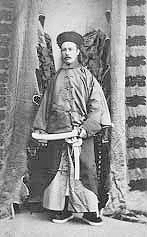 "Chinese" Gordon.
Following Ward's death in September 1862, after the Battle of Cixi, command of the Ever Victorious Army passed, after a short period, to Charles George Gordon, known as "Chinese" Gordon. Under Gordon, the Ever Victorious Army, in collaboration with the Chinese Imperial forces, would fight some of the final and decisive battles that ended the Taiping Rebellion.
Though Gordon has received most of the credit for the victories, it was Ward who originated the concepts that led to the Ever Victorious Army and its ability to secure those victories for Gordon. In recent years, there has been an effort to pay tribute to the man who molded the Ever Victorious Army, Ward, rather than to Gordon, aided by Li Hongzhang.
Gordon's stringent discipline led to an increase in desertions and several small-scale mutinies. Accordingly, by June 1863, the force had declined to 1,700 men. It was disbanded in May 1864 with 104 foreign officers and 2,288 Chinese soldiers being paid off. The bulk of the artillery and some infantry transferred to the Chinese Imperial forces. (source Wikipedia).
The Taiping Rebellion
The Taiping Rebellion was a widespread civil war in southern China from 1850 to 1864, led by heterodox Christian convert Hong
Xiuquan against the ruling Manchu-led Qing Dynasty.
With the capture of Soochow by the Taiping rebels in June 1860, Shanghai was faced by a deadly menace, and on August 17, 1860, the rebels attacked Shanghai. There was desultory, long-range fighting, but the city was stoutly defended by British and French forces, the Volunteers, and foreign warships in the Whangpoo.
At this juncture, in a concerted effort to suppress the Taiping Rebellion, one of the romantic figures of history appeared, Frederick Townsend Ward, a New England (American) shipmaster, who organized the "Ever Victorious Army," composed of foreigners and loyalist Chinese. Ward, commissioned a General by the Imperial government, led his force in many engagements against the Taipings and was killed in action near Ningpo September 21, 1862. His memory is still revered by the Chinese.
Ward was succeeded by a lieutenant, Henry A. Burgevine, who soon faded from the picture, and command of the "Ever Victorious Army" fell to Charles George Gordon ("Chinese Gordon"), a British army officer. Gordon's aggressive campaign broke the Taiping Rebellion by May 1864, and the "Ever Victorious Army" was disbanded. The rebellion ended entirely in 1865.
It is a grotesque fact that the years of the Taiping Rebellion proved a temporary boon to Shanghai, for from the influx of Chinese refugees into the foreign settlements there resulted an enormous increase in population and property values, and, necessarily, the subsequent extension of the settlements' boundaries. There was a marked population recession later, it is true, but permanent gains were made.
Ward and "Chinese Gordon." Historians differ widely in their evaluation of the character and services of the American, General Ward, but it is noteworthy that Gordon paid him a very eloquent tribute as a man and a soldier. "Chinese Gordon," as he was afterward known, served Great Britain brilliantly in North Africa and died in the defense of Khartum against the Mahdi, January 26, 1885, a gallant gentleman and officer. It is not unreasonable to assume that the joint efforts of Ward and Gordon saved Shanghai from destruction during the Taiping Rebellion.
