Pictorial maps
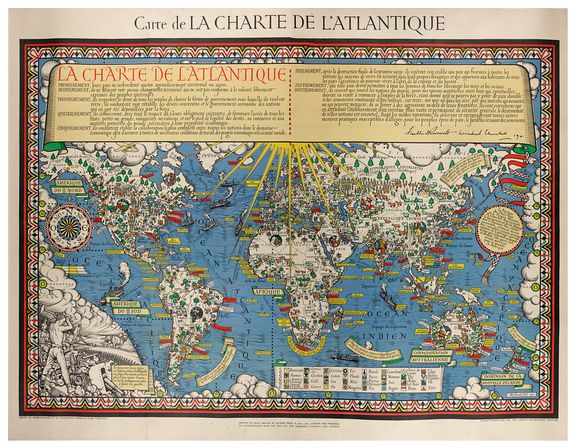
Throughout the ages, pictorial maps have been used to show the cuisine of a country, the industries of a city, the attractions of a tourist town, and the history of a region, or its holy shrines.
Unlike regular maps, the emphasis is less on illustrating a particular area to scale and more on selecting specific landscape features to illustrate a place or process, and sometimes to
emphasize a specific feature.
In Medieval cartography, pictorial icons and religious and historical ideas usually overshadowed accurate geographic proportions. A classic example of this is the T-O map, which represents the three known continents as a cross, with Jerusalem at its center.
Used in the classroom, they can help students visualize the nature of different and contrasting areas of a country or, indeed, contrast different countries.
Pictorial maps can be very simple, a matter of collecting images to illustrate different places, or extremely sophisticated, requiring a deep understanding of a place to select the 'correct' image for the map's purpose.
Later, during the Age of Exploration, maps became progressively more accurate for navigation needs and were often sprinkled with sketches and drawings such as sailing ships showing the direction of trade winds, little trees and mounds to represent forests and mountains and of course, plenty of sea creatures and exotic natives much of them imaginary.
Another form is the Leo Belgicus map, showing the Low Countries as a lion.
Pictorial maps may require considerable design, creativity, and skills in finding and manipulating images from various sources. They can also form a type of Geographic Information System (GIS).
The 20th Century
Some outstanding artists are: MacDonald Gill, Ernest Dudley Chase, Ashburton Tripp, Jo Mora, Ruth Taylor White, Lucien Boucher, Gerald Eddy, Miguel Covarrubias, Heinrich Berann, Ernest Clegg, Karl Smith, Edwin Olsen, Stanley Turner, Coulton Waugh, Everett Henry, Lindgren Brothers, Don Bloodgood, Colortext Corp, Frank Dorn, C.V. Farrow, Richard Edes Harrison, Alva Scott Garfield, Elizabeth Shurtleff, Tony Sarg, Louise Jefferson, Harrison Godwin, and Courtland Smith.
